
IBJJF points system: when a position earns its score
Quick answer: IBJJF awards two points for takedowns, sweeps, and knee on belly; three for guard passing; and four for qualifying mount or back control. The position must meet its definition and stabilization requirements. Advantages, penalties, and submission danger are separate parts of the scoring decision.
A position can look complete from the spectator seats before it qualifies for points. A passer may be beyond the legs but not yet stable. An athlete may be on the back without the required leg placement. Another may reach a scoring position while still caught in a submission.
The point values are easy to memorize. The more useful skill is recognizing the conditions that make those values apply. This guide uses the IBJJF rulebook’s positional definitions and then works through hypothetical examples, rather than treating every familiar-looking movement as an automatic score.
The point values are only the first layer
The official IBJJF rules assign points to specified positions and movements. The basic values are:
Takedown, sweep, and knee on belly: two points.
Guard pass: three points.
Mount, back mount, and qualifying back control: four points.
A value is not awarded merely because a spectator uses the position’s name. The rulebook defines the scoring configuration, requires stabilization in the relevant cases, and describes exceptions. The referee signals the score after those conditions are met.
The scoreboard also has separate fields for advantages and penalties. They are not fractional positional points. A competitor leading on points is not overtaken simply because the opponent has accumulated several advantages; the tie-breaking order matters when the points are equal.
A useful viewing habit is to ask two questions: what action is being claimed, and have its conditions been completed? That is more accurate than counting every movement toward a good position as the full score.
Stabilization and submission danger
The rulebook’s general scoring requirement is three seconds of stabilization. A brief arrival at a position can therefore look like a score without meeting the full condition. The relevant interval is stable control, not merely elapsed time since a limb first crossed a line.
Submission danger adds another condition. An athlete who reaches a scoring position while caught in a submission is not simply given the points as if the attack did not exist. The rulebook describes when the athlete must escape the attack and stabilize the position, and how interrupted counts or unresolved attacks affect the outcome.
Consider a hypothetical athlete who arrives on top while still trapped in a locked submission. The correct analysis is not just top equals points. It needs the scoring action, the submission situation, whether the hold is escaped, and whether the required control is then established.
That example is a rules illustration, not a claim about a named match. A real replay requires the complete exchange and referee signals. A cropped frame may show the position while omitting the attack that explains why the score has not yet been awarded.
A takedown and a sweep have different origins
Both actions can earn two points, but they are not interchangeable names for any change to top position. A takedown begins from the relevant standing situation. A sweep is defined through an athlete’s guard or half-guard action and the resulting change to top.
That is why escaping bottom side control into top position is not automatically an IBJJF sweep. The movement may improve the athlete’s position substantially, but the scoring definition needs the required origin. A useful escape and a point-scoring sweep are different descriptions.
The finishing configuration and stabilization also matter. A standing exchange can continue through several phases before the takedown’s scoring conditions are settled. A sweep attempt can reach top briefly without completing the required stable control.
For study, identify the starting position before watching the ending. If the clip begins only after the reversal, it may not contain enough information to classify the action. Ask for the preceding sequence instead of deciding the score from the final top-and-bottom arrangement alone.
Passing requires a guard to pass
A guard pass is worth three points when the rulebook’s conditions are met. The action involves overcoming the opponent’s guard or half guard and establishing the required control beyond it. Reaching side control from another situation is not automatically a guard pass.
This makes the preceding position important. If a top athlete attacks, ends underneath, and the other athlete reaches side control without a guard having been established, a three-point pass cannot be assumed simply from the final position. The rulebook specifically addresses situations in which the legs were not used to prevent side control.
A passer also needs stabilization rather than a momentary crossing of the legs. An opponent’s recovery can interrupt the attempt before the full score is established. A near pass may raise an advantage question, but that is a separate assessment rather than an automatic three points.
For replay notes, retain the guard, the moment the legs are cleared, the control that follows, and any submission danger. Those details make a scoring discussion much more useful than a still image labeled side control.
Knee on belly and mount need the right configuration
Knee on belly is worth two points when the athlete is clear of the guard and meets the rulebook’s placement and stability requirements. The opposite knee must not remain on the floor in the full-scoring configuration. A similar-looking kneeling position may therefore have a different scoring status.
Mount is worth four, but it also has defined conditions. The athlete must be clear of half guard and occupy the qualifying orientation and leg position. The number and placement of trapped arms can affect whether the configuration meets the scoring definition.
These are good examples of why a familiar gym name does not settle a referee question. A training partner may casually call several related positions mount or knee on belly. A competition score needs the specific configuration in the rulebook.
The practical study task is to pause a replay before and after the stabilization interval, then compare the actual limbs and orientation. That can make the rule understandable without pretending that every borderline configuration is obvious from one camera angle.
Back control is not every position on the back
Qualifying back control is worth four points. The rulebook specifies the required control and leg placement. Crossed legs, a body triangle, or only one heel in the relevant position do not automatically meet the four-point configuration.
That distinction can surprise viewers accustomed to another ruleset. A body triangle may provide strong practical control while having a different IBJJF scoring treatment. Technical usefulness and a particular points definition are not identical judgments.
The rulebook’s advantage examples include certain back-control configurations that fall short of the full score. Those examples should be read as examples within the broader advantage rules, not as a promise that any moment on the back earns an award.
For a competitor, the useful response is to know the scoring requirement before the match and practice recognizing it under the applicable rules. A coach can help distinguish secure control, a legal finish opportunity, and a configuration that completes the positional score.
Continuous progress can produce cumulative points
The rulebook permits cumulative points through a qualifying continuous progression, with the required stabilization at the final position. Its explicit example is a guard pass followed by mount, producing seven points: three for the pass and four for mount.
That does not mean every sequence of two position names automatically earns their sum. The earlier and final positions must meet the relevant conditions, and control must satisfy the rule’s continuity requirements. Submission danger and other exceptions still need consideration.
The rulebook also prevents voluntarily giving up a scored position simply to repeat the same score. An athlete cannot assume that leaving and regaining the same position by choice creates an unlimited points cycle. The actual progression and loss of control matter.
The broader IBJJF rules guide places these scoring questions beside other competition rules. For a narrow replay review, choose one progression and check each condition rather than trying to explain the entire match with a total alone.
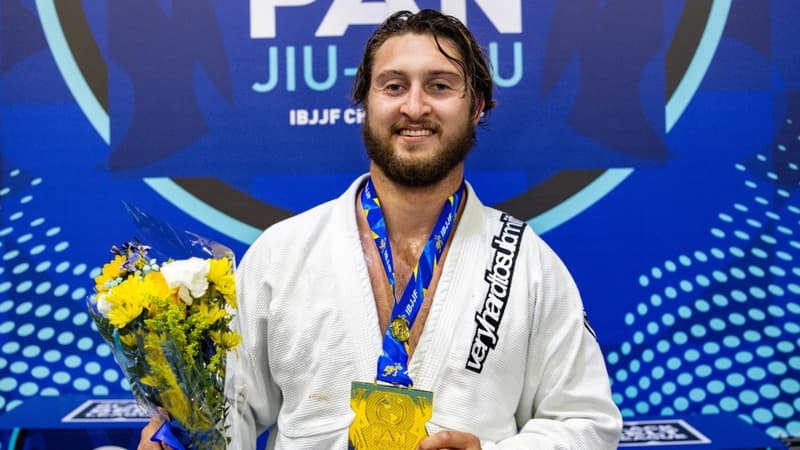
Main photo: Archive: Nolan Stuart at the 2026 Pans — IBJJF; photographer not identified on source page.
The takeaway
The IBJJF point values are two, three, and four, but the score depends on definitions, stable control, the action’s origin, and any relevant submission danger. A useful position and a completed scoring position are not always the same thing.
Study the full sequence with the clock and referee signals visible. The most productive rules question is usually which condition was or was not completed, rather than whether a movement looked impressive enough to deserve points.
Practice under the rules you will use
Find open mats and agree on the scoring and permitted techniques with a coach and partner before a competition-focused round.
FAQ
How many points is an IBJJF guard pass? Three, when the action meets the guard-pass definition and the applicable stabilization requirements. Arriving in side control from another situation is not automatically a pass.
Is a sweep always any reversal to top? No. The IBJJF sweep definition requires the relevant guard or half-guard origin. An escape from another bottom position can improve position without being a scoring sweep.
Does a body triangle automatically score four back points? No. IBJJF specifies a qualifying back-control configuration. A body triangle should not be treated as an automatic four-point score.
Can a pass straight into mount score seven? Yes, when the cumulative-scoring conditions are met. The rulebook gives guard pass plus mount as a seven-point example, with the required continuity and final stabilization.

Nina Okada
Nina Okada explains positions the way a good training partner does: one problem at a time, with the limits of the explanation said out loud. She is careful about the difference between what footage shows and what it only suggests.
Related Posts

Lucas “Hulk” Barbosa’s best work is in the details
Lucas Barbosa’s nickname explains the first impression. His gi world title, no-gi record, and 2022 ADCC final give viewers more to study.
João Miyao’s record deserves its own first name
João Miyao’s adult world title and 2026 Master1 results tell a distinct story, even when his brother appears beside him on the podium.

Jena Bishop made time for a second sporting life
Jena Bishop’s 2026 PFL title followed a deliberate move from championship jiu-jitsu into learning a different sport.
Comments (0)
Loading comments...