
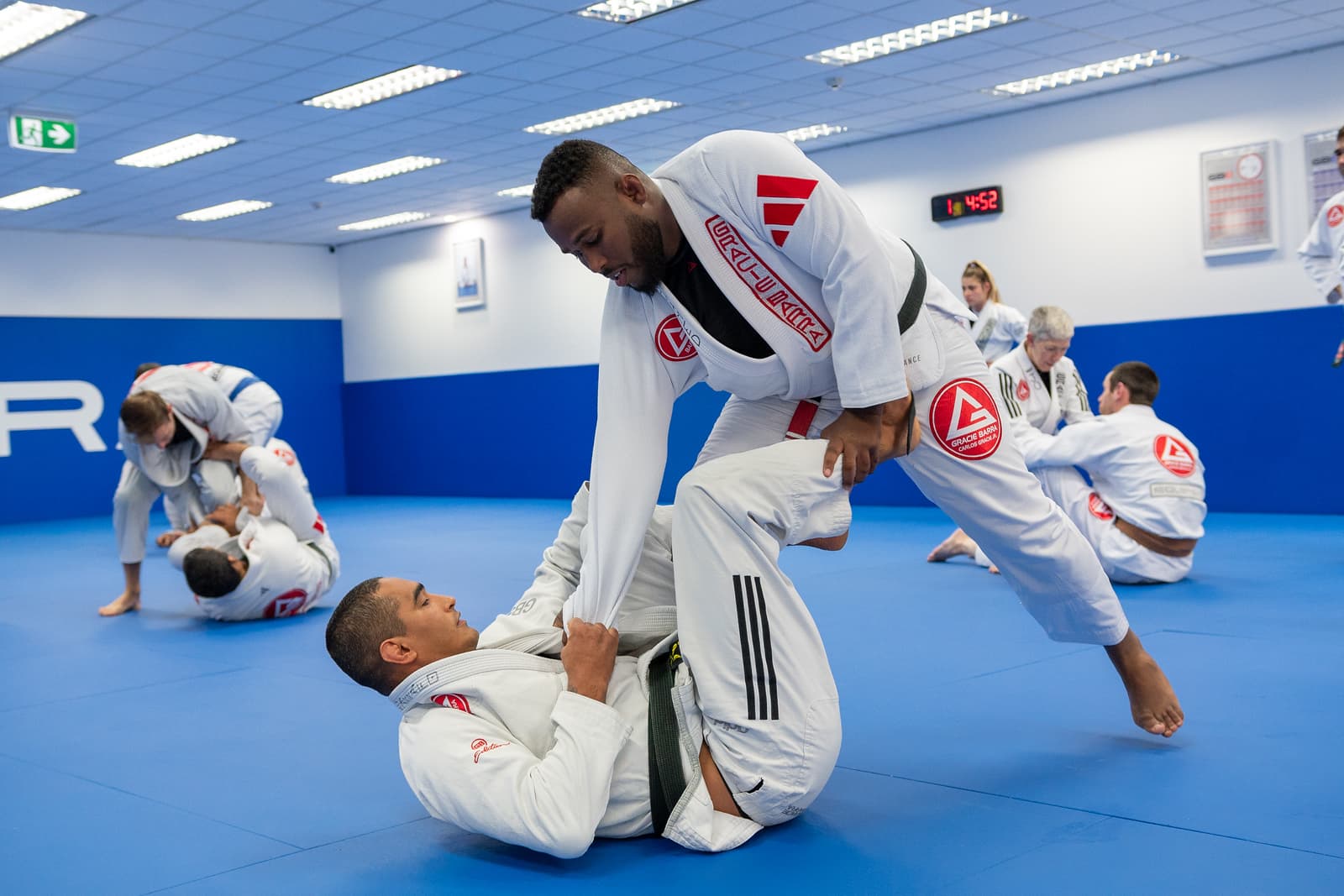
Gracie Barra classes: what GB1, GB2, and GB3 mean
Quick answer: Gracie Barra organizes its adult training into GB1 fundamentals, GB2 advanced instruction, and GB3 expert training. Its North American program pages identify GB1 as the beginner entry point, GB2 for three-stripe white belts and above, and GB3 for blue belts and above who have progressed through GB2. Confirm your placement with the local school, especially if you are transferring or visiting.
A timetable can look precise while leaving a new student with no idea which box to choose. GB1, GB2, and GB3 occupy separate rows. A trial button sits nearby. The missing information is what the numbers mean for someone who has never stepped on a mat.
The numbers describe a progression. They are not rankings of how worthwhile a class is, and the highest number is not automatically the best choice for a new member. The useful class is the one whose starting assumptions match what you can already do.
Gracie Barra's published descriptions provide a baseline. Use them to understand the structure, then ask the academy you intend to attend how it places students within that structure. A national program page cannot personally assess a visiting white belt or explain a particular instructor's Tuesday session.
GB1 establishes the starting point
The official GB1 fundamentals page describes a program for students with no previous experience. Its scope includes foundational techniques and self-defense. It also says initial instruction emphasizes drills and controlled practice before sparring.
That description should make the first booking easier. You can identify yourself as a complete beginner and ask for the recommended GB1 introduction. There is no need to attend an advanced class simply because its time slot appears first in a search result.
Once booked, clarify the arrival procedure. Ask where to check in, whether a waiver should be completed beforehand, and how early the school would like you there. Arriving with the administrative steps understood lets you pay attention to the lesson itself.
During class, focus on the task being taught. A fundamentals label does not mean every movement will feel immediately familiar. You may need the starting position shown again or a partner's role explained more slowly. That is useful information for the instructor, and there is no advantage in concealing it to appear further along.
GB2 adds demands after a foundation
The GB2 program description includes live sparring, more advanced technical work, and no-gi training. The published entry threshold is at least three stripes on a white belt. It describes those stripes as typically following a minimum of four months of consistent training.
Read the wording carefully. Four months is not a purchase that comes with guaranteed access on day one hundred and twenty. The stated rank threshold and the instructor's assessment still matter. Calendar time alone does not establish what a student has learned.
For a transferring student, explain both rank and recent practice. Someone returning after a long break may need a different introduction from someone training several times a week. The conversation should give the coach enough information to recommend a useful starting class.
No-gi also raises a clothing question. Ask which uniform applies to the actual session you are booking. An academy can offer gi and no-gi training under one program umbrella while placing them at different times. Reading the broader gi and no-gi guide helps with the distinction, but the local timetable determines what goes in your bag.
GB3 is not restricted to people chasing medals
Gracie Barra's GB3 page identifies blue belts and above who have completed GB2 as its audience. It emphasizes advanced technique, tactical application, and more demanding training. The same page explicitly says competition is not required.
That last point is useful for experienced hobbyists. An interest in deeper technical work does not require a tournament entry. Tell the school what kind of training you want rather than assuming that an expert class comes with a competition obligation.
The opposite assumption also needs checking. A competition goal does not make a beginner ready for every advanced session. If you want to enter an event soon, ask how the coach would prepare you within the appropriate classes. Urgency is a planning detail, not a substitute for prerequisites.
For a visitor, request approval for the particular session. Your belt gives the instructor some information, but it does not settle class capacity, booking requirements, or the host's expectations. A short confirmation can prevent an awkward exchange at the mat edge when the lesson is already beginning.
Progression should be explained in concrete terms
Ask what the school expects before a move between programs. A helpful answer might cover technical understanding, participation, and how the instructor evaluates readiness. Keep the discussion tied to your present stage rather than asking for a promised date for every belt to come.
It is reasonable to want a sense of direction. You may be deciding whether the program fits your goals or how often to attend. The useful information is what to work on and how to receive feedback, not a schedule that pretends every student learns at the same rate.
Consider a simple example. Two people join in the same month. One can attend twice weekly, while the other has rotating work shifts and several weeks away. Their calendar anniversary may match even though their practice does not. A progression policy needs room for that difference.
Keep a record of questions after class if it helps. If the same position repeatedly confuses you, bring that specific problem to the instructor. It is easier to discuss a missing step than a general feeling of being behind, and the answer can give your next few sessions a clearer purpose.
Confirm uniforms before spending money
The GB2 and GB3 pages specify official Gracie Barra training uniforms. The GB1 page describes loan clothing for an introductory class. Treat those as published program information and confirm the arrangements at your location before buying anything.
Ask whether the trial includes a loan gi, which sizes are available, and what you should wear underneath. If you already own equipment, explain what you have and ask whether it is accepted. A photo can help the school answer a uniform question more accurately than a vague description.
For a membership decision, include equipment in the initial cost. Tuition, enrollment charges, and required clothing should be understood together. A low first payment may be part of a useful offer, but it does not tell you the full amount needed to attend the classes you want.
Avoid assuming that a friend's experience at another branch settles the policy. Their loan arrangement may have been a promotion or a location-specific service. A current reply from the school you are joining is more useful than a confident answer about somewhere else.
Read the local timetable as a weekly plan
The Gracie Barra class overview also lists children's, women's, and private instruction. Availability at a particular academy still needs checking. A network's menu of programs is not proof that every option appears at every address.
Before deciding, turn the timetable into a realistic week:
Mark the classes that match your current level.
Cross out sessions you cannot reach after work or school.
Identify the clothing format for each remaining class.
Confirm any booking limits or prerequisites.
Choose a first visit and a realistic repeat visit.
The repeat visit deserves attention. A trial can fit an unusually free afternoon while the regular schedule remains impossible. You want to know how attendance works once the novelty has passed and an ordinary week returns.
Parents comparing adult and children's programs should ask about the actual overlap. Two class names appearing on the same day does not establish simultaneous training, supervision, or a workable pickup arrangement. Match the start and finish times before building a family routine around them.
Use the trial to resolve the remaining questions
A trial is a chance to see whether the published structure becomes understandable in practice. Notice how the instructor introduces the exercise, explains the partner's job, and helps when you lose the sequence. Those observations are more useful than trying to grade every technique from one visit.
Ask who normally teaches the sessions you would attend. If the trial instructor is covering a class, that is worth knowing without treating it as a problem. The goal is simply to understand the instruction you will receive regularly.
After class, get the membership terms in a form you can review. Check the included sessions, payment frequency, minimum commitment, cancellation notice, and any separate equipment charges. Specific terms allow a fair comparison with other schools and reduce the chance that two people remember the same conversation differently.
Then make a decision at the level of the actual academy. The GB program names help organize the search. Your available classes, the local teacher, and the membership arrangement determine whether the plan works. A clear answer to each is more valuable than choosing a class because its number looks ambitious.
Main photo: Gracie Barra.
The takeaway
GB1, GB2, and GB3 describe stages of training, with published entry points and different demands. Use those descriptions to ask for appropriate placement. Do not turn a typical minimum training period into a guaranteed promotion deadline.
Confirm the local timetable, uniform arrangements, and full membership terms before committing. When those details are clear, the letters and numbers become useful: they tell you where to start and what questions to bring to the instructor.
Find a school near your routine
Build a shortlist in the gym directory, then confirm the beginner or visitor class directly with each academy.
FAQ
Can a complete beginner attend GB1? Yes. Gracie Barra describes GB1 as an entry program requiring no previous experience. Contact the local school to book its introductory session and confirm the clothing and arrival arrangements.
Does four months of training guarantee entry to GB2? No. The published guidance refers to a typical minimum period alongside a three-stripe white-belt threshold. Ask your instructor how readiness and placement are assessed at your school.
Do I have to compete to attend GB3? No. The official GB3 description includes students who want advanced training without entering tournaments. Eligibility and approval for the actual class should still be confirmed with the academy.
Can I wear a gi I already own? Ask before attending. The advanced program pages specify official GB uniforms, while introductory arrangements may include loan equipment. Your local school can explain what applies to a trial, membership, or visit.

Tess Hanley
Tess Hanley reads the rulebooks, the entry fees and the fine print. When a federation or a gym changes something, her first question is who ends up paying for it.
Related Posts
Choosing a BJJ seminar worth your time and travel
Choose a BJJ seminar by the subject, teaching format, access, and total cost. Know what to ask the host before buying a ticket.

IBJJF membership: finish the paperwork before the deadline
IBJJF membership and tournament entry are separate steps. Plan documents, professor approval, renewals, and junior accounts before registration closes.
The turtle position needs an exit plan
Turtle can interrupt a pass, but staying there creates another problem. Learn to identify the threat, control a connection, and choose an exit.
Comments (0)
Loading comments...