
The turtle position needs an exit plan
Quick answer: Treat turtle as a position from which you need to assess the opponent and work toward an exit, rather than a place to wait indefinitely. Protect yourself from the immediate attack, then use a coached escape suited to the grips and pressure you actually face. Returning to guard and getting to your feet are different options, not interchangeable instructions.
Stopping a guard pass does not end the exchange. If you turn to your knees and your partner follows, the problem has changed shape. They are still connected to you, and you still need to decide what happens next.
Turtle is particularly easy to misunderstand because a compact posture can look like a completed defensive action. You have closed some space. That does not tell you where the partner's hands are, what they can attack, or which direction is available to move.
A better study session starts with those details. Identify the exact version of turtle in front of you, choose one escape to learn with a coach, and find out which connection must change before it becomes possible.
Name the position more precisely than turtle
A partner beside your shoulder presents a different arrangement from one directly behind you. Add a hand at the neck or a grip around the waist and the assignment changes again. Calling all of these positions turtle is convenient conversation, but insufficient description for a useful correction.
Before drilling, have both people pause in the starting position. Ask the coach to identify the attacker's permitted grips and where their weight begins. That small amount of setup saves the pair from practicing different problems on alternate repetitions.
This is especially helpful when revisiting an escape from a previous class. Memory can preserve the final movement while losing the initial connection that made it work. Recreating the finish without recreating the start may leave you trying to solve a problem the original lesson never addressed.
If you cannot describe how the partner is attached, begin there. You need not know a specialized name for every arrangement. Saying that their right arm is over one shoulder and their weight is beside you gives a coach more information than saying that turtle never works.
Address the immediate attack before a preferred escape
Do not let an escape plan make you ignore a developing submission. A movement that would be sensible before a grip closes may be inappropriate after it. In training, tap rather than trying to complete an escape through a submission you do not understand.
BJJ Fanatics' lesson on guillotine defense from turtle, featuring Priit Mihkelson, makes a useful distinction: keeping the elbows close does not by itself resolve every defensive problem. Neck exposure requires attention as well. Compactness is part of an arrangement, not proof that the whole arrangement is sound.
Ask your coach what you should recognize early in the version being taught. Then have the partner present that cue slowly, without finishing an attack unexpectedly. The first task is identifying the problem while there is time to respond with the instructed action.
Separate that recognition exercise from submission-resistance practice. Neither partner should have to guess whether the other is demonstrating a grip or trying to finish it. Agree on the limits before beginning, especially when either person is new to the position.
A connection can make an exit possible
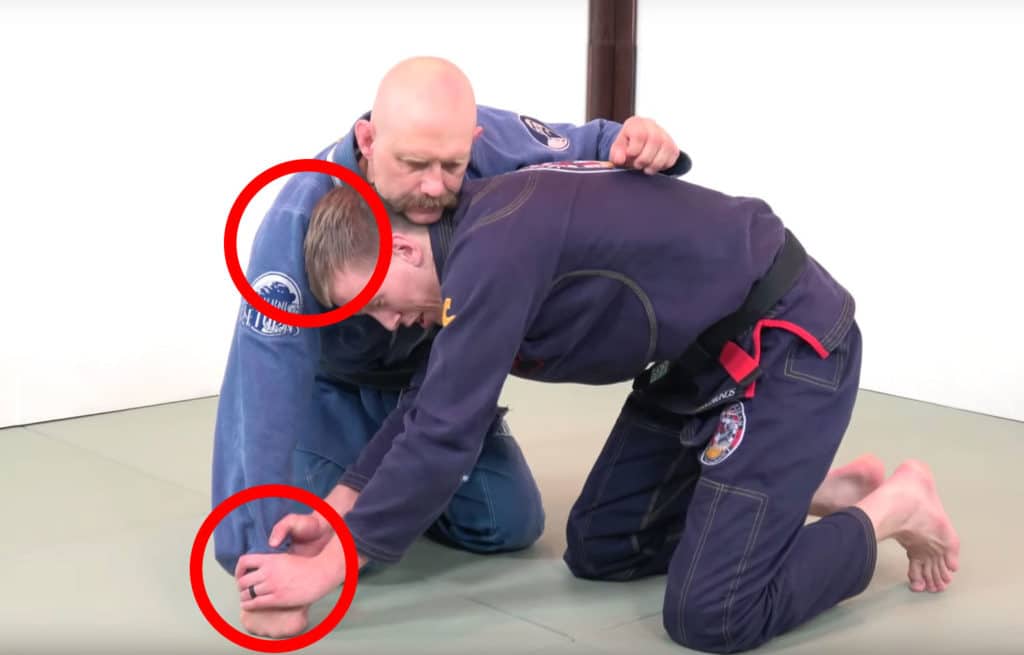
In their turtle escape lesson, Rory Van Vliet and Stephan Kesting demonstrate controlling an opponent's near-side wrist with both hands while positioning the head against the inside of the armpit. They use that relationship to organize an escape, rather than treating posture alone as the solution. Their examples include returning to guard and standing.
The lesson supplies a concrete point to investigate with your coach: which part of the opponent are you controlling, and what does that control allow you to do? Learn the shown placement in person before adding pressure. A short description is not enough to reproduce every detail of the demonstration.
During practice, ask the partner to tell you when the intended connection has been lost. That feedback can be more informative than waiting for the entire escape to fail. The missing connection identifies a smaller problem to work on.
Avoid collecting grips simply because more contact feels reassuring. A grip should have a purpose in the escape you are learning. If neither person can explain that purpose, ask before increasing resistance.
Choose a destination you can recognize
An escape needs an endpoint. Returning to a usable guard is one kind of result; getting upright is another. Choose the one being taught and agree on what the position must look like before the pair resets.
This is where a demonstration can become a practical exercise. If the goal is guard recovery, ask the coach what establishes the guard for that drill. If the goal is standing, ask what must happen to the remaining grip. Do not decide the repetition is over merely because your knees have left their original spot.
It helps to give the observing partner one thing to check. They might watch whether you reach the assigned position or whether a particular connection remains. Asking them to assess everything at once tends to produce general encouragement instead of specific information.
The destination should also be appropriate to the training setting. A crowded open mat may not have room for a stand-up exchange. Follow the host's rules and choose a practice area where the intended finish will not carry either person into another pair.
Learn one escape without turning it into the only escape
There is value in a narrow assignment. Learning one route carefully allows you to recognize its requirements. The difficulty comes when that route becomes a command you try to obey from every version of turtle.
Have the coach show a starting condition where the escape is available and another where it is blocked. Compare them before sparring. The difference might be a grip or the location of the partner, but let the actual lesson determine which feature matters.
A short practice note can preserve the distinction:
Start: describe where the partner is and how they are attached.
Requirement: record the connection or space the coach identifies.
Finish: describe the position that ends the repetition.
Obstacle: note the change that stopped this particular route.
Leave complicated rolling escapes for supervised instruction if you have not learned their mechanics. A video that makes an action look effortless does not establish that you can improvise it under a partner's weight. Ask for a suitable first option instead of forcing a route because it is the one you remember seeing online.
Use short rounds with a clear stopping point
Starting every round from a complete roll can make a specific turtle problem hard to study. You may reach it once, rush through it, and spend the remaining time somewhere else. Set aside a short, agreed block in which both people begin at the position you want to understand.
Stephan Kesting's targeted sparring guide includes starting from turtle with the partner on top. It also describes resetting after an escape and alternating roles. A clear reset makes it possible to return to the same problem rather than wait for it to appear by chance.
For a first session, ask the coach to limit the top player's job. They could try to maintain the assigned position while the bottom player practices the selected exit. Do not silently add every submission and back attack to a drill agreed around one task.
After each attempt, identify where the arrangement first changed. Switch roles often enough that both people understand what the other is trying to achieve. Keep the feedback brief; the pair should spend more time practicing the agreed problem than negotiating a new one after every reset.
Inspect the transition that brought you there
Turtle practice should eventually connect to the exchange before it. Otherwise, you can become comfortable escaping from a carefully arranged starting position while remaining confused by the hurried transition that produces it in a round.
Return to that transition with your coach. Was the turtle reached during a pass, after an unsuccessful attack, or through a deliberate choice? Recreate the sequence slowly enough that both people can identify the first point where the defender had to make a decision.
The purpose is not to attach blame to reaching turtle. It is to identify whether the next useful practice belongs there or slightly earlier. Sometimes you need more experience with the escape. Sometimes the recurring difficulty is that you arrive with a particular grip already established against you.
Keep both questions available in your notes. Record what you need to do from turtle and what you want to understand about getting there. That avoids treating every bad ending as the same problem. A coach can then choose whether the next session should begin with the transition, the defensive position, or the attempted exit.
Main photo: Grapplearts / Rory Van Vliet and Stephan Kesting — turtle escape demonstration.
The takeaway
Describe the position you are actually in before choosing the movement you want to use. Account for the immediate attack, learn the relevant connection, and define a finish. Those details give turtle practice a purpose beyond remaining compact for as long as possible.
Start with one coached escape and one clearly arranged problem. Once you can identify why that route works or stalls, connect it to the transition that brought you there. The next useful adjustment should be specific enough for a partner to help you practice it.
Work through the position with a coach
Find a gym near you and ask about positional instruction. Bring a precise description of the turtle situation you keep encountering.
FAQ
Is turtle always a mistake? No. It can arise during transitions and can be part of a deliberate defensive choice. Evaluate the particular situation with your coach. Reaching turtle does not remove the need to manage the opponent's next attack.
Should I hold turtle until my partner moves? Waiting without understanding the grips leaves the decision to the other person. Learn to recognize the current threat and an appropriate exit. The timing depends on the actual position, rather than a blanket instruction to move immediately in any direction.
Is standing better than returning to guard? The available space, connections, and training goal determine which option makes sense. Learn each from a suitable starting position. Do not treat them as interchangeable finishes or assume either can be forced from every arrangement.
Can beginners practice turtle escapes? Yes, with appropriate instruction and controlled resistance. Start with an escape the coach has selected for your experience, agree on the partner's role, and tap to submissions. Avoid improvising unfamiliar rolling movements under pressure.

Nina Okada
Nina Okada explains positions the way a good training partner does: one problem at a time, with the limits of the explanation said out loud. She is careful about the difference between what footage shows and what it only suggests.
Related Posts

Mikey Musumeci gives up the belt to make room for MMA
Musumeci is vacating his UFC BJJ title to focus on MMA training. What he is leaving, what continues, and why the transition matters.
IBJJF membership: finish the paperwork before the deadline
IBJJF membership and tournament entry are separate steps. Plan documents, professor approval, renewals, and junior accounts before registration closes.
Choosing a BJJ seminar worth your time and travel
Choose a BJJ seminar by the subject, teaching format, access, and total cost. Know what to ask the host before buying a ticket.
Comments (0)
Loading comments...