

Gi vs No-Gi — Which Should You Start With?
If you're starting BJJ, the gi-or-no-gi question is the first format decision you'll face. Every BJJ subreddit, YouTube channel, and forum has a take. Here's mine, plus what I'd actually recommend for someone new.
The short answer
If your goal is "I want to be good at BJJ," start in the gi.
If your goal is "I want to compete in submission grappling or transition to MMA," start no-gi.
If your goal is "I want to try BJJ and see if I like it," start with whatever's offered at the gym nearest you that has the schedule you can actually attend. Either format will hook you if jiu-jitsu is going to hook you. You can always cross-train later.
The rest of this guide is for people who want the detailed why.
What the gi teaches you
The gi is a uniform with friction. Lapels, sleeves, collars, the pants — every piece is a grip and a control surface. That changes the sport in some fundamental ways.
Patience. Grip fighting is slow. Setups take longer. You can't rush past positions because your partner has handles to hold you in place with. The gi rewards thinking turns ahead.
Defense. Because escapes are harder (your opponent has fabric to grip), you develop better positional defense. Gi practitioners coming to no-gi tend to feel "uncatchable" in side control compared to the no-gi practitioners they meet.
Submission breadth. The gi opens up a category of submissions that don't exist in no-gi — collar chokes from anywhere, lapel-based attacks, baseball chokes, bow-and-arrows. These are technically interesting and they teach you something about how grips and angles produce submissions.
Concept of structure. Frames, posture, base — these things matter in no-gi too, but in the gi you learn them faster because the gripping makes the consequences immediate.
What the gi underweights: explosive scrambling, single-leg takedowns where there's no upper-body grip to start from, leg-lock entries (most gi gyms still treat leg locks conservatively).
What no-gi teaches you
No-gi removes the friction. You're grappling in a rashguard and shorts. Sweat. Slick. Less control, faster pace.
Movement. Without lapels to hold you, scrambles happen. You learn to move your hips constantly, to chain transitions, to recover positions you've already lost.
Modern leg locks. No-gi is where the leg-lock revolution of the last decade lives. Heel hooks, knee bars, ankle locks — these are the dominant attack category in submission grappling and they exist almost entirely in no-gi.
Closer to wrestling and MMA. If you're cross-training another grappling art or thinking about MMA, no-gi transfers better. Underhooks, head positioning, takedown attempts that don't rely on grips — these all map directly.
Cardio. No-gi rolling is harder cardio than gi rolling. The pace is faster, the rest periods inside a roll are shorter (less time spent grip-fighting), and slippery sweaty partners require more effort to control.
What no-gi underweights: collar/lapel chokes don't exist. Pressure passing styles that rely on cross-collar grips don't translate. The slower, more methodical positional play of high-level gi BJJ is less developed in most no-gi programs.
Schools dedicated to one or the other
Some gyms only run gi. Some only run no-gi. Most run both, usually with more gi classes on the schedule.
The biggest no-gi-only system is 10th Planet — Eddie Bravo's curriculum is famous for things like the rubber guard and the twister, and the brand has affiliates across the US. If you walk into a 10th Planet school, you're not going to train in a gi. That's the trade. Many practitioners love it; some feel limited by it.
Most traditional lineages — Gracie Barra, Alliance, Carlson Gracie, Renzo Gracie — emphasize the gi. They'll usually offer one or two no-gi classes a week, but the core program is gi.
There's a middle category — modern competition-focused gyms like Atos — that run both formats equally seriously.
If you're not sure what's in your area, browse city pages or filter the find-gyms search by discipline. Hub pages also list which gyms offer dedicated no-gi classes versus pure-gi schools.
The case for starting in the gi
For a beginner, my actual recommendation:
The gi forces you to learn position before submission. You can't shoot heel hooks at white belt in most gi rooms — and the temptation to skip positional fundamentals is real when leg locks are on the table from day one. The gi naturally slows the curriculum down.
You also learn submissions you wouldn't otherwise see. Sleeve chokes, collar drags, lapel-wrapped guards. These don't transfer to no-gi, but they teach you something about how grips and leverage produce results that does transfer. You'll be a better no-gi grappler later if you spent your first eighteen months in the gi.
The case for starting no-gi
There are real reasons to skip the gi:
Hot climate. Training in a heavy gi in Phoenix summer is its own punishment. No-gi is much more livable in high heat.
No nearby gi school. If the only gym with a schedule that works for you is a no-gi school, that's the right choice. The "right" format that you don't attend is worse than the "wrong" format that you do.
Specific goals. You want to compete in ADCC, IBJJF no-gi, or you're training for MMA. Don't waste two years in a gi.
Hygiene logistics. Gis are heavy laundry. If you have a 15-minute window between training and your next obligation, no-gi is more practical.
After your first year, train both
Wherever you start, after a year of consistent training, add the other format. One or two sessions a week is enough. The cross-pollination is where higher-belt jiu-jitsu compounds.
Almost every world-class grappler trains both. The split varies — competition specialists might do 80/20 in their primary format — but everyone trains both.
If your gym only offers one, plan a quarterly open mat visit to a gym that runs the other. It's an underrated upgrade.
How to pick the right starting gym
If you want gi: look for a school with a clearly named "fundamentals" track and at least four gi classes a week. The bigger lineages (Gracie Barra, Alliance, Renzo, Carlson Gracie) all qualify in most cities.
If you want no-gi: look for a 10th Planet school, an Eddie Bravo Invitational/ADCC-style program, or a general school with at least three no-gi classes a week. Many gyms have a no-gi class only on Friday — that's not enough for primary training.
If you want both: most major gym networks fit the bill. Check the schedule carefully and confirm beginners are welcome in both formats.
Browse by city to see what's near you, or filter by no-gi directly. Each gym profile lists what they offer.
Related Posts

Mikey Musumeci gives up the belt to make room for MMA
Musumeci is vacating his UFC BJJ title to focus on MMA training. What he is leaving, what continues, and why the transition matters.

IBJJF membership: finish the paperwork before the deadline
IBJJF membership and tournament entry are separate steps. Plan documents, professor approval, renewals, and junior accounts before registration closes.
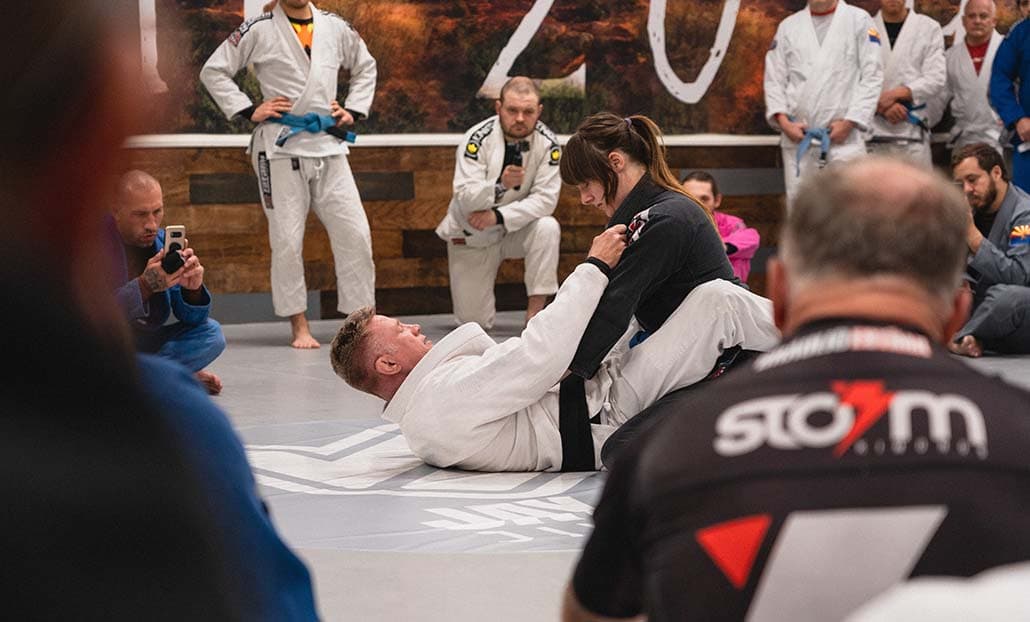
Choosing a BJJ seminar worth your time and travel
Choose a BJJ seminar by the subject, teaching format, access, and total cost. Know what to ask the host before buying a ticket.
Comments (0)
Loading comments...