
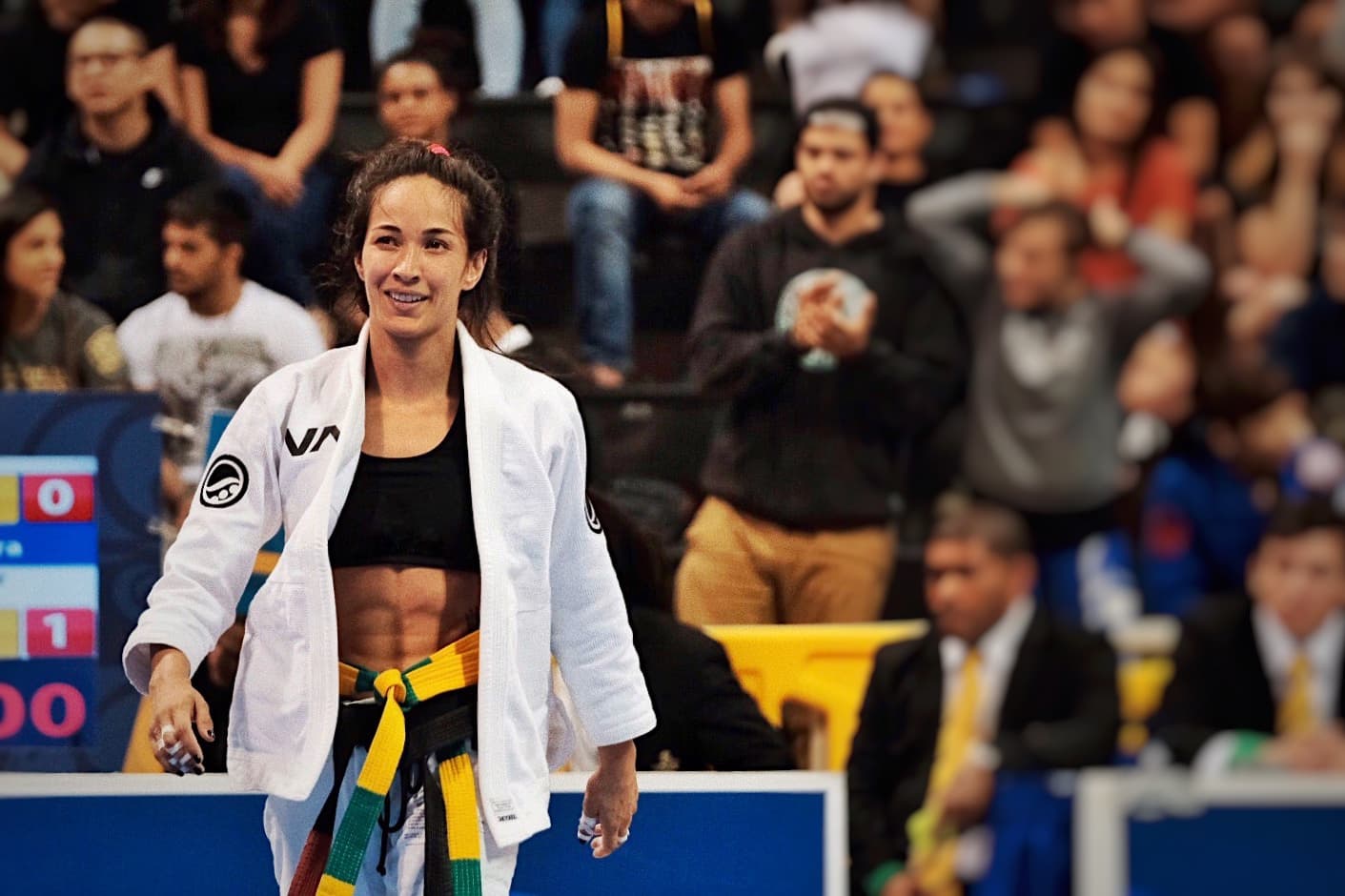
Gezary Matuda and the danger of remembering only one finish
Quick answer: Gezary Matuda won adult black-belt light-featherweight gold at the IBJJF Worlds in 2013, 2014, and 2016. Her rapid armbar against Michelle Nicolini at Polaris 2 belongs in that story, but it does not contain the whole career. The world-title sequence shows a competitor worth following beyond a single highlight.
A spectacular submission can become an athlete’s calling card and, eventually, a very small box. Every introduction returns to the same exchange. Every replay ends in the same place. The rest of the record has to fight for a sentence.
Gezary Matuda’s finish against Michelle Nicolini at Polaris 2 is an obvious place to begin watching. It is a poor place to stop. Either side of that 2015 match sits a run of IBJJF World Championship results that makes the short clip more interesting.
Start two years before Polaris
The 2013 IBJJF Worlds results list Gezary Matuda Kubis Bandeira first in the adult female black-belt light-featherweight division, representing American Top Team. Nyjah Easton finished second, with Kanako Inaba and Miriam Cardoso sharing third.
The full name in an official record can be longer than the name used in a broadcast. Checking that connection matters when following an athlete across different sources. Here, the division and academy make the entry clear.
This title predates the Polaris appearance by two years. Matuda did not need a later highlight to establish that she could win a major gi championship. The sequence runs the other way: an already accomplished competitor went into the match that would supply such an easily shared image of her ability.
For a viewer arriving through that image, the earlier result changes the introduction. Instead of discovering a surprising winner through one finish, you are meeting someone who had already been at the top of a world-championship podium.
The second title gave the first one company
Matuda returned to the top of the same adult black-belt division in 2014. Ariadne de Oliveira placed second, while Leticia Ribeiro and Easton took the bronze positions. American Top Team again appears beside Matuda’s name.
Consecutive titles establish something a single result cannot: she won the division at successive editions. They do not reveal whether preparation was easier the second time or whether she felt pressure defending a title. Those are questions for a sourced account from the athlete, rather than details to supply on her behalf.
The names around her also deserve to remain visible. A title is won in a field of other competitors, not in an empty line on a résumé. Reading the podium places the achievement among athletes who were also earning results.
For readers interested in that period, Leticia Ribeiro’s career offers another route into the wider competitive history. Following those connections can turn a single profile into a more useful understanding of a division.
Then came the finish people could replay in seconds
At Polaris 2 in Cardiff in September 2015, Matuda submitted Michelle Nicolini with an armbar. The event broadcaster’s match page identifies the contest as a gi match; its event archive includes Matuda’s post-match interview about the quick finish.
The attraction of that exchange is straightforward. A decisive action arrives early enough that a viewer can watch the entire outcome almost as quickly as someone can describe it. It is easy to share, easy to remember, and easy to attach to a name.
But the speed of a result does not make the athlete’s broader skill equally simple. A short finish provides little time to see how a competitor handles a different opening, a failed attack, or a longer match. Those questions require other footage.
The right response is not to dismiss the highlight. Enjoy it, then widen the viewing list. Matuda’s world-title record gives you a reason to do that before the clip becomes the only fact you retain.
The same year included a different kind of result
Earlier in 2015, Matuda finished second in the adult black-belt light-featherweight division at Worlds. The official results list Rikako Yuasa first, with Ariadne de Oliveira and Laurence Cousin in the bronze positions.
That silver belongs beside the Polaris win. A career can contain a memorable submission and a second-place world finish in the same year without either requiring an explanation that diminishes the other.
It is easy to make a sports profile artificially neat: first an obstacle, then a breakthrough, then an uninterrupted climb. The result sheet does not cooperate with that shape. It records a competitor who won Worlds twice, placed second the following year, and continued competing.
There is more room for an actual athlete in that sequence than in a claim that she always found the answer. A loss or a silver medal should not disappear simply because a writer has chosen an exciting opening. It helps establish what the next result really adds.
A third world title followed in 2016
The next year, Matuda was back at the top of the division. At the 2016 Worlds, she took adult black-belt light-featherweight gold ahead of Kristina Barlaan, with Ariadne de Oliveira and Patricia Fontes sharing third.
Put the four editions together: gold in 2013, gold in 2014, silver in 2015, and gold in 2016. That is a much fuller competitive picture than one rapid finish. It also avoids a common counting problem by naming the championship, belt level, and division.
The third title matters to the chronology because it comes after both the silver and the Polaris match. Matuda’s major gi results did not end at the moment that makes the shortest video. The record continued beyond it.
That is enough to establish the point without inventing a comeback speech or a private vow. The sequence has its own interest. A competitor who had already won twice returned from second place to first in the same world-championship category.
Watch one question across more than one match
If you want to study Matuda rather than simply collect results, choose a viewing question that survives beyond a single clip. You might follow how the athletes establish grips, how the first attack develops, or what happens when the initial movement does not produce a finish.
Treat those as questions to investigate. Do not assume a sequence must be present in every match because it is associated with the athlete’s reputation. A useful study session can discover differences as well as recurring choices.
Build a small viewing list with a purpose:
Include more than the best-known finish.
Keep the event, opponent, and rules context with each recording.
Watch the setup before replaying the final movement.
Note what the available angle does not let you see.
A highlight can suggest where to look. A full match gives the opponent time to have a say. That makes it more useful for understanding how a technique functions inside a contest.
Leave room for the opponent in the story
Nicolini’s name is not incidental to the Polaris result. She is an accomplished athlete with a history of her own. A profile of Matuda can acknowledge the significance of the opponent without reducing Nicolini to the person caught in a famous clip.
The same applies to Yuasa, Barlaan, and the athletes on the world-championship podiums. Their presence gives the record context. Turning every opponent into a minor character in a predetermined victory story makes the sport smaller than it is.
For a reader, following the other name can be rewarding. Our Michelle Nicolini profile provides one starting point. You do not need to choose one athlete to appreciate and treat the others as supporting evidence.
This is also a useful way to read any competitive biography: ask whether the account gives opponents enough identity to make the result meaningful. A championship is more interesting when the field remains populated by real competitors.
A wider record makes a better introduction
The best short introduction to Matuda can still be concise. Name the three adult black-belt world titles, identify the division, and place the Polaris finish within that period. A few accurate details do more than a stack of adjectives about explosiveness or greatness.
From there, the reader has several directions to follow. The repeated world appearances invite longer match viewing. The named opponents lead into the history of the division. The Polaris contest shows the athlete in a different event format.
None of that requires pretending to have interviewed her or watched her prepare behind the scenes. Public results and available footage can support an engaging profile if the writing stays interested in what they actually show.
A memorable moment is valuable because it makes people look. The writer’s next job is to give them something worth looking at after that moment ends. In Matuda’s case, the championship record is already there.
Main photo: Gezary Matuda official website; archive competition photograph.
The takeaway
Gezary Matuda’s quick Polaris armbar is part of a larger run: three adult black-belt light-featherweight world titles across 2013, 2014, and 2016, with a world silver in between. Keep that sequence beside the highlight.
For a fuller introduction, follow the results into complete matches and give the opponents their place in the story. The short clip can be the beginning of your interest without becoming the limit of it.
Take a specific question back to training
Find BJJ gyms on Let’s Roll and bring a coach a clear question from your match viewing, rather than trying to reproduce a fast finish without its setup.
FAQ
How many adult black-belt IBJJF world titles did Gezary Matuda win? The results cited here record three: light-featherweight gold in 2013, 2014, and 2016. Naming the belt level and event avoids mixing those titles with other competition results.
Who did Matuda submit at Polaris 2? She submitted Michelle Nicolini with an armbar in their gi match in September 2015. That result is a well-known part of her competitive record.
Did Matuda win Worlds in 2015? She took silver in adult black-belt light feather. The official result names Rikako Yuasa as champion, with Matuda returning to first place in 2016.
Should a beginner copy the Polaris finish? Use the footage as a question for a qualified coach. Understanding entries, control, and safe practice comes before trying to recreate a fast competition sequence with a training partner.

Miles Serrano
Miles Serrano writes about competitors and the decisions that shaped their careers. He is more interested in the adjustment someone made in the third minute than in the medal count afterward.
Related Posts
Competing in gi and no-gi on the same day takes two plans
Prepare for gi and no-gi competition on the same day with separate rule checks, complete outfits, schedule coordination, and a realistic second-bracket plan.
Jiu-jitsu in Montreal: build the visit around a real class
Plan BJJ training in Montreal around confirmed classes, language arrangements, winter travel, visitor policies, and equipment that is ready to use.

BJJ gi pants that fit standing up can still fail on the mat
Check BJJ gi pants at the waist, rise, knees, and cuffs so a good-looking size label becomes a uniform you can actually move in.
Comments (0)
Loading comments...