
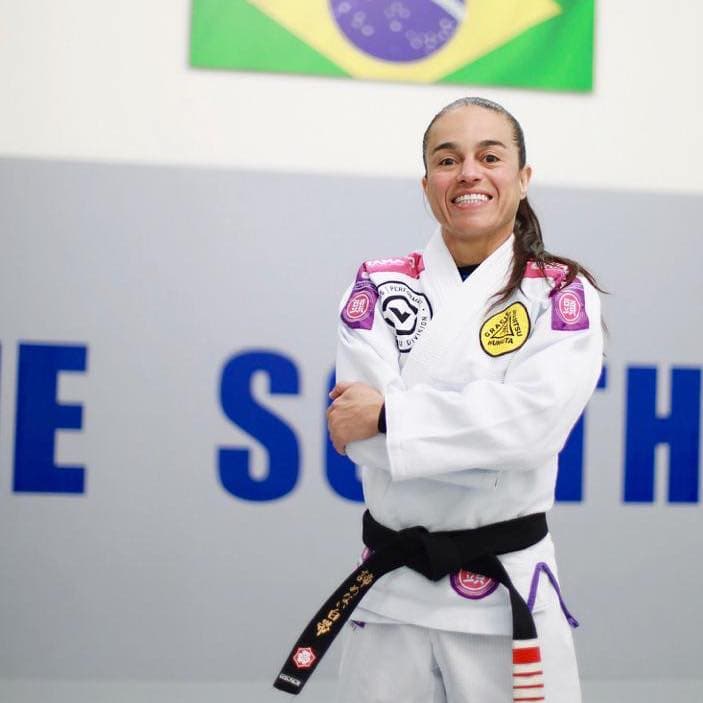
Leticia Ribeiro: the champion behind other champions
Quick answer: Leticia Ribeiro is a multiple-time world champion, IBJJF Hall of Fame member, and a teacher whose influence includes Bia Mesquita. Her career is worth following through competition results, her students' own accounts, and her continuing work at Gracie South Bay. The coaching story adds to her achievements as an athlete rather than replacing them.
The 2012 Worlds results place Leticia Ribeiro and Beatriz Mesquita at the top of different black-belt divisions. Ribeiro won light featherweight; Mesquita won lightweight. On a results page, the two names occupy separate lines. Their relationship makes those lines part of a larger story.
A profile of Ribeiro can begin with medals, but it should not end there. Her public record includes competing, teaching, running an academy, and helping interpret the sport in a newer professional format. Each role asks something different of the same body of experience.
In 2012, the teacher was still competing
The official 2012 Worlds results confirm Ribeiro's light-featherweight gold for Gracie Humaitá and Mesquita's lightweight title for the same team. The result is a useful fixed point: the teacher's competitive career and the student's success were happening at the same event.
That matters because coaching stories are often arranged into a neat sequence. First an athlete competes, then retires, then passes everything along. The 2012 result offers a less orderly and more interesting picture. Ribeiro's own work as a competitor remained visible alongside the work of someone she taught.
A results sheet does not reveal the private preparation behind either title. It cannot tell you what was said before a match or how the two experienced the day. What it does establish is enough: both were winning at the highest adult belt level in their respective divisions.
The overlap gives Ribeiro two responsibilities at once: improving her own performance and helping other athletes improve theirs. Her comments before that championship show how she understood the arrangement. The students were part of her preparation, not simply people waiting for her to finish competing.
Her own account made the exchange two-way
In a 2012 Graciemag interview, Ribeiro discussed entering another Worlds and described her students as a source of motivation. Speaking about the Gracie Humaitá women's team, she explained that she learned from the athletes she also taught.
The interview named competitors across several belt levels, including Mesquita, Penny Thomas, and Mackenzie Dern. It presented a group preparing together rather than a single champion working in isolation. Ribeiro's role was within that group as both teacher and active athlete.
That is a specific way to understand coaching influence. Instruction goes toward the student, but resistance, questions, and the demands of preparing alongside other competitors can also give the teacher something to work with. It need not be described as a mystical transfer of knowledge.
For a reader who trains recreationally, the useful observation is modest. A class can contain people with very different levels of experience while still giving each of them meaningful work. The instructor's expertise organizes the room; it does not make the other people in it incidental.
Mesquita describes a relationship beyond the belt
On her UFC athlete profile, Mesquita names her professor Leticia when asked about a favorite fighter. She describes Ribeiro's influence on her as an athlete, a person, and a coach. The statement comes from Mesquita herself, rather than from a biography assigning importance on her behalf.
That testimony should be given room without making Ribeiro the sole author of another athlete's career. Mesquita has done her own competing, learning, and adapting. A significant teacher can be acknowledged while the student's agency remains intact.
The connection is also visible in the way Mesquita's grappling instruction is presented. BJJ Fanatics identifies her as a Ribeiro black belt in its no-gi guard instructional. The former student is now explaining material to students of her own, through a different teaching format.
That progression gives the relationship a practical dimension. What began as one person's education becomes part of what she can teach others. The influence is carried through choices and explanations, not only through a name in the lineage section of a profile.
The academy serves people with different ambitions
Gracie South Bay identifies Ribeiro and Fabricio Camoes as its founders. The academy in National City offers adult and children's programs, women's classes, and private instruction. Its stated audience includes recreational students as well as competitive athletes.
Those details broaden the picture beyond major-event results. Running a school means providing useful training for people whose goals may have little to do with a world championship. A parent arranging a child's class and an adult returning after work need clear instruction and an appropriate place in the room.
An academy website cannot prove what every visitor will experience. It can show which programs the school says it offers and how to ask for more information. Someone planning to attend should confirm the current timetable, visitor procedure, and suitable class directly with the staff.
The distinction matters in a profile too. A famous founder is a reason to be interested in a school, not a guarantee that every session will be taught personally by that founder. Give the academy the opportunity to explain the actual visit rather than arriving with an itinerary built from a career highlight.
The record needs the competition named
BJJ Heroes' career record lists seven gi World titles and two World No-Gi titles for Ribeiro. Keeping those categories separate explains why a profile may describe nine world championships while another headline uses seven.
The figures are not competing answers to the same question if the events being counted differ. A careful reader should ask whether a total refers to gi, no-gi, adult black belt, or another category. The label beside the number does as much work as the number itself.
Ribeiro also appears in the IBJJF Hall of Fame. That recognition provides another documented part of her standing in the sport, without requiring every achievement to be squeezed into one headline statistic.
For someone beginning to follow women's jiu-jitsu history, this is a useful habit to develop early. Read results with their categories intact. It preserves the actual achievement and makes comparisons more meaningful. There is plenty to appreciate in the record without making the counting less precise for dramatic effect.
A judging role brought another perspective
In a May 2026 Mundo da Luta interview reported by Combate, Ribeiro discussed her work as a UFC BJJ judge. She explained the format's effort to make action understandable to an audience familiar with MMA scoring and emphasized its interest in active exchanges and submissions.
This is a different use of experience from competing or coaching. A judge must apply the event's criteria to what happens in front of them. The role is not to reward the style they personally prefer or to imagine how the match might have unfolded under another rule set.
Her involvement also offers a useful reminder for viewers. Familiar athletes can appear in a competition whose format requires a fresh explanation. Knowing traditional BJJ scoring does not mean every professional event can be watched through exactly the same assumptions.
Read the UFC BJJ format guide alongside the promotion's current rules if you are following that competition. Ribeiro's interview is valuable as her account of the role, but no single interview should replace the complete rules for a particular event.
Follow the work through several kinds of evidence
A career this broad is easier to understand when each source is used for the question it can answer. Results establish placement. An athlete's interview explains what she chose to say about a relationship. An academy page describes programs and contact details. None needs to do all the work alone.
A useful reading path is:
Start with Ribeiro's own competition record and keep the event categories clear.
Read her 2012 comments about competing alongside the women's team.
Compare that account with Mesquita's description of her influence.
Look at the academy and judging work as separate responsibilities.
This approach also prevents a familiar distortion in profiles of successful coaches. The athlete does not disappear as soon as a famous student becomes the subject of more current coverage. Ribeiro's own results remain part of the record, while the later work gives that record more dimensions.
For students, the practical question is how teaching becomes useful over time. A medal can establish that someone competed successfully. The accounts of instruction, continued learning, and students becoming teachers help explain why a person remains relevant after a particular championship season ends.
Main photo: Gracie South Bay; Leticia Ribeiro profile photograph.
The takeaway
Leticia Ribeiro's career is visible on several levels: her own results, the development of athletes such as Mesquita, an academy serving different students, and work within professional grappling. The strongest account keeps those roles connected without flattening them into one oversized medal count.
Her students' words are especially useful because they show how the relationship is understood from the other side. Alongside the official results, they give a fuller picture of a champion whose work continued to matter in other people's training and careers.
Find a place to keep learning
Explore the gym directory and ask prospective academies about their instructors and programs, including the class that matches your own experience.
FAQ
Who is Leticia Ribeiro? She is a multiple-time jiu-jitsu world champion, IBJJF Hall of Fame member, and instructor associated with Gracie Humaitá and Gracie South Bay.
Did Leticia Ribeiro teach Bia Mesquita? Yes. Mesquita identifies Ribeiro as her professor, and her black-belt connection to Ribeiro is documented by the academy and instructional publisher.
Why do profiles list both seven and nine world titles? BJJ Heroes lists seven gi World titles and two World No-Gi titles. State which competitions are included when using a combined total.
Can beginners train at Gracie South Bay? The academy advertises programs for different experience levels. Contact the staff for the current timetable, a suitable first class, and visitor arrangements.

Rafael Moura
Rafael Moura profiles competitors as people with lives outside the bracket. Some of those stories are comebacks. Most are not, and he does not force them.
Related Posts
Mikey Musumeci gives up the belt to make room for MMA
Musumeci is vacating his UFC BJJ title to focus on MMA training. What he is leaving, what continues, and why the transition matters.
IBJJF membership: finish the paperwork before the deadline
IBJJF membership and tournament entry are separate steps. Plan documents, professor approval, renewals, and junior accounts before registration closes.
Choosing a BJJ seminar worth your time and travel
Choose a BJJ seminar by the subject, teaching format, access, and total cost. Know what to ask the host before buying a ticket.
Comments (0)
Loading comments...