
Michelle Nicolini was a beginner more than once
Quick answer: Michelle Nicolini won eight IBJJF world titles and the 2013 ADCC women's under-60kg championship before making MMA her main competitive focus. Her career is worth revisiting for what happened between those achievements: uncertainty, useful coaching, and the practical work of adapting an exceptional ground game to another sport.
Eight world titles make a poor introduction to somebody who once considered giving up competition. The number gets there too quickly. It skips the version of Michelle Nicolini who had entered three times, lost three times, and wondered whether entering again was worth it.
That earlier version belongs in the story. So does the accomplished grappler who later had to prepare for opponents who could punch her. A medal collection can establish how good someone became at one task. It cannot do the next task for them.
Before the medals, a reason to come back
In a 2017 interview published by ONE Championship, Nicolini described her early competition record plainly: “I tried three times and I lost all three.” Working with Robert Drysdale, she said, helped her gain the confidence to compete again. The next attempt brought a win.
The useful detail is the presence of another person. It complicates the familiar sports story in which an athlete simply decides to become more determined. Coaching can give somebody a reason to return that is more concrete than being told to believe in themselves. There is a position to improve, a decision to change, and someone who can help distinguish a bad afternoon from a permanent limitation.
For a recreational competitor reading that account, the sensible response is small. Bring a specific problem to a coach. Ask what can be worked on before entering again. You do not need to interpret one loss as a verdict, and you do not need to turn every loss into a grand turning point either. Sometimes the next useful thing is an ordinary practice.
Capoeira did not spare her the first lesson
ONE's athlete biography places Nicolini's start in capoeira at 14 and her move into BJJ at 17. It records a black belt six years later. Those are different stages of learning, not one uninterrupted period of already knowing what to do.
Previous athletic experience can make a new activity appealing without making its problems familiar. In grappling, being comfortable moving your body does not automatically explain where to put a frame when somebody has pinned it. That distinction is easy to forget while watching an accomplished athlete. We see competence now and mentally send it backward through their whole life.
There is a kindness in resisting that habit. A new teammate with a sporting background should be allowed to ask basic questions without everybody treating the questions as a surprise. An adult beginner without that background deserves the same room. The mat presents the position that is in front of you; a résumé does not remove it.
Nicolini's later achievements can be admired without requiring her earliest sessions to have contained obvious evidence of them. It is enough that she learned.
The record has more than one language
Eight IBJJF titles establish the scale of Nicolini's gi career. Her no-gi record gives that assessment another dimension: the official 2013 ADCC results place her first in the women's under-60kg division, ahead of silver medalist Luanna Alzuguir. The event was held in Beijing.
Removing the gi changes what a grappler can hold. It changes the pace at which a connection can disappear. Success across the two formats asks more of a game than having a favourite finish with one reliable sleeve grip on the way there. The shared knowledge is substantial, but its application has to travel.
That makes this part of Nicolini's record useful to a viewer. Put the gi and no-gi matches beside each other rather than making separate piles of highlights. Look for the decisions that remain recognisable when the available grips change. Notice when an athlete chooses to come up from underneath, and when staying underneath offers a better attack.
A submission compilation can show you the destination. A full match gives you the rejected routes, including the ones the opponent successfully closed. That is where an athlete's judgement becomes visible.
Changing sports means accepting unfinished work
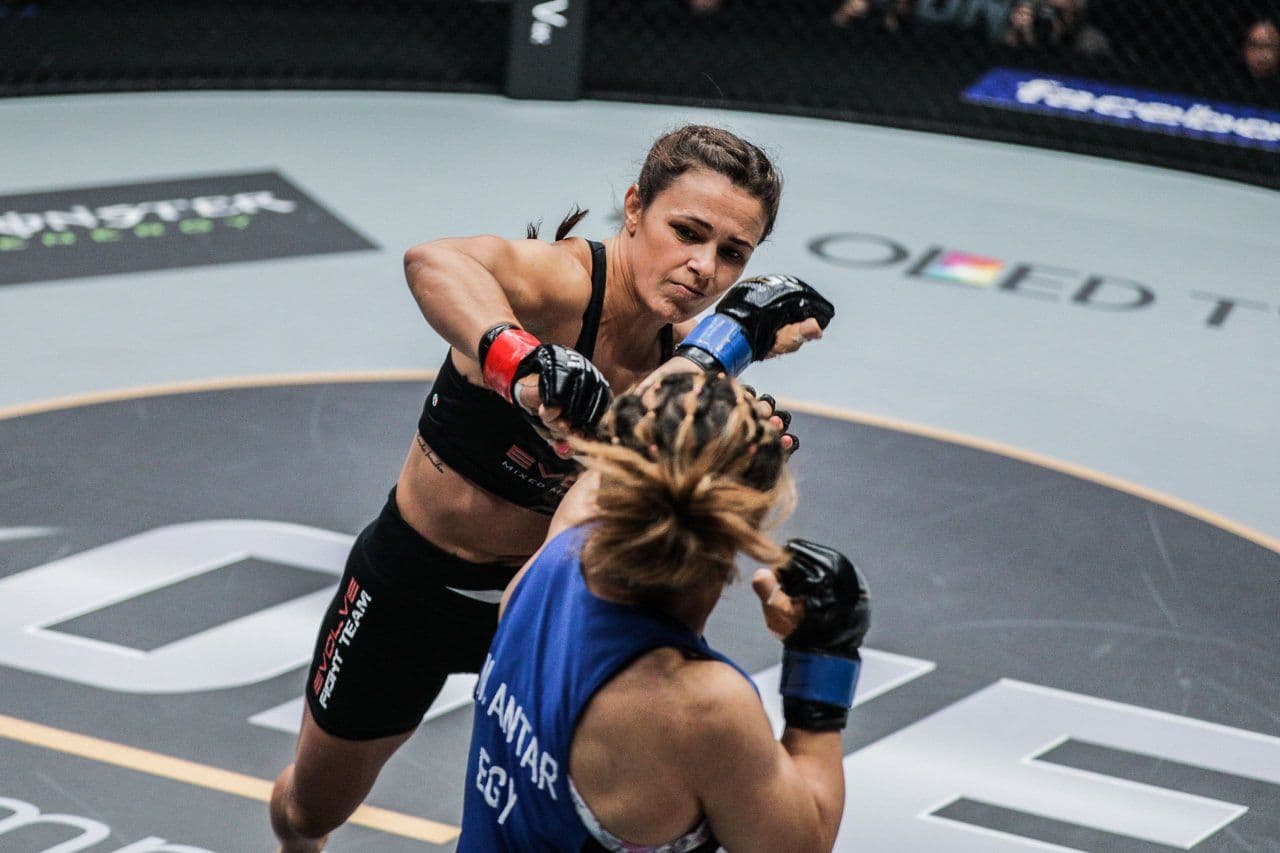
Nicolini's professional MMA debut came in 2011. ONE's biography dates her decision to leave BJJ competition and concentrate on MMA to 2016. There was an overlap before there was a change in emphasis.
For an elite specialist, that transition presents an awkward bargain. You carry an advantage into the new sport, along with a set of situations where that advantage is harder to reach. Being excellent on the ground does not make the distance between two standing opponents disappear. Nor does it make every bottom position equally desirable once strikes are allowed.
It would be strange to call such an athlete a novice without qualification. It would be equally strange to assume the learning was finished. A more accurate picture allows both things at once: deep expertise and work still to do.
That is part of the appeal of following crossovers beyond the announcement. The announcement sells a possibility. Training and competition have to give it a shape. Fans get to see which habits remain useful, which need adjusting, and how a competitor puts a familiar strength into unfamiliar circumstances. The interesting question becomes how the game changes, not simply whether the old reputation survives.
A decision win tells a different story from a finish
On July 12, 2019, Nicolini defeated Angela Lee by unanimous decision in Kuala Lumpur. ONE's contemporary fight report describes a contest with changes of position: Nicolini worked from her back in the first round, reached mount in the second, and had to deal with Lee's own reversals and late back take.
That is a more interesting record than a summary that gives one athlete every exchange. A good opponent remains an active part of the story, even in defeat. Their resistance determines which parts of the winner's game actually get tested.
A decision also keeps the unglamorous work in view. The audience does not get to use a finishing move as shorthand for everything that preceded it. There are positions to maintain and failed attacks to leave behind. The contest has to be managed after a submission opportunity passes.
For a BJJ audience, this is a reason to watch past the first recognisable technique. Knowing the name of an attack is only the beginning of following it. What did the defender make unavailable? Where could the attacker move next? The answer may be a better position rather than a tap, which is still an answer worth seeing.
Part of the preparation was arriving earlier
In her post-fight interview with ONE, Nicolini credited preparation in Brazil with Demian Maia and a final week at Monarchy MMA in Kuala Lumpur. She contrasted the early arrival with a previous trip when landing shortly before fight night had left her tired. She also mentioned the value of female training partners there.
Travel planning is a modest detail to put beside a high-profile win. That is why it deserves room. A competition performance comes out of a schedule as well as a training program. Getting to the venue is not the only thing a journey asks of an athlete; there is also the business of being ready when they arrive.
Most hobbyists cannot copy a professional camp, and pretending otherwise makes advice expensive very quickly. The transferable question is more practical: which avoidable complications can you remove before your own event? Perhaps that means knowing the route, organising a lift, or leaving enough time to eat without rushing. It does not require borrowing a champion's itinerary.
Our guide to the difference between hobbyist and competitor priorities starts with that same need to fit a plan to the person who has to live with it.
Watch the choices between the recognisable moves
Nicolini's career gives a viewer several entry points. You can follow the championship results, compare rule sets, or pay attention to how an athlete changes the setting around their training. None requires treating a win as evidence that every choice was perfect.
For a useful first viewing session, keep the assignment narrow:
Choose a full match or fight instead of a compilation, and identify which rules apply.
Follow one transition from initial contact to an established position. Rewind the failed attempt as well as the successful one.
Write down one question for a coach rather than collecting six techniques to try immediately.
That last restraint matters. A spectator can recognise something exciting without yet understanding the circumstances that made it work. Bringing the question into a supervised session gives it somewhere to go. Copying the ending while missing the entry is a different exercise.
There is pleasure in watching this way even if you never intend to compete. You begin to notice the opponent's contribution, the adjustment after resistance, and the decisions a highlight edit has no time to keep. The athlete becomes more interesting as the viewing gets less hurried.
Main photo: ONE Championship; archive photograph, photographer not identified on source page.
The takeaway
Nicolini's record earns attention on its own. What keeps it is the range of situations surrounding those results: learning a new sport, accepting help, adapting to different rules, and taking practical preparation seriously. Her published accounts give those changes a human scale without needing an invented scene in a locker room.
You can admire the medals and still spend more time with the work between them. For somebody training a few evenings a week, that is often where a champion's career becomes useful: in a question to ask, a match to study properly, or a manageable change before the next attempt.
Give the next question some mat time
Find an open mat near you, check its visitor arrangements, and bring one specific training question rather than a whole new game.
FAQ
How many IBJJF world titles did Michelle Nicolini win? ONE's athlete biography credits her with eight IBJJF world titles. That specific count should not be confused with broader totals that combine titles from different competitions or formats.
Did Michelle Nicolini win ADCC? Yes. ADCC's official results list her as the 2013 women's under-60kg champion in Beijing. Luanna Alzuguir took silver in that division.
When did she move into MMA? Her professional MMA debut was in 2011, according to ONE's biography. The same source dates her shift away from BJJ competition to focus on MMA to 2016.
Why is the Angela Lee fight worth watching? The 2019 bout offers an example of grappling decisions continuing after submission attempts fail. Read the contemporary report for context, then follow how both athletes change positions across the full contest.

Rafael Moura
Rafael Moura profiles competitors as people with lives outside the bracket. Some of those stories are comebacks. Most are not, and he does not force them.
Related Posts
Mikey Musumeci gives up the belt to make room for MMA
Musumeci is vacating his UFC BJJ title to focus on MMA training. What he is leaving, what continues, and why the transition matters.
IBJJF membership: finish the paperwork before the deadline
IBJJF membership and tournament entry are separate steps. Plan documents, professor approval, renewals, and junior accounts before registration closes.
Choosing a BJJ seminar worth your time and travel
Choose a BJJ seminar by the subject, teaching format, access, and total cost. Know what to ask the host before buying a ticket.
Comments (0)
Loading comments...