
Your first IBJJF tournament: the day from check-in to results
Quick answer: Prepare an IBJJF entry by confirming active membership, the correct category, correction deadlines, uniform, identification, and the event schedule. The official guidance asks athletes to be ready one hour before their division’s estimated start. Use the actual event page for weigh-in and venue procedures rather than assuming every tournament operates identically.
The first tournament day gets easier when fewer decisions are left for the venue. A correct category, a compliant uniform, and a saved schedule are practical tasks that can be settled before the first match call. None requires guessing how the match will go.
The official IBJJF guidance divides preparation into registration, corrections, and competition day. That sequence is useful, but the event page remains necessary for local details. A general guide cannot promise a spectator policy, a particular scale procedure, or the same schedule arrangement at every championship.
Make the entry real before planning around it
IBJJF’s first-championship page requires active membership under the current belt and academy before championship registration. The academy must be registered and have the relevant instructor available for the membership process.
The guidance says membership approval can take up to five business days after all required documents are received. That is not a guarantee that an incomplete request will be processed before a closing event. Submit the necessary information with enough time to resolve corrections.
Membership and event registration are different steps. An active membership does not by itself reserve a place in a championship, and an intended entry is not the same as a completed registration. Verify the event’s confirmation and the athlete list rather than relying on a payment screen remembered in passing.
The membership guide covers that first administrative task in more detail. For the event, save the official page and relevant deadlines together so later questions refer to the same registration.
Choose the complete category
The official guidance explains that age divisions use birth year, while weight limits include the required uniform. The actual event provides the belt-and-age table and weight chart. Those are the references for the entry.
Read the whole category: sex, age, belt, clothing, and weight. A familiar lightweight label from another organization is not a universal limit, and a gi category is not automatically the same number as its no-gi namesake.
Eligible masters athletes can choose a lower age division under the stated guidance, but cannot enter a higher masters group for which they are not eligible. Youth entries have their own constraints. Do not import an adult choice into a juvenile registration without the actual rule allowing it.
This is an administrative decision, not a recommendation for rapid weight change. Use the actual uniform and chart to understand the limit, then raise uncertainty while the correction process is still open. A category chosen from a vague memory is harder to fix after the relevant deadline.
Treat corrections as separate stages
IBJJF distinguishes the athlete correction deadline, professor correction period, and registration checkday. Each has a different function. The first two provide defined correction routes; checkday is not an unrestricted chance to make any new change.
After requesting a correction, verify it on the official athlete list. Sending an email or asking a professor does not itself prove that the entry has changed. Save the corrected category so the competition-day check uses the same information.
A short preparation list can prevent confusion:
Confirm the entry and academy on the athlete list.
Save the relevant deadlines in event-local time.
Check that any requested correction appears correctly.
Read the special options if the athlete remains alone in a division.
The guidance has specific instructions for single-athlete brackets and staff errors. Those conditions should be read directly for the event rather than replaced with a teammate’s experience from a different tournament.
Prepare the uniform and identification
The official uniform requirements define permitted gi and no-gi clothing. A normal training outfit may not meet every competition requirement, so check fit, condition, colors, and any relevant rank-color rules before packing.
The event can also impose additional instructions for particular rounds or categories. The safest preparation is to read those notes, not assume a general clothing summary is the complete event policy. A backup compliant uniform is a practical option where the athlete can reasonably bring one.
The first-championship guidance says a valid government-issued photo ID can be used when an athlete does not have the membership card. It lists separate arrangements for minors. Keep identification available rather than packing it somewhere difficult to reach when officials ask.
Uniform inspection and weighing are different questions. Clothing can be compliant and still contribute to the measured weight. It can also fit the weight calculation and fail a clothing requirement. Check both before the day rather than assuming one approval establishes the other.
Read the schedule as an estimate
The official guidance asks athletes to be ready at the venue one hour before the division’s scheduled start. Brackets and schedules provide approximate times, and the actual event information explains where athletes should wait and monitor calls.
Do not build the day around arriving at the venue door exactly at the first-match estimate. Time is needed for the event’s entry procedure, changing, finding the designated area, and responding if the schedule moves. The one-hour guidance is a preparation requirement, not a promise that a match will start at an exact minute.
Check the bracket once it is released, then recheck the official schedule and calls on the day. A screenshot can be useful offline, but it should not replace a later update. Keep the division and athlete name visible so the right schedule is being read.
For anyone traveling with a teammate, agree on where to meet and how to find the official updates. That is a practical plan, not an assumption that the teammate can enter every restricted area or act as a credentialed coach.
Follow the actual weigh-in procedure
The first-championship page explains that athletes are called to weigh in as their division starts, rather than completing a universal check-in on arrival. The actual event page should be read for the official timing, unit, attempt count, and any special procedures.
The weight limit includes the required uniform, and the guidance states that an athlete above the registered limit is disqualified. Do not assume an allowance, a second attempt, or a day-before procedure because another tournament offered one.
If the event provides additional instructions for a particular black-belt schedule or category, those notes matter. A general article should not erase the exception by promising that every athlete has precisely the same process.
Bring the identification and required clothing to the designated area, follow staff instructions, and keep monitoring the official call system. If a procedure is unclear, ask the appropriate event staff rather than leaving the waiting area on an assumption that the match is far away.
Know the rules before the first exchange
The IBJJF rulebook covers scoring, penalties, legal techniques, and match procedures. The applicable age, belt, and clothing category determines important parts of that rule set. An elite adult no-gi highlight is not permission for every technique in a first competition.
Review the starting command, stop signal, scoring values, and illegal-moves chart with a coach before the day. A controlled practice round can make those conditions familiar without trying to simulate every possible competition situation.
During a match, follow the referee’s instructions. A spectator’s interpretation is not a substitute for the official command. If a scoring question needs review afterward, retain the full sequence and use the proper event process rather than trying to reconstruct it from a single remembered instant.
The goal of preparation is to remove avoidable confusion. It cannot guarantee a medal, a particular opponent, or a calm feeling at every moment. A correct entry and a clear understanding of the procedures are useful achievements before the competitive result is known.
Finish the event with a usable record
After the match, follow staff directions for the result and any podium procedure. The official guidance tells medalists to proceed to the podium after their division’s completion and follow the event team’s instructions. The specific arrangement can vary with the venue.
For a personal review, write down the event, category, round, score, and one position worth discussing with a coach. If footage is available, keep the minute before the important exchange. That provides more useful context than a broad judgment about the whole performance.
Spectators, shirts, coaching access, and other venue details should come from the current event page. General pages can retain older notes, so a historical spectator restriction should not be assumed to apply everywhere now. Check the actual championship’s published policy.
Finally, separate the result from the administrative review. A win does not prove that every preparation choice was good, and a loss does not make a correct entry or useful lesson disappear. Record what happened accurately, then choose one concrete change for the next event.
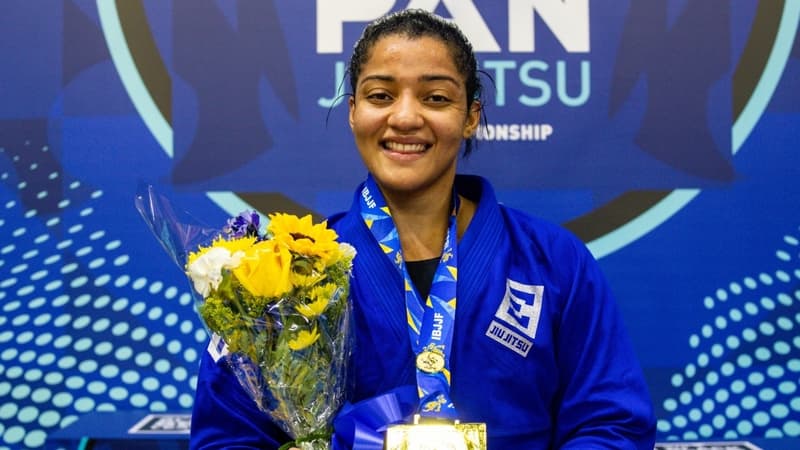
Main photo: Archive: Larissa Dias at the 2026 Pans — IBJJF; photographer not identified on source page.
The takeaway
A first IBJJF tournament is easier to manage when membership, entry, corrections, uniform, ID, and schedule are checked before arrival. The event page supplies the local details that a general guide cannot guarantee.
Be ready early, monitor the official calls, and follow the actual weigh-in and match procedures. Afterward, keep a specific record for review rather than asking one result to judge every part of the day.
Find the event that fits your plans
Browse the tournament directory, then verify the organizer’s current entry conditions, dates, and venue information before registering or traveling.
FAQ
Does an IBJJF membership automatically register me for a tournament? No. Membership and championship registration are separate steps. Verify the actual event entry and athlete list.
How early should I be ready? The official first-championship guidance asks athletes to be ready one hour before their division’s estimated start. Follow any additional event-specific instructions.
Can I assume I weigh in the day before? No. Read the actual event procedure. The general guidance describes being called to weigh in as the division starts, with event-specific details still relevant.
Can friends always enter free? Do not assume that. Spectator access and fees depend on the current event page, which should be checked before making plans.

Maya Corbett
Maya Corbett answers the questions you have before walking into an unfamiliar academy — what to book, what to bring, who to ask. Every detail in her guides traces back to something the gym published itself.
Related Posts
Lucas “Hulk” Barbosa’s best work is in the details
Lucas Barbosa’s nickname explains the first impression. His gi world title, no-gi record, and 2022 ADCC final give viewers more to study.

João Miyao’s record deserves its own first name
João Miyao’s adult world title and 2026 Master1 results tell a distinct story, even when his brother appears beside him on the podium.

Jena Bishop made time for a second sporting life
Jena Bishop’s 2026 PFL title followed a deliberate move from championship jiu-jitsu into learning a different sport.
Comments (0)
Loading comments...