
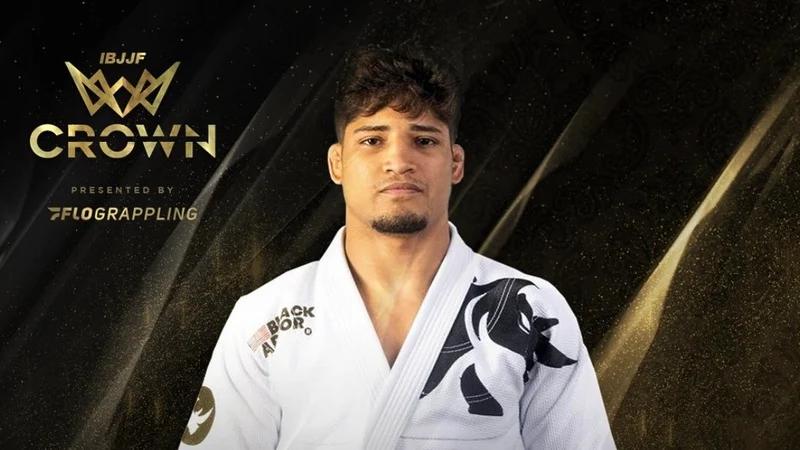
Fabricio Andrey’s first Worlds ended with a triangle
Quick answer: Fabricio Andrey won the 2021 IBJJF featherweight World Championship on his black-belt Worlds debut, submitting former champion Shane Jamil Hill-Taylor with a triangle. His Brasileiro and European results, followed by a close Crown match against Isaac Doederlein, reveal a career with more range than one spectacular finish.
The athlete across from Andrey in the 2021 Worlds final had already won this title. Shane Jamil Hill-Taylor was the 2018 featherweight world champion. Andrey was making his first World Championship appearance at black belt.
The final ended with Hill-Taylor caught in a triangle. Andrey left with the title, adding a world championship to a season in which he had already won his first major black-belt gold at the Brasileiros. The IBJJF’s later account of his breakthrough connects those two achievements.
After that title, every future opponent could prepare for a world champion. Andrey’s subsequent seasons would bring finals decided by points and a match against another former champion that neither athlete could settle before the clock expired. Those results reveal more of the game around the triangle.
A first world final against a previous winner
Winning a first Worlds at black belt is difficult to appreciate if every champion’s name arrives without context. Hill-Taylor brought experience of winning this same adult division. His presence made the final more than a meeting between a newcomer and an anonymous last opponent.
Andrey’s triangle provided a decisive ending. That distinction matters at featherweight, where a major bracket can contain several athletes capable of beating one another by the smallest scoring margin. A submission removes the need to compare those margins at the end of the clock.
It also asks for control against an opponent who understands the danger. A triangle does not become effective merely because the legs reach the upper body. The attacker needs to restrict posture and preserve the angle while the defender tries to create space, stack, or withdraw the trapped arm. The finish identifies the technique. The achievement lies in completing it against someone of Hill-Taylor’s standard on that stage.
The Brasileiro title had its own history
Before returning to the Brasileiros in 2022, Andrey described having won the event in four appearances across juvenile, adult blue, purple, and black-belt competition. Those milestones appear in his interview with the federation.
The sequence gives the 2021 black-belt title a longer setting. Success at the colored belts did not make adult black-belt victory automatic, but it meant the tournament was already part of his development. The opponents, technical demands, and expectations had changed as he moved through the ranks.
In that same interview, Andrey emphasized the importance of competing in Brazil, including the opportunity for athletes who had difficulty obtaining visas for events in the United States. That was his stated view of the field’s significance. It also supplies a useful reason to follow more than one major tournament: access can affect which opponents are able to enter a particular bracket.
A champion’s calendar therefore contains more than repeated versions of the same event. Each major brings its own field and its own route to the podium.
The triangle is an alignment problem
A triangle is visually dramatic because the finishing position is easy to recognize. The details that make it possible are smaller. The defender’s shoulders, the trapped arm, the attacker’s angle, and the ability to change posture determine whether the position becomes a real finishing threat.
For spectators, this makes the setup more revealing than the final squeeze. A defender may be working to recover balance or clear a leg when the attacker changes the relationship between the upper body and the hips. The match can move from a positional exchange into a submission before either player has traveled very far across the mat.
Andrey’s Worlds finish is a good reason to watch those transitions carefully. It is not evidence that every future match must be won through the same attack. At the highest level, showing one credible danger can affect which options the next opponent is willing to use. The strongest athletes have to exploit the space around the threat as well as the threat itself.
Three different answers in Paris
Andrey’s 2023 European title came through another varied route. In the quarterfinal, he beat Israel Almeida 2–0. He submitted Lucas Rodrigues with a kneebar in the semifinal, then beat Alex Sodre 2–0 in the final. The IBJJF’s submission study records that sequence.
The two matching scores surround a completely different result. One opponent conceded the decisive scoring difference. Another was caught in a leg attack. The final required Andrey to finish the scheduled match ahead rather than finish the opponent.
That matters because a reputation for exciting jiu-jitsu can become a misleading instruction to perform the same kind of match every time. The athlete’s actual job is to win against a resisting opponent within the available rules. Some opponents allow a route to the finish. Others defend that route effectively enough that the result has to come through a smaller opening.
The Paris bracket demonstrates both. Andrey left as champion without requiring every match to resemble the triangle that had made his first world title memorable.
Featherweight kept producing new champions
The division around Andrey helps explain why sustaining that success is difficult. Hill-Taylor won Worlds in 2018, Matheus Gabriel in 2019, Andrey in 2021, and Doederlein in 2022. The federation set out that sequence in its 2023 Worlds guide.
A changing list of champions creates a different sporting environment from a division organized around one long reign. Several athletes have evidence that their game can win the event. Each new title adds another credible contender rather than erasing the previous ones.
That context improves the meaning of an individual match. Andrey facing Doederlein is not simply one recognizable name meeting another. It pairs athletes who had already navigated separate World Championship brackets successfully. Their strengths have to be understood in relation to an opponent with comparable achievement and a different set of answers.
For a viewer choosing which division to follow, that depth offers an excellent reason to watch early rounds as well as finals. A future champion may have to beat a former one before reaching the last match.
Doederlein made the Crown semifinal close
At the inaugural Crown in November 2023, Doederlein defeated Andrey by referee’s decision. FloGrappling’s original event report described Andrey working from top while Doederlein played open guard.
That match supplies a useful counterweight to the clean ending of the 2021 Worlds final. A triangle creates an unmistakable result. A close top-versus-guard contest can leave both athletes actively engaged without either producing the scoring difference required to settle the match before the decision.
The top player has to clear the defender’s legs without giving away a sweep or submission entry. The guard player needs meaningful offense while preventing a pass. Each successful defensive response can make the other athlete’s attack look smaller than it would against a less capable opponent.
Doederlein advanced. Andrey did not. The narrow ending belongs in the same career as the submission victories, because it shows the standard of resistance waiting when former world champions meet in a compact invitational field.
Speed needs a useful destination
Andrey is an engaging athlete to follow because exchanges involving movement can end in several different kinds of reward. A change of direction might create a scoring opportunity, expose a leg, or force the opponent to defend long enough for a new position to become available.
The results discussed here separate those outcomes clearly:
The 2021 Worlds final ended with a triangle.
The 2023 European semifinal ended with a kneebar.
The European final ended with a two-point margin.
The Crown match ended with Doederlein receiving the decision.
Movement is therefore only part of the explanation. Its value depends on what it changes for the opponent. Did it remove a base, isolate a limb, or make a grip difficult to recover? A fast exchange that creates none of those problems may be attractive without being decisive.
Our BJJ rules guide helps connect the positional changes to the scoreboard. Andrey’s career provides a particularly good setting for that connection because his major results include both immediate finishes and matches decided through much smaller differences.
Main photo: ibjjf.com. Archive image published by ibjjf.com. The photograph is not an image of every event discussed in the profile.
The takeaway
The triangle against Hill-Taylor remains an excellent way into Andrey’s story. A debut black-belt world title against a former champion needs little decoration. The Brasileiro milestones before it and the European title after it make the achievement part of a wider career.
The close Crown loss adds the resistance that every serious sporting story needs. Andrey has shown several ways to win, and he has faced opponents capable of denying the ending he wants. Following those exchanges reveals considerably more than a nickname or a finishing clip can hold.
Explore the rooms behind the competition
Use the Let’s Roll gym directory to find local academies and compare the training available near you.
FAQ
Who did Fabricio Andrey beat in his first black-belt Worlds final? He submitted Shane Jamil Hill-Taylor with a triangle in the 2021 IBJJF featherweight final. Hill-Taylor had won the division in 2018.
Did Andrey win the 2023 Europeans? Yes. His final three matches included a 2–0 quarterfinal win, a semifinal kneebar, and a 2–0 final win over Alex Sodre.
What happened when Andrey met Isaac Doederlein at the 2023 Crown? Doederlein won their close featherweight match by referee’s decision, advancing to the final.
Is Andrey’s game only about submissions? His results include submission victories and points wins. The 2023 European title alone required him to succeed through both kinds of outcome.

Miles Serrano
Miles Serrano writes about competitors and the decisions that shaped their careers. He is more interested in the adjustment someone made in the third minute than in the medal count afterward.
Related Posts
Diogo Reis carried the pressure from ADCC into ONE
Baby Shark’s ADCC titles and ONE championship show different ways to win. Start with the opponent’s recoveries as well as Reis’s attacks.
Adele Fornarino won the small division, then the open one
Fornarino’s 2024 ADCC double gold put two different fields on the same record. Read the separate routes and the support around the result.
Elisabeth Clay made the gi catch up with her no-gi results
Clay’s first major gi title and later No-Gi Worlds run tell different parts of a career built around dangerous submission opportunities.
Comments (0)
Loading comments...