
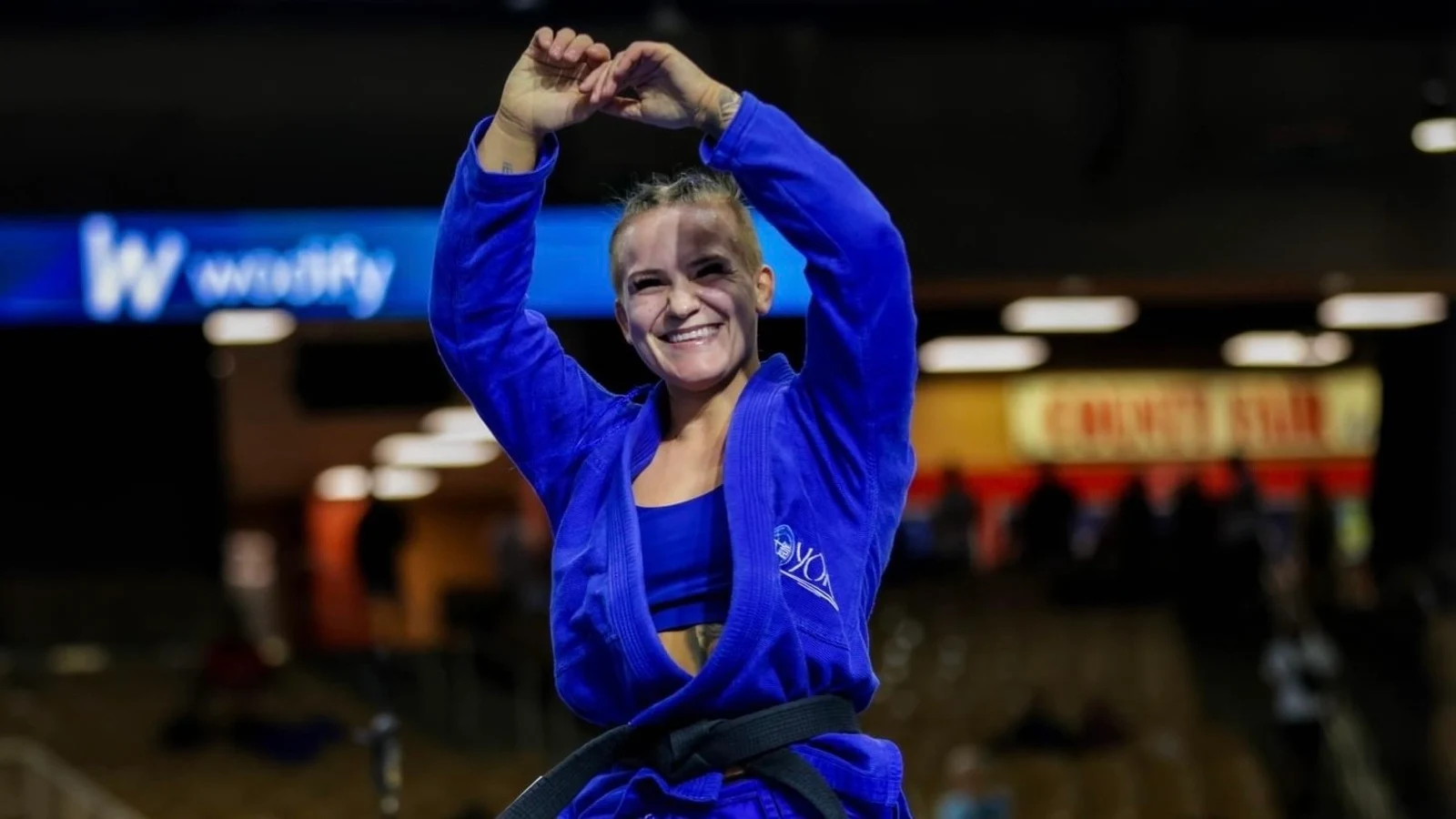
Elisabeth Clay made the gi catch up with her no-gi results
Quick answer: Elisabeth Clay established major no-gi results before winning her first major gi title at the 2023 Pans. Her 2025 No-Gi Worlds double gold and her 2026 gi finals against Lillian Marchand show an athlete whose submission game has remained dangerous across very different competitive problems.
Thalyta Silva had beaten Clay on points in the quarterfinals of the 2022 World Championships. When they met again in the 2023 Pan final, Clay ended the match with a kneebar. The previous result did not guarantee the next one.
That finish brought Clay her first major gi title at black belt. It was a meaningful gap to close for someone already producing major no-gi results. The clothes change the grips, the pace, and the defensive resources available to an opponent. Success in one format gives an athlete useful skills; it does not deliver the other title automatically.
Clay’s career is interesting in that space between familiar threat and unfamiliar resistance. A knee or ankle attack remains a recognizable danger. The work needed to reach it changes with the opponent, the scoring situation, and the fabric in everyone’s hands.
The no-gi results arrived first
Clay received her black belt from Osvaldo “Queixinho” Moizinho and Samir Chantre in late 2020. In 2021 she won the No-Gi Worlds, finishing the final with a guillotine. The IBJJF’s interview before her next Worlds appearance placed that achievement alongside her Pan No-Gi success.
By the latter half of 2022, she was winning both her weight division and the open class at the No-Gi Pans and No-Gi Worlds. Across those two events, nine of her ten victories came by submission, according to the federation’s account of her subsequent gi breakthrough.
Those results established something more demanding than the possession of a dangerous move. Double-gold weekends require an athlete to solve a second bracket after already competing in a first. The opponents and size relationships change. A finishing game has to remain usable when the next person has seen what happened earlier in the day.
The gi title had been close before
Before the 2023 breakthrough, Clay had already reached the Pan final in 2021 and the Brasileiro final in 2022. Silver medals can disappear in a career summary once the gold arrives. Here they explain why the Pan title was a development within an existing gi career rather than a sudden experiment.
At the 2023 Pans she defeated Raquel Canuto and Thamara Ferreira on points before submitting Silva in the final. The IBJJF’s post-event interview described her adjustments as changes across her overall game, rather than one opponent-specific trick.
The first two results are an essential part of the story. Clay did not submit everyone that weekend. She advanced through scoring matches and then found a finish in the final. A strong submission identity has more value when it can sit inside a complete match, including the stretches where the opponent successfully denies the finish and the scoreboard still matters.
A kneebar changed a familiar matchup
The Silva rematch offers a compact example of how little a previous result settles. The athletes had already faced one another on a major stage. Silva’s earlier points win supplied a real reference point. Clay’s kneebar produced a different ending under another day’s conditions.
A kneebar attacks the knee through control of the leg and the surrounding alignment. At a technical level, the finish requires more than finding a loose foot: the defender’s rotation and ability to move the hip can determine whether the attack stays connected. That makes the route into the position as important as the final extension.
For a spectator, the interesting moment is often the transition into danger, when a position that appeared to be about guard retention or passing becomes a submission exchange. Clay’s final is a reason to pay attention before the finishing grip is obvious. The match changes when one athlete loses the freedom to turn, stand, or withdraw the leg on their own terms.
Eight matches, eight finishes in 2025
At the 2025 No-Gi Worlds, Clay won middleweight and the open class with eight submissions in eight matches. The weight final ended against Rebeca Lima; the open final ended against Gabrieli Pessanha. Both finishes were outside heel hooks, according to the official championship recap.
That is an unusually clean set of outcomes for a long competition day. It also puts a particular demand on the reader: the same submission label should not make every exchange sound identical. Different opponents can give away access to the leg through different choices. The final result records the finish, while the sequence explains how it became available.
Pessanha’s status as the larger opponent adds another dimension to the open-class match. A leg attack can change the shape of that contest by making a specific joint and the defender’s movement the immediate problem. It does not erase the difficulty of controlling a larger elite athlete long enough to complete the attack.
Marchand made 2026 a running argument
The 2026 gi season brought Clay into repeated major finals against Lillian Marchand. Marchand won their Pan final. Clay then returned to São Paulo and won the Brasileiro title, submitting Marchand with a toe hold at roughly the halfway point of the final.
Clay’s Brasileiro path included an opening cross-collar finish after an omoplata setup and a semifinal toe hold against Gisele Menezes. Those details come from the federation’s female black-belt report. The two finalists arrived at Worlds with a major final win apiece that season.
Marchand won the subsequent World Championship final, leaving Clay with silver in the official middleweight results. That sequence gives the rivalry substance without requiring a personal feud. Two athletes kept reaching the same late stage and taking titles from one another. The sporting tension was already there in the brackets.
For Clay, the Brasileiro toe hold also connected the 2026 story to the earlier Pan breakthrough. Different years, different opponents, different leg attacks: the recurring theme was a finishing opportunity found inside a gi match against a highly capable defender.
The jacket adds another defensive layer
Gi and no-gi are often discussed as if one were simply the faster version of the other. Clay’s results make a better comparison possible. In the gi, the defender can use fabric to regulate distance, tie up an attacking hand, or create a connection that remains available through movement. Those grips change the work required to arrive at a leg entanglement or upper-body finish.
The attacker gains fabric too. Clay’s Brasileiro opening finish moved from an omoplata setup into a cross-collar choke, a sequence that links a shoulder threat and a jacket-based neck attack. Her no-gi finals do not offer that same collar resource.
The important distinction is the available set of decisions. The athlete has to know which controls survive the transition and which depend on a grip that only exists in one format. Our gi versus no-gi guide explains those broader differences for readers choosing what to train. Clay’s competition record shows them under considerably more pressure.
Why the whole match is worth watching
Clay’s title matches reward attention to three connected questions:
How does she obtain a useful connection before the submission position becomes obvious?
Which route can the defender still use to free the hip, knee, or upper body?
Does the response to one attack expose something different?
These questions fit the kneebar against Silva, the heel-hook finals in 2025, and the gi attacks at the 2026 Brasileiros without pretending that all of them are one technique. They direct attention toward the decisions that separate a threat from a completed finish.
They also leave room for the matches she loses. Marchand’s 2026 Worlds victory belongs beside Clay’s Brasileiro title because a rivalry is made from both athletes’ successful adjustments. Repeated finals are especially useful here. Familiarity does not produce a permanent answer; it raises the standard for the next exchange.
A career built around submissions can still include close scoring matches, silver medals, and opponents who solve the immediate danger. Those results make the wins more intelligible. There is a resistant person on the other side of every impressive finishing statistic.
Main photo: ibjjf.com. Archive image published by ibjjf.com. The photograph is not an image of every event discussed in the profile.
The takeaway
Clay’s first major gi title mattered because her no-gi results had already shown what a serious submission threat she could be. Winning the 2023 Pans required her to carry that threat through a different set of controls, including two points victories before the kneebar in the final.
The later results keep that story moving. Eight finishes at the 2025 No-Gi Worlds demonstrated a devastating competition day. The 2026 exchanges with Marchand showed a different kind of challenge: repeated major finals against an opponent who could beat her, and whom she could beat. That is a much richer career than a list of leg locks.
Find your next training room
Use the Let’s Roll gym directory to compare academies offering gi and no-gi classes near you.
FAQ
When did Elisabeth Clay win her first major gi title? She won the 2023 IBJJF Pans at black belt, submitting Thalyta Silva with a kneebar in the final after two points victories.
What did Clay win at the 2025 No-Gi Worlds? She won middleweight and the open class, finishing all eight of her matches. Her two finals ended with outside heel hooks.
Did Clay and Lillian Marchand meet more than once in 2026? Yes. Marchand won their Pan final, Clay won their Brasileiro final, and Marchand won their World Championship final.
Are Clay’s gi and no-gi games exactly the same? They share submission threats, but jacket grips change the available controls and defenses. Her gi results include collar-based finishes alongside leg attacks.

Rafael Moura
Rafael Moura profiles competitors as people with lives outside the bracket. Some of those stories are comebacks. Most are not, and he does not force them.
Related Posts

Adam Wardzinski made the butterfly guard a world-title problem
Wardzinski’s 2024 world title came with four submissions. His career gives a better story than reducing him to one guard or one nationality.

Fight 2 Win: watch the attack before looking for points
Understand Fight 2 Win’s submission-focused superfights, how to watch the attacks, and why applying differs from receiving a match.

Moving from juvenile to adult BJJ needs a new entry check
A new competition year can change the age division before a birthday. Read the organizer’s age calculation and the rules for the actual adult entry.
Comments (0)
Loading comments...