
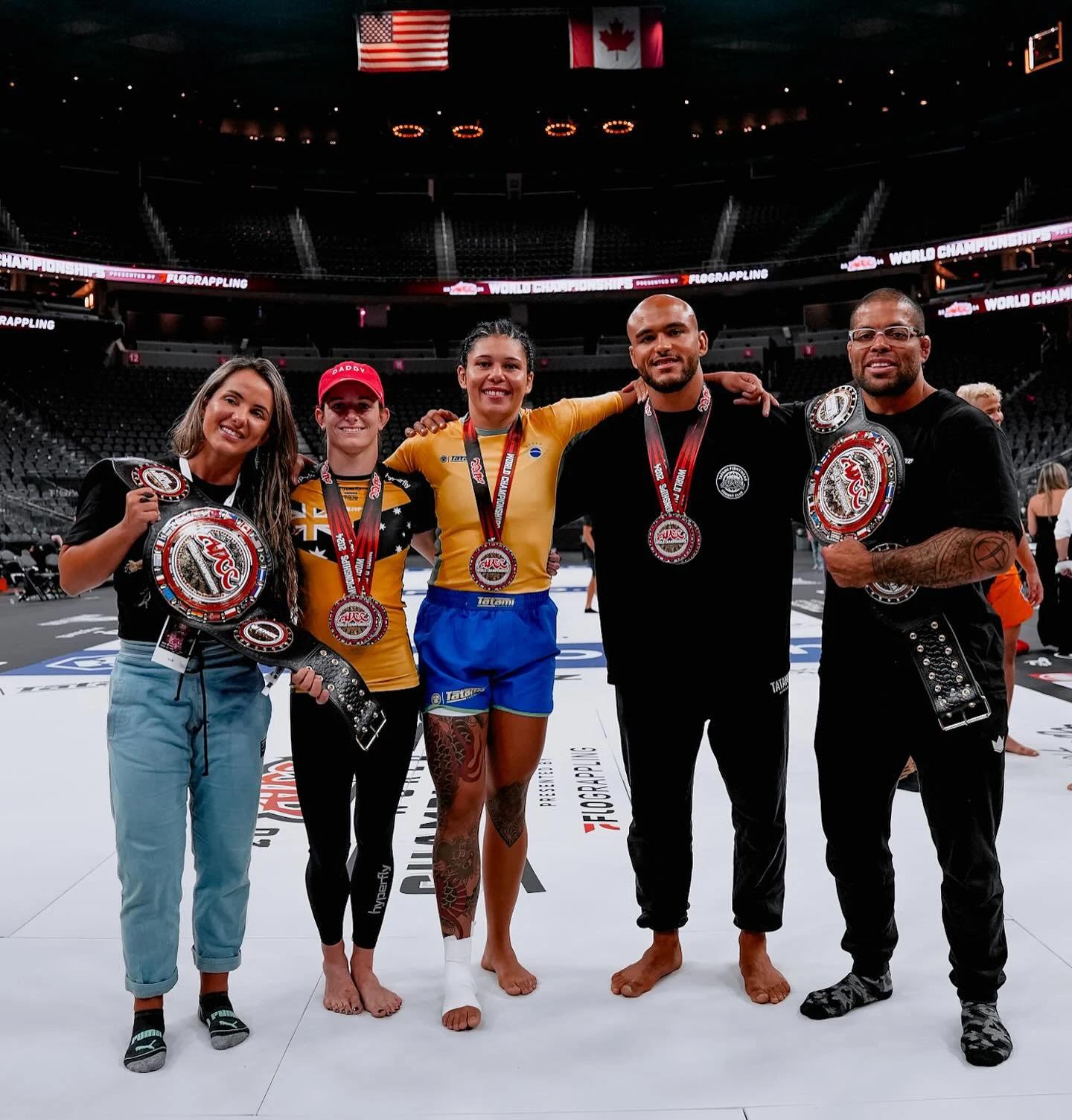
Adele Fornarino won the small division, then the open one
Quick answer: Adele Fornarino won both the women’s under-55-kilogram division and the open class at the 2024 ADCC World Championship. Her two finals produced different kinds of victories, and her subsequent No-Gi Worlds and UFC BJJ appearances show why that weekend was part of a larger competitive story.
A weight-division title establishes the best performance within one defined field. An open-class title asks the winner to start another argument against opponents of different sizes. In Las Vegas in 2024, Fornarino won both.
The Australian’s name appears twice in the official ADCC championship results: first at under 55 kilograms, then again in the women’s absolute. That neat pair of lines hides two very different finals. Bianca Basilio was submitted. Bia Mesquita was beaten on penalties.
Keeping both endings in view makes the achievement more interesting. Fornarino did not need every match to resemble the last one. She found quick finishes, sustained a serious submission threat against a larger opponent, and completed a championship day in which the next problem kept changing.
The under-55 final turned on an arm
Fornarino submitted Jasmine Rocha with an armbar in the under-55 semifinal. In the final, Basilio scored an early trip and later stood from the closed guard. Fornarino attacked the arm and finished at 2:40. Those details appear in FloGrappling’s live finals account, produced by the event broadcaster.
The contrast between the opening trip and the ending is central to the match. The athlete initiating a successful movement does not necessarily retain control of what follows. A standing opponent still has to keep the arms and posture protected while trying to clear the guard.
Our BJJ rules guide explains the wider scoring context, but the danger inside closed guard is positional: crossed ankles are only the most visible part of the connection. Its attacking value comes from changing the opponent’s alignment and making a limb difficult to withdraw. The guard player needs enough connection to turn a defensive movement into a new angle. In this final, the transition out of the standing posture became more consequential than the early takedown.
The absolute final stayed unresolved longer
The open-class final against Mesquita did not end with a tap. Fornarino won on penalties after threatening an armbar and moving into a reverse-triangle position. Earlier in the bracket, she had submitted Brianna Ste-Marie with an armbar, according to the same broadcaster’s results account.
An unresolved submission position produces a different viewing experience from a fast finish. The attacker must continue controlling a defender who is actively trying to escape. The defender can be in real danger without having reached the point of submission. Both facts can remain true until the end.
That distinction is especially important in an open class. A smaller competitor cannot assume a useful position will stay useful simply because it has a recognizable name. The larger opponent may have more power to restore posture or create space. Maintaining the connection becomes its own contest, played through changes in angle, hand position, and the defender’s ability to move.
Fornarino’s two golds therefore should not be compressed into a story about identical finishes. One final ended quickly. The other required a threat to remain meaningful through a much longer exchange.
A Melbourne room had a long view of the result
Dominance MMA founder and head coach Dave Hart celebrated Fornarino as the first Australian ADCC champion in an academy account published after the event. His account described a decade of preparation and acknowledged the support of Atos in San Diego.
That perspective places more people around a medal usually photographed with one athlete. A competition game needs partners who supply different reactions, coaches who can identify recurring problems, and rooms in which an athlete can keep developing once the familiar answers stop working.
The geographical part matters too. Fornarino’s achievement came out of a career connected to an Australian academy and international training relationships. That is a more concrete picture than a generic story about someone suddenly appearing on the world stage. The double gold was a weekend result. The preparation belonged to a much longer period and a wider group of people.
It also gives newer Australian competitors a specific reference point: a world championship won by someone connected to their own competitive community.
Closed guard can become an open-class weapon
Fornarino’s 2024 finals offer a useful corrective to the assumption that a smaller athlete must spend the entire match moving away from a larger opponent. Distance is valuable, but close connections can create a different kind of control. A guard that ties the opponent’s upper body to the attacker’s hips can restrict the freedom that size would otherwise help preserve.
The trade-off is demanding. Close enough to attack is also close enough to carry pressure. The bottom player needs to make that connection productive, changing the alignment or forcing a response before the top player settles comfortably.
An arm attack helps because it turns one of the defender’s supporting limbs into a problem. A posted hand may preserve balance but expose an elbow. Protecting that elbow can alter the posture. The attacker is trying to make the next defensive choice expensive.
These are general mechanics that help explain the value of the positions in Fornarino’s finals. They do not make an elite armbar easy to copy. The difference lies in controlling the transitions against someone who already knows the danger.
Another three finishes at No-Gi Worlds
Fornarino’s 2025 No-Gi Worlds featherweight title came through three submissions. The final against Ana Mayordomo ended with an Aoki lock in sixteen seconds, as recorded in the IBJJF’s black-belt recap.
That is a strikingly different image from a sustained upper-body entanglement in the ADCC absolute final. Here the match was over almost immediately, through a leg attack. The result broadens the picture of an athlete whose best-known weekend included memorable arm attacks.
A fast finish can make the preceding position look inevitable. It was still a contest in which the defender needed to recognize danger and select a response under severe time pressure. When an athlete has credible threats in several parts of the body, the opponent cannot make every decision solely around protecting one familiar attack.
The title also came under another organizer’s competition structure. ADCC success and an IBJJF no-gi championship occupy related sporting territory, but they remain separate events. Winning both requires the athlete to work within the match conditions actually in front of her.
The UFC BJJ debut ended in a kneebar
Fornarino entered UFC BJJ competition in 2026 and submitted Alex Enriquez in her debut at UFC BJJ 7. The official results record a first-round kneebar at 2:02. The promotion’s account describes an ankle-lock exchange before Fornarino changed attacks.
That transition is the interesting detail. A submission exchange is not necessarily won by the athlete who continues squeezing the first grip. The opponent’s defense may change which joint is exposed or which direction remains available. Recognizing that change is a separate skill from applying the original attack.
Her debut also moved the story into a professional match card rather than a two-day championship bracket. A featured match asks for preparation around one announced opponent and a particular event format. A tournament asks the athlete to advance through whoever emerges from the bracket. Fornarino now had significant results in both settings, without either format making the other redundant.
A title final brought another kind of test
At UFC BJJ 12 on October 8, 2026, Cassia Moura defeated Fornarino by split decision for the women’s flyweight title. The UFC’s results report records Moura adding that belt to her existing bantamweight championship.
For Fornarino’s career, the important point is straightforward: a successful promotional debut was followed by a title final she did not win. The final added another difficult opponent and another kind of result to a career already extending across several major competition formats.
Across these events, three different endings reveal different competitive demands:
A submission completes an attack before the available match time expires.
A penalty result can settle an otherwise unresolved tournament final.
A judges’ decision can decide a professional match that reaches its scheduled end.
Fornarino’s recent record contains all three. The variety is part of what makes following a career more rewarding than watching only its fastest finishes.
Main photo: adcombat.com. Archive image published by adcombat.com. The photograph is not an image of every event discussed in the profile.
The takeaway
The 2024 ADCC double gold is the clearest starting point for Fornarino’s story, but the two finals deserve to remain distinct. Her armbar against Basilio and her sustained threat against Mesquita demanded different kinds of control. Both contributed to the same exceptional weekend.
The later No-Gi Worlds title and UFC BJJ appearances expanded that story into leg attacks, another championship format, and professional title competition. Fornarino’s most compelling quality as a subject is the range of problems she has already solved, alongside the difficult matches that remain part of the record.
Explore the sport beyond the highlights
Find more explanations of competition formats and positions in the Let’s Roll learn library.
FAQ
What did Adele Fornarino win at ADCC 2024? She won the women’s under-55-kilogram division and the women’s absolute division, earning two gold medals at the same World Championship.
Did she submit both opponents in the ADCC finals? No. She submitted Bianca Basilio in the weight final and beat Bia Mesquita on penalties in the absolute final.
What happened in Fornarino’s UFC BJJ debut? She submitted Alex Enriquez with a kneebar at 2:02 of the first round at UFC BJJ 7 in 2026.
Did Fornarino win the UFC BJJ flyweight title in October 2026? No. Cassia Moura won their October 8 title match by split decision at UFC BJJ 12.

Miles Serrano
Miles Serrano writes about competitors and the decisions that shaped their careers. He is more interested in the adjustment someone made in the third minute than in the medal count afterward.
Related Posts
Elisabeth Clay made the gi catch up with her no-gi results
Clay’s first major gi title and later No-Gi Worlds run tell different parts of a career built around dangerous submission opportunities.
Adam Wardzinski made the butterfly guard a world-title problem
Wardzinski’s 2024 world title came with four submissions. His career gives a better story than reducing him to one guard or one nationality.

Fight 2 Win: watch the attack before looking for points
Understand Fight 2 Win’s submission-focused superfights, how to watch the attacks, and why applying differs from receiving a match.
Comments (0)
Loading comments...