

Dominyka Obelenyte: the double gold that was no one-off
Quick answer: Dominyka Obelenyte won both her weight division and the open class at the 2015 and 2016 IBJJF World Championships as a black belt. Her story also includes a route through influential women coaches and the later creation of Rag Doll Camps with Callie Brennan, giving the medal record a wider setting.
Dominyka Obelenyte's name appears twice at the top of the 2015 black-belt results. Once in the heavyweight division. Again in the open class. The following year, the weight category changes to super-heavyweight, but the two first-place finishes remain.
Four world titles in two editions is a compact fact. It can also crowd out the questions that make the career interesting: who helped her reach that level, what the second year added to the first, and what she later chose to build around training with other women.
Black belt arrived before the first double
Obelenyte's own account of her early career places her black-belt promotion under Marcelo Garcia in January 2015, when she was nineteen. That timeline matters because the first double-gold Worlds came in the same year. The result was an early black-belt achievement, not the final step of a long run in that rank.
Early success is often told as though the athlete appeared fully formed. A promotion date makes that shortcut especially tempting: one milestone in winter, two titles in summer, and the intervening work disappears into a phrase about talent. The available facts support a more careful account.
She arrived at black belt with years of training and competition behind her. The new rank changed the category of opposition; it did not mark the beginning of learning the sport. Calling an athlete a rookie in a division should not make the earlier experience invisible.
That distinction is useful for readers watching young competitors now. A first year at a rank is a narrow description. It does not tell you how much preparation preceded the promotion or allow a direct comparison with someone who began training as an adult.
The 2015 result contained two separate achievements
The 2015 IBJJF results list Obelenyte first at heavyweight, ahead of Vanessa Oliveira. In the open class, she is first again, with Monique Elias second and Bia Mesquita and Mackenzie Dern on the bronze line. The two placements should be read as distinct results within the same championship.
A weight division asks an athlete to compete within its specified category. The open class brings a different set of possible matchups. Winning both does not make the formats identical; it makes the combined result more informative than either line alone.
The open-class podium also resists the idea that the achievement happened in an empty corner of the event. The names around Obelenyte belong in the account. They give the reader a concrete competitive setting without requiring a writer to exaggerate every opponent into an unbeatable obstacle.
A results table cannot describe every exchange or establish that the champion faced each medalist. It can establish the ordering at the end. That is enough to make the basic point clearly: Obelenyte left the 2015 championship with first place in two black-belt categories.
Repeating the double changed its meaning
In 2016, Obelenyte won super-heavyweight and the open class. Venla Luukkonen finished second in the weight division. Mesquita took open-class silver, with Andresa Correa and Dern sharing bronze. The second double was another set of results, produced in another edition of the event.
The change from heavyweight to super-heavyweight is worth preserving. Compressing both years into a phrase about defending the same weight title would lose a detail the official record supplies. Repetition does not mean every condition stayed the same.
Nor does the second year require an invented account of pressure. We can reasonably recognize that a returning champion has a visible record. We cannot supply her private thoughts about expectations without a source. The achievement remains substantial without imagining a conversation in the warm-up area.
What the second double adds is evidence of another successful campaign after the first was already known. The 2015 result no longer stands alone as a single exceptional edition. Together, the two years form the four-title black-belt total that belongs at the center of her competitive profile.
The route to the academy included another woman coach
In her biography, Obelenyte describes training with Emily Kwok and credits Kwok with bringing her to Marcelo Garcia's academy. That detail gives the story a person and a relationship between the early training years and the room associated with her black belt.
It is easy for an academy name to absorb every influence in an athlete's development. The final affiliation becomes the shorthand, and the earlier teachers disappear. Obelenyte's account gives a reason to keep Kwok in view instead of reducing the path to one famous coach.
This does not require assigning precise shares of credit for a championship. Development is not a medal that can be divided mathematically among instructors. It does require paying attention when an athlete identifies someone who helped connect one stage of training with the next.
For a reader choosing instruction, the limited practical point is that useful guidance can include direction toward another opportunity. A coach's contribution is not always the technique that appears in a final. It can also be recognizing where a student might find the next productive training environment.
Rag Doll Camps extended the work beyond one competitor
Obelenyte's account dates the creation of Rag Doll Camps with Callie Brennan to July 2017. She describes a project intended to bring women together through training and a shared camp experience. The chronology matters: this was something built after the two double-gold Worlds, not an event that can be used to explain those earlier wins.
A camp creates a different task from preparing one athlete for a bracket. Organizers must think about who attends, how the sessions work, and what participants can take back to their regular training. The project has to serve people whose goals and experience may be unlike the founders' own competitive lives.
That is why it belongs in a profile without being presented as another medal. It shows a public activity with a different audience and purpose. The competitive record explains one source of Obelenyte's experience; it does not, by itself, describe everything a participant would need from a camp.
Readers interested in attending any camp should examine the actual program and current arrangements. Historical involvement by a champion is useful context, but it should not become a promise that a particular person will teach a particular session or that the format will remain unchanged.
Read the training opportunity as carefully as the résumé
A decorated instructor can be a compelling reason to investigate a seminar or camp. The next questions are practical: who is the session designed for, what will be taught, and how will participants practice it? Those questions respect expertise by asking how it will be made usable.
When considering a women-focused training event, look for details such as:
The experience levels the organizers expect to accommodate.
The balance between instruction, drilling, and rounds.
How partners and differing levels are managed.
Which instructors are confirmed for the dates you will attend.
The arrangements for accommodation, equipment, and cancellations.
These are general planning questions, not claims about a specific Rag Doll event. A profile can explain why a project attracts attention while leaving its current booking terms to the people running it. That separation keeps admiration from becoming an accidental recommendation based on outdated information.
The guide to choosing a BJJ seminar offers a useful comparison. The instructor's competitive background matters, but so does the fit between the lesson and the student. A world title does not tell a beginner which session to book or an experienced athlete which problem will be addressed.
Keep the different parts of the record visible
Obelenyte's four black-belt world titles came from two weight-class wins and two open-class wins. Labeling the total that way makes it easier to understand than simply calling her a four-time champion and leaving the reader to guess the categories or years.
Her coaching influences and camp work belong alongside that record without being forced into a single explanation. The results do not prove that every later project succeeded, and the later projects do not need to be justified solely by medals. They are different parts of a public career.
That approach also leaves room for the people around her. Kwok appears as an influence in Obelenyte's own account. Brennan appears as a co-founder rather than a background character. Opponents retain their names and placements instead of becoming anonymous evidence for a champion's greatness.
For practitioners seeking community, women's BJJ open mats offer another kind of training opportunity to investigate. The relevant connection is access to useful partners and instruction. It can be pursued at many levels without pretending that every participant is on a path to reproducing a world champion's record.
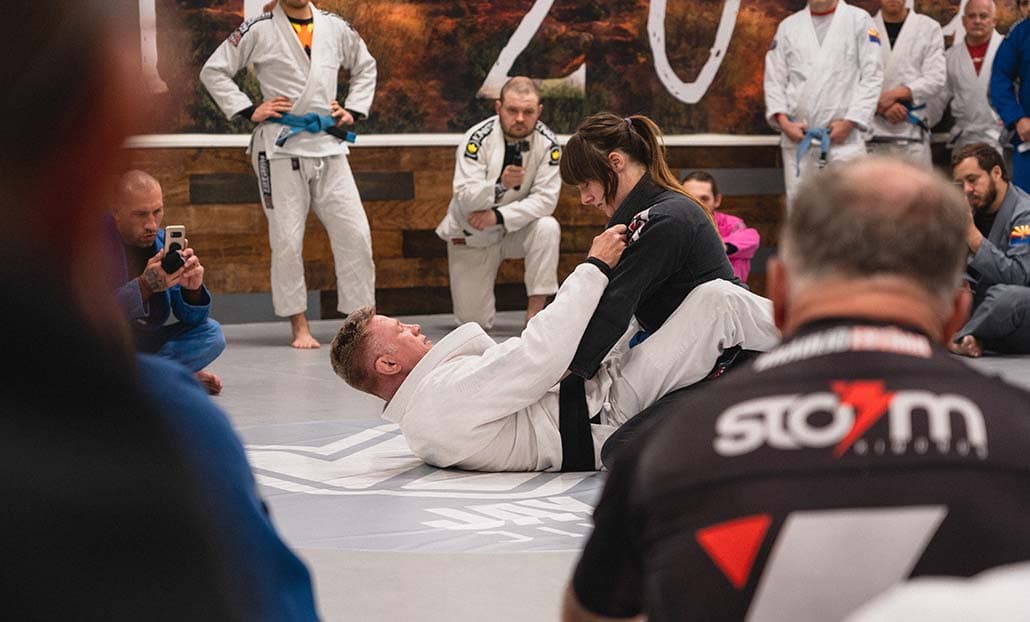
Main photo: Mike Calimbas, via Dominyka Obelenyte; archive competition photograph.
The takeaway
Dominyka Obelenyte's 2015 and 2016 Worlds results establish two consecutive double-gold editions at black belt. The weight categories changed, the open-class podiums changed, and she finished first twice at each championship.
Her own account also keeps Emily Kwok in the development story and identifies Callie Brennan as a partner in building Rag Doll Camps. Those details give the profile more substance than a title count alone, while leaving each achievement in its proper place.
Find the next useful training environment
Explore BJJ seminars on Let's Roll, then check the instructor, intended level, and practical arrangements before choosing an event.
FAQ
How many black-belt world titles did Dominyka Obelenyte win? She won four IBJJF black-belt world titles across 2015 and 2016: a weight division and the open class in each year.
Did she win the same weight category both years? No. The official results list heavyweight in 2015 and super-heavyweight in 2016, alongside her open-class victories in both editions.
Who awarded Obelenyte her black belt? Her own biography identifies Marcelo Garcia and dates the promotion to January 2015. It also credits Emily Kwok with bringing her to Garcia's academy earlier in her development.
What is the connection to Rag Doll Camps? Obelenyte's biography identifies her and Callie Brennan as co-founders in July 2017. Check the organizers' current information for any specific event, instructor lineup, or booking arrangement.

Miles Serrano
Miles Serrano writes about competitors and the decisions that shaped their careers. He is more interested in the adjustment someone made in the third minute than in the medal count afterward.
Related Posts
Choosing a BJJ seminar worth your time and travel
Choose a BJJ seminar by the subject, teaching format, access, and total cost. Know what to ask the host before buying a ticket.

Claudio Calasans and the second bracket of ADCC 2015
Claudio Calasans won gi Worlds and ADCC absolute gold in 2015. The separate brackets tell a better story than a simple comeback slogan.

A university BJJ club needs a plan for after graduation
Keep a university BJJ club running after graduation with clear coaching arrangements, newcomer information, and a practical committee handover.
Comments (0)
Loading comments...