
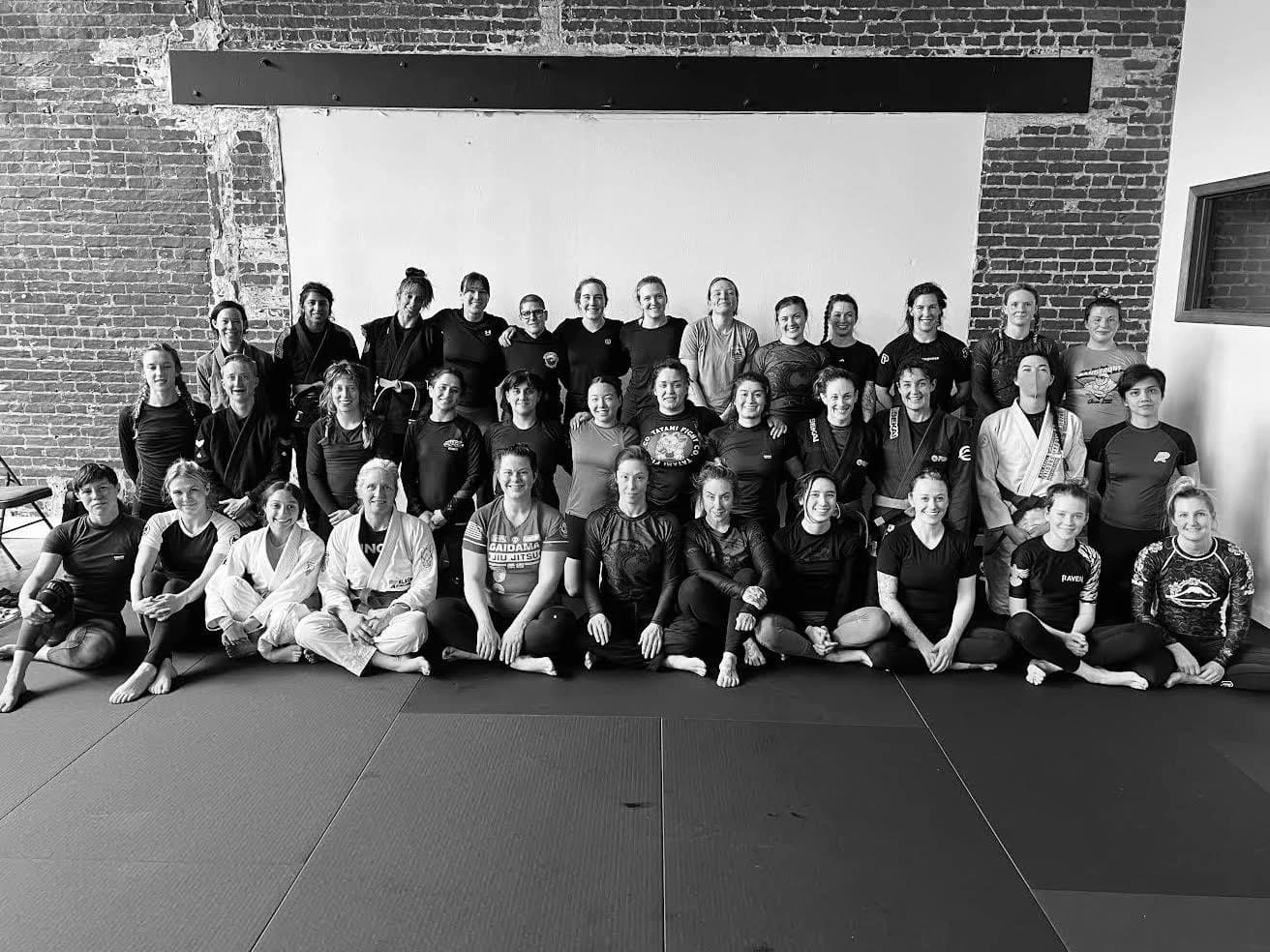
Women’s open mats create a different kind of training room
Quick answer: A women's BJJ open mat brings eligible participants together for training outside a regular class, often across academy affiliations. Check the organizer's experience requirements, age policy, and gi or no-gi format before attending. The best use of the session depends on what each person wants to practice, not an assumption that every woman arrives for the same reason.
A room with more possible partners changes the choices available during a training session. Someone looking for competition rounds may find an appropriate match. Someone trying a position may find another person willing to repeat it. Those are ordinary training needs, and a gathering across several academies can make them easier to meet.
A women's open mat can also be a place to meet people who train at different times or in different neighborhoods. That social value does not require describing every attendee as isolated at her home gym. The invitation can stand on what the event offers: more people, more potential rounds, and time to train together.
Start with the actual invitation
Read the event description rather than relying on the words open mat alone. Some sessions accept beginners with no previous experience; others require an existing training background. Age limits, registration, and eligibility policies can also differ. The host should be the source for those details.
Oregon Grappling Arts, for example, describes its women's open mats as open across affiliations while requiring participants to have an active membership at a grappling gym and complete a waiver. Its stated age threshold is sixteen. Those are that organizer's conditions, not a definition that applies to every women's event.
Ask privately if the invitation leaves an eligibility question unclear. That lets the organizer explain its policy without requiring someone to discuss personal information in a public comment thread. A clear answer before traveling is better than uncertainty at the door.
Also distinguish an open mat from a structured introductory class. If you have never trained, ask which session provides instruction suited to your first visit. A room full of available training partners is not automatically a replacement for a first lesson.
Let different training goals coexist
An attendee might want several hard rounds before a tournament. Another may want controlled positional work, and another may be returning after time away. The event does not need one shared intensity to be successful. It needs a way for people to communicate their preferences and find compatible partners.
Introduce yourself and say what you are looking for before the round begins. Ask the other person the same question. If the goals do not match, it is fine to choose a different partner or agree on a limited exercise that works for both of you.
Avoid reading competitive ambition from appearance, size, or how sociable someone is between rounds. Ask. Equally, do not treat a decision to rest as an invitation to persuade someone into one more round. The session should leave each participant control over how she uses the time.
A host can help by announcing how rounds will work and whether there is space for drilling. Separating those activities clearly can prevent a pair practicing slowly from being crowded by a faster exchange beside them. The available mat space should determine the arrangement.
A larger network can begin with one repeat partner
You do not have to meet everyone in the room for the visit to be useful. One good round followed by a short conversation can be enough to establish a future training connection. Ask which sessions the other person attends and whether she is comfortable sharing contact details.
Make any follow-up specific and low pressure. You could ask about the next open mat or an academy's visitor procedure. Do not assume that exchanging an account name creates an obligation to coordinate training, provide coaching, or join a new group chat.
The broader women's grappling community includes formats beyond open mats. Women Who Fight describes its work as bringing women together through jiu-jitsu and has organized international camps since 2023. A camp and a local open mat involve different commitments, but both show that training connections need not stop at one academy's membership list.
For someone with limited time or money, a nearby event may be the more practical choice. There is no need to make community participation into another expensive training goal. Start with a session you can attend and a conversation you actually want to continue.
Good hosting makes the first ten minutes easier
A visitor should be able to work out where to check in, where to put a bag, and how to join the training. Clear information reduces the amount of social guessing required before the first round. It also helps the host spend less time repeating logistical answers.
Useful event information includes:
Eligibility, experience requirements, and the registration process.
Gi, no-gi, or mixed-format expectations.
The fee, if any, and what attendees need to bring.
How rounds, drilling space, and breaks will be organized.
A contact for questions before the event.
At the session, a brief welcome can explain who is supervising and how to raise a concern. That does not need to become a long speech. People mainly need to know how the room works and whom to approach if something is unclear.
If the host wants to introduce visitors, ask first rather than turning everyone into a compulsory public biography. Some people enjoy that moment; others would prefer to start with a partner. A welcoming room can accommodate both without interpreting either preference as a lack of enthusiasm.
Keep ordinary partner responsibilities visible
A women's session still needs the same attention to consent, pace, and technique selection as any other training room. Agree on the round, respect taps, and communicate before changing the task. Shared participation in the event does not remove differences in experience or physical size.
If you are practicing a submission unfamiliar to your partner, ask the supervisor for appropriate guidance. Do not use the open mat as a place to test something neither person understands. The fact that a movement appears in a video does not establish that it belongs in this exchange.
Size differences also deserve an explicit conversation. You can choose a starting position or task that works for both partners rather than pretending the difference is irrelevant. Our guide to positional rounds with a size mismatch offers ways to make that discussion concrete.
If a pairing is not working, stop and speak to the host. You do not need to finish every round to be a good guest. The organizer should help maintain the event's expectations without asking participants to negotiate a persistent problem on their own.
Photographs are a separate invitation
A group photograph can help promote the next event and preserve a record of the gathering. Participation should still be a choice. Ask before photographing identifiable people and explain where the image is intended to appear. Attendance is not an automatic agreement to be used in marketing.
Offer a simple way to stay out of the picture without making someone explain why. If the session includes younger participants, follow the organizer's guardian-consent process. Avoid attaching names, locations, or account tags that the pictured people have not agreed to share.
The same care applies to filming rounds. Get permission from the people involved and consider who else is visible in the background. A useful training clip does not need to become a public reel. Agree on the intended use before pressing record.
For hosts, a short photo policy in the event information can prevent awkwardness later. It lets people decide what they are comfortable with before the session and gives photographers a clear instruction to follow. The policy should be easy to understand and easy to act on.
Make a return visit possible
Before leaving, check where the organizer announces future sessions. Do not rely on a screenshot of an old event poster being passed around indefinitely. Dates and formats can change, and the next gathering may have a different registration process.
If you enjoyed a particular aspect of the session, tell the host specifically. A useful comment might concern the availability of drilling space or how the check-in worked. That gives the organizer more to use than a broad statement that everything was good.
If you want to organize something similar, begin by discussing space and supervision with an academy rather than announcing a date first. Estimate how many people the room can comfortably accommodate and how you will communicate the format. A modest session that runs clearly is a sound starting point.
Keep the purpose local and concrete. You are arranging an opportunity for people to train together. It does not need to represent every woman's experience of jiu-jitsu or carry the burden of solving every participation problem in the sport.
Main photo: Oregon Grappling Arts; women’s open-mat archive photograph.
The takeaway
A women's open mat works best when its invitation is clear and its participants can choose suitable training. Check the host's requirements, explain what you want from the session, and respect the different goals of the people around you.
The lasting value may be a useful round, a new practice partner, or simply a session you would like to attend again. None of those outcomes requires a dramatic story. They require a room that is organized well enough for people to use it.
Find a session near you
Browse open mats, then confirm the current format and eligibility details directly with the host.
FAQ
Can beginners attend a women's BJJ open mat? It depends on the organizer. Some welcome complete beginners, while others require previous training or gym membership. Ask before attending if you need introductory instruction.
Do I have to belong to the host academy? Some events welcome all affiliations, but check the specific invitation. Open mat does not automatically mean unrestricted public attendance.
Are all rounds expected to be competitive? No single intensity should be assumed. Discuss your goals and the intended pace with each partner, and follow the host's format.
Can I attend without appearing in event photos? Tell the organizer your preference before photographs are taken. Hosts should make photo participation separate from the decision to attend training.

Rafael Moura
Rafael Moura profiles competitors as people with lives outside the bracket. Some of those stories are comebacks. Most are not, and he does not force them.
Related Posts

Mikey Musumeci gives up the belt to make room for MMA
Musumeci is vacating his UFC BJJ title to focus on MMA training. What he is leaving, what continues, and why the transition matters.
IBJJF membership: finish the paperwork before the deadline
IBJJF membership and tournament entry are separate steps. Plan documents, professor approval, renewals, and junior accounts before registration closes.
Choosing a BJJ seminar worth your time and travel
Choose a BJJ seminar by the subject, teaching format, access, and total cost. Know what to ask the host before buying a ticket.
Comments (0)
Loading comments...