
BJJ training games need a question worth answering
Quick answer: A useful BJJ training game gives both partners a clear task, a defined starting position, and an agreed stopping point. Change the rules to bring attention to a specific problem, then check whether the resulting behavior is useful when the restrictions are removed. Games still need coaching and ordinary safety boundaries.
A room can be busy without working on the problem the coach intended. Partners move, rounds finish, and somebody wins the little contest. The important question is what they had to notice to win it.
That is where a BJJ training game earns its place. Restricting a round should make a particular exchange easier to encounter and examine. A rule that merely makes the exercise strange has not necessarily improved it.
The examples here are proposed practice designs for a coach to adapt, not claims that one teaching system outperforms every alternative. The target is a better-designed exercise, not a vote in an argument about how all jiu-jitsu should be taught.
Begin with the problem the full round keeps hiding
Choose something specific enough to observe. Improving guard is too broad for a short exercise. Recognizing when a partner has cleared your feet is a more useful starting question. It points toward an event both people can identify.
A full round may pass through that event only briefly. A constrained starting position lets the pair return to it without first completing several unrelated exchanges. That is the practical reason to narrow the round.
Rob Gray's resources on the constraints-led approach describe constraints as boundaries that discourage some movement solutions and invite others. Applied here, the idea is to shape which choices are available rather than simply order a participant to perform a memorized sequence.
The design still needs a reason. If you remove gripping, standing, or changing sides, identify what that restriction is supposed to make easier to explore. Do not assume that fewer options automatically produce a more useful exercise.
Write the problem in one sentence before choosing the rules. If the sentence contains several unrelated skills, split the work. You can combine the pieces later, after the coach has seen what each exercise actually produces.
Give both partners an active job
An exercise becomes clearer when each person can explain their own goal. The top player should know more than that they are supposed to provide resistance. The bottom player should know more than that they should try something.
Consider a hypothetical seated-guard game with no submissions. One partner tries to establish an agreed, controlled position beyond the legs. The other tries to keep their legs between the partner and their torso. The coach must define what counts as establishing the position and which movements are permitted for this group.
That description is a sketch, not a ready-made universal drill. A beginner class may need a different start, pace, or stopping point from an experienced group. The coach should demonstrate the boundary before the pair begins.
Both tasks must remain possible. If one person can win immediately from the initial setup, the exercise may mostly test who reacts first to the start signal. Adjust the arrangement so the intended decision actually appears.
Switch roles. A student who always performs the preferred side may miss information available from the other position. Taking the opposing job also makes it easier to explain what stopped the first attempt.
Define the reset before someone asks for one
A game needs an ending that both participants recognize. Without it, one person may believe they have completed the task while the other continues toward a submission that was never part of the exercise.
Decide what ends a repetition, what counts as a neutral restart, and who begins in each role. Keep those instructions short enough to remember during movement. A complicated scoring system can pull attention toward administration instead of the exchange.
Before starting, confirm:
The starting position and each person's objective.
The permitted actions, pace, and ordinary stop signals.
The event that ends the repetition and how the pair resets.
A tap or request to stop always ends the action. A game rule does not override that. Removing submissions from an exercise also does not remove the need to control movement or protect a partner from collisions.
Choose sufficient space and follow the coach's instructions about standing, falling, and boundaries. If the pair repeatedly leaves the available area, change the exercise rather than allowing momentum to decide where practice happens.
The reset is part of the design. It should return the partners to a useful question without giving either person an unannounced advantage.
Change one feature when the game stops asking anything
An exercise can become too predictable. One person finds an easy answer, repeats it, and no longer needs to respond to the partner. At that point, the coach should inspect the task before demanding greater effort.
Perhaps the initial grip makes escape unrealistic. Perhaps the distance is so large that the defender can simply retreat. Perhaps a rule excludes the response that would make the exchange interesting. These are possible design problems, not diagnoses you can make from the score alone.
Change one feature and watch again. Move the starting connection, alter the permitted direction, or redefine the endpoint. Avoid changing all of them at once; that makes it harder to understand why the next repetitions look different.
Ask both participants what they noticed. Their answers may reveal that they interpreted the instructions differently. Correcting that misunderstanding is more useful than building another layer of rules around it.
A coach can also stop and demonstrate a relevant option. The exercise does not become invalid because someone receives an explanation. The practical concern is whether the explanation helps the pair work on the intended problem when movement resumes.
Watch for a loophole that teaches the wrong lesson
People can become good at winning a small game in a way that has little value outside it. That does not make them dishonest. They may be responding exactly to the incentives the rules provide.
Imagine a hypothetical control game in which a brief touch counts as success. A player might rush in, make contact, and immediately lose position. If the real target was stable control, the success condition rewarded a different behavior.
The coach can revise the endpoint so the player must demonstrate the intended control at an appropriate pace. The particular criterion belongs to the exercise; it should not be confused with a tournament scoring rule unless competition rules are explicitly being practiced.
Look for patterns such as:
Winning without encountering the movement problem the game was designed around.
Stalling because the rules offer no reason to attempt progress.
Rushing the endpoint in a way that defeats the agreed level of control.
Do not respond to every unexpected solution by banning it. An unfamiliar answer may be useful. Ask whether it survives the purpose of the exercise and the partner's legitimate responses before deciding that it is a loophole.
Return the missing choices a little at a time
A narrow game can clarify a problem while leaving out much of the surrounding round. Once participants understand the task, restore a relevant option and see what changes. The original answer may need adjustment when the partner has more freedom.
For example, the coach might allow a previously excluded direction of movement or start the pair one step earlier. That creates a new question: can the player still reach the useful exchange, or did the starting position do that work for them?
This is a practical test of the exercise's relevance. Success under restrictions should not be treated as proof that the same choice will work in every live round. Conversely, difficulty in a broader round does not make the earlier practice pointless. It may identify the next part that needs attention.
Keep the transition within the participants' experience and the academy's rules. Adding complexity does not require adding dangerous submissions or greater speed. The coach can widen the available decisions while retaining a controlled setting.
Our guide to learning from different BJJ coaches addresses a related habit: preserving the context that makes an instruction useful. The same care applies when you carry an answer from a small game into a larger exchange.
Record what the exercise revealed
A score can tell you who completed the assigned task more often. It cannot, by itself, explain what either person learned. Add a short observation before moving on.
The observation might concern timing, a connection that repeatedly disappeared, or a response the player did not notice until their partner described it. Keep it tied to the exercise rather than making a sweeping judgment about someone's talent.
If you are a student, ask the coach what to carry into the next round. You do not need to redesign the class yourself. A clear question about why the game was difficult may give the instructor enough information to make the next repetition more useful.
If you are organizing informal practice, get the host's approval for the activity and invite partners rather than imposing it. Agree on the scope before starting. A person who arrived for ordinary open mat may prefer a different kind of round.
The final note should be small enough to use: this was the problem, this was the response, and this is what we will examine next. A training game has done useful work when it leaves the pair with a clearer exchange to study.
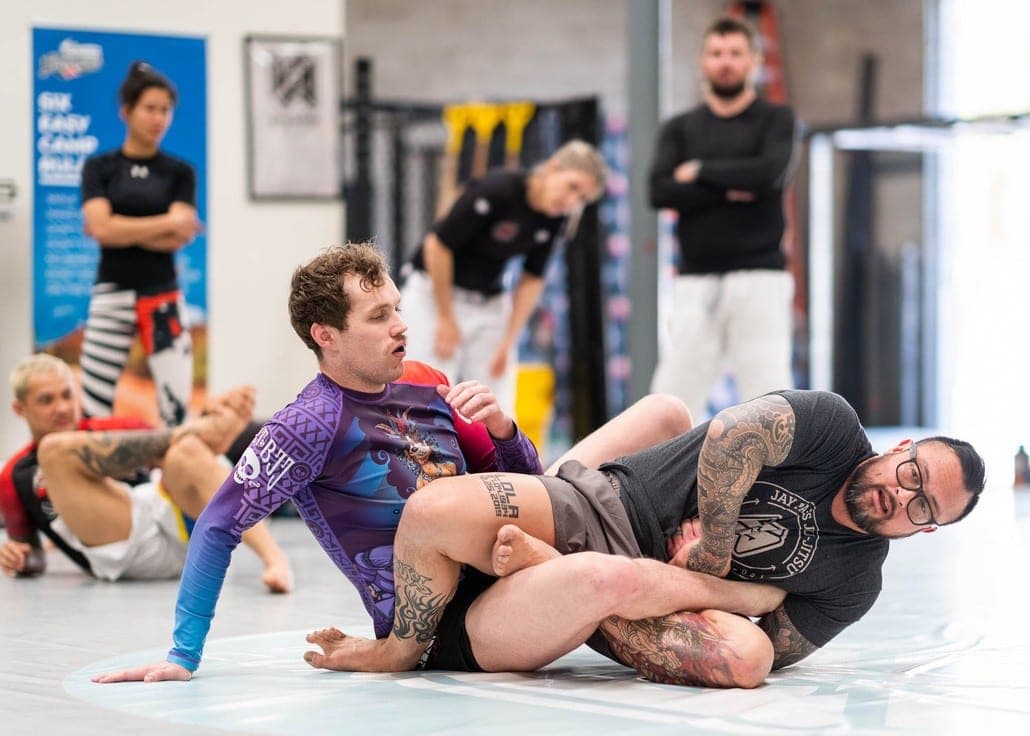
Main photo: BJJ Globetrotters; illustrative archive photograph.
The takeaway
A BJJ game needs a technical purpose that survives its rules. Define the problem, give both partners meaningful tasks, and establish the reset. Then watch what the rules actually encourage rather than assuming the design worked because everyone stayed busy.
Use the outcome to adjust the next exercise and test the idea with more choices available. The aim is a useful practice conversation between partners and coach, with clear boundaries and enough room to discover that the first design needs changing.
Find a place to practice with guidance
Explore jiu-jitsu academies on Let's Roll and ask how the appropriate class combines instruction, positional work, and supervised rounds.
FAQ
What is a constraint game in BJJ? It is a practice exercise that limits or shapes available actions around a task. The useful details are the starting position, each partner's objective, permitted actions, and reset condition.
Are training games better than drilling? This guide makes no universal superiority claim. Judge an exercise by the problem it addresses and what the coach observes. Explanations, repetitions, games, and broader rounds can serve different purposes.
Can beginners use constrained games? A coach can adapt a task to their experience, with clear safety boundaries and simple objectives. Beginner suitability depends on the actual exercise, not on whether it has been called a game.
What if one person always wins? Ask the coach to inspect the starting position, rules, and task difficulty. Repeated wins may reflect a skill difference, but they may also reveal an exercise that gives one role too little meaningful choice.

Nina Okada
Nina Okada explains positions the way a good training partner does: one problem at a time, with the limits of the explanation said out loud. She is careful about the difference between what footage shows and what it only suggests.
Related Posts

Mikey Musumeci gives up the belt to make room for MMA
Musumeci is vacating his UFC BJJ title to focus on MMA training. What he is leaving, what continues, and why the transition matters.
IBJJF membership: finish the paperwork before the deadline
IBJJF membership and tournament entry are separate steps. Plan documents, professor approval, renewals, and junior accounts before registration closes.
Choosing a BJJ seminar worth your time and travel
Choose a BJJ seminar by the subject, teaching format, access, and total cost. Know what to ask the host before buying a ticket.
Comments (0)
Loading comments...