
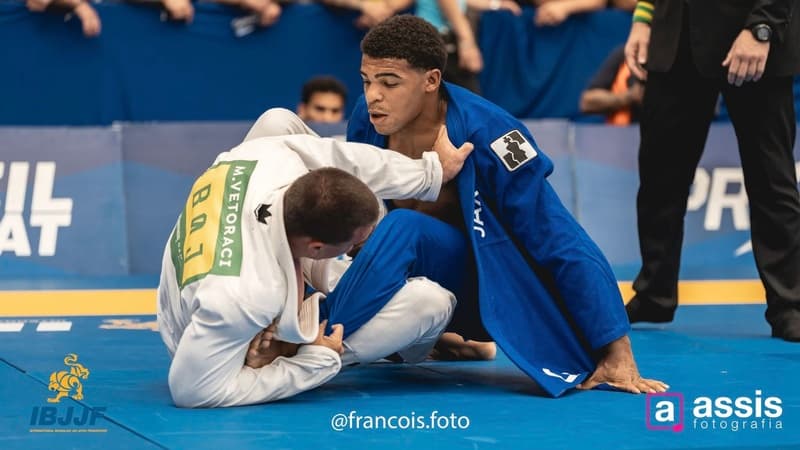
The toreando pass starts before you run around the legs
Quick answer: The toreando pass is more than moving quickly around someone’s legs. Your grips, distance, and angle must work together, and the pass still needs a controlled finish after you clear the feet. Learn one variation with your coach and practice the moment when the bottom player tries to recover a knee.
Getting past the feet can feel like passing the guard until the knees arrive again. You have moved to the side, your partner has turned with you, and the same pair of legs is back between your chest and theirs.
The toreando is a useful place to study that problem. It makes the difference between going around the guard and finishing a pass difficult to ignore. Speed can help a coherent movement, but it cannot explain which part of the guard you have actually cleared.
Start with one version and a clear distance
Different toreando variations use different grips and finishing routes. Start with a single version from your coach so that the hand position, footwork, and ending belong to the same lesson. Combining the opening from one demonstration with the finish from another can leave a gap you do not recognize.
Pay attention to the starting distance. If you cannot establish the required connection without leaning out of balance, the starting arrangement may already need adjustment. If you stand where the guard player can immediately engage your legs, you may be practicing a different problem from the one the coach demonstrated.
Ask what the first grips are intended to control. Naming them is less useful than understanding their job. The answer should connect the opponent’s legs to the route you intend to take around them.
Repeat the entry slowly enough to notice whether you can keep your own base while making the connection. The pass should begin before the hurried attempt to reach the other side.
Let the hands and feet contribute to the same action
A common practice problem is moving the feet while the hands remain in a position that no longer supports the route. The body circles, but the grips do not meaningfully limit how the bottom player follows.
Another problem is trying to move the opponent’s legs entirely with the arms while the passer’s stance remains unchanged. That can make the movement feel like a pulling contest rather than a coordinated change of angle.
Use the coach’s demonstration to connect the two parts. Ask when the feet move relative to the leg control and how the grips should change as the angle changes. Do not assume the instruction is simply to push harder or run faster.
In early repetitions, stop after the first movement and check your balance. If you cannot pause without falling into the partner or taking an extra recovery step, show that moment to the coach. It is easier to adjust a clear starting movement than to diagnose an entire fast pass after it has failed.
Clearing the feet leaves more work to do
The bottom player’s guard is not represented only by the soles of the feet. Knees, hips, and frames can still affect the space you need to occupy. Reaching a position beside the legs does not automatically place your torso beyond every recovery route.
Watch what the bottom player does next. If a knee comes back between you, identify when it became free to move. If the hips follow your circle, notice whether your angle actually changed relative to the torso or whether both of you simply rotated together.
The open-guard guide provides a broader view of those connections. For the toreando, keep the question narrow: which part of the guard remains able to return during your chosen finish?
This is why a cooperative partner should not go motionless the instant you pass their feet. Once the basic sequence is understood, an agreed recovery attempt gives the passer a more useful test of the movement.
Study the finish as its own piece of training
A pass needs an ending that you can control. Learn where the upper body, hips, and base should arrive in your variation before adding a submission or another transition. Otherwise, the attempt can end with you reaching across open space while the guard player recovers underneath.
The connection between an outside pass and its follow-up is also a recognized teaching topic. Lachlan Giles’s around-the-legs retention course includes several ways the bottom player can recover against a toreando, including bottom-leg and top-leg recovery. That outline is a useful reminder that getting around one obstacle does not remove every defensive option.
For your own practice, ask the coach to isolate the final part. Begin near the point where you usually lose the pass and work on establishing the intended control from there.
Keep the movement measured. Do not drop your weight onto a partner to compensate for uncertainty about where it belongs. A controlled landing is part of the technique, not a courtesy added after learning it.
Give the bottom player a specific assignment
Once both partners understand the basic movement, use a constrained exercise to test one recovery route. The bottom player might be asked to recover a knee, square the hips, or maintain a particular frame, depending on the lesson.
Let the coach set the starting grips and the permitted actions. The purpose is to learn whether a particular part of the pass works against a recognizable response. Unlimited resistance too early can make every failed attempt look the same.
Agree on a few details:
Which toreando variation you are practicing.
What the bottom player is trying to recover.
What counts as a completed pass or a reset.
The pace and the signal to stop.
There is a coaching precedent for organizing the pass this way. Giles Garcia’s toreando drilling lesson describes using positional tasks with constraints to work on the basic pass. Your own coach can choose an exercise appropriate to your level.
Change direction because of a response
Side-to-side movement can be useful, but it needs a purpose. If you switch direction without noticing what the guard player has done, you may simply give them repeated chances to reset their position.
Ask the coach which response makes a direction change appropriate in the variation being taught. It may relate to how the opponent turns or how a particular leg remains controlled. Learn that cue rather than adding a second movement because the first did not immediately succeed.
You should also know when to stop insisting on the pass. A changed guard configuration may call for resetting the grips or choosing another route. That is a technical decision to develop through instruction, not a failure of commitment.
Keep the first practice set simple. One direction change linked to one clear reaction is easier to assess than a long sequence of feints. Once the relation between response and movement is understood, the sequence can become more open.
Gi and no-gi need their own grip details
Do not assume that removing the pants grips leaves every other detail unchanged. If you want to use a toreando-style pass without the gi, ask for a version taught with the hand placement and contact available in no-gi.
The broad problem of going around the legs remains recognizable, but the particular connection needs to be learned. A grip that feels secure in fabric may not exist in the same form without it. Trying to reproduce the old sensation can distract you from the actual task.
Our discussion of gi and no-gi training covers the larger differences. For this pass, stay with the specific setup in front of you and follow the rules and safety expectations of the class.
Practice each version as a coherent sequence. Once both make sense, compare what carries over and what changes. That comparison is more useful than declaring the two identical because they share a name or unrelated because the clothing differs.
Measure progress before you count full passes
A completed pass is one outcome, but early practice can reveal progress in smaller parts of the exchange. You may establish the intended grips more consistently, keep your base during the angle change, or recognize the recovery attempt sooner.
Choose one of those observations with the coach. If every repetition is judged only as success or failure, you may miss the part that has improved and the different part that still needs work.
When the pass fails, describe the sequence accurately. Did you lose the first connection, get followed by the hips, or fail to settle after clearing the legs? Those are different questions. A useful correction depends on identifying which one happened.
After a short set, change roles and experience the recovery yourself. Feeling when the bottom player has room to move can sharpen the next question you ask as the passer. Then return to the version being taught with one adjustment rather than a completely rebuilt game plan.
Main photo: IBJJF; illustrative archive photograph.
The takeaway
The toreando begins with distance and useful leg control, continues through a coordinated angle change, and ends with a settled position. Getting beside the feet is only part of that work.
Learn one variation, practice its finish, and test it against a defined recovery. When the guard returns, locate the moment that made the recovery possible. That gives you something concrete to improve before adding speed or more combinations.
Work on the pass in a suitable class
Find BJJ gyms on Let’s Roll and ask a coach to watch the exact part of your toreando where the guard comes back. A short, specific demonstration of the problem can make the correction clearer.
FAQ
Is the toreando just a speed pass? Speed can be part of the movement, but the grips, distance, angle, and finish still need to work together. Moving faster does not automatically solve a gap in control.
Why do I get around the feet but fail to pass? The bottom player may still be able to recover a knee, follow with the hips, or establish a frame. Identify the particular recovery with your coach and practice that section of the finish.
Can the toreando be used in no-gi? Toreando-style outside passing can be taught in no-gi, but learn the appropriate hand placement and control rather than assuming fabric grips transfer unchanged.
How should beginners practice the pass? Start with a coach-taught variation and cooperative repetitions, then add a clearly defined recovery task at an agreed pace. Keep the landing controlled and stop when either partner needs to reset.

Nina Okada
Nina Okada explains positions the way a good training partner does: one problem at a time, with the limits of the explanation said out loud. She is careful about the difference between what footage shows and what it only suggests.
Related Posts
Jiu-jitsu in Montreal: build the visit around a real class
Plan BJJ training in Montreal around confirmed classes, language arrangements, winter travel, visitor policies, and equipment that is ready to use.
Competing in gi and no-gi on the same day takes two plans
Prepare for gi and no-gi competition on the same day with separate rule checks, complete outfits, schedule coordination, and a realistic second-bracket plan.
BJJ gi pants that fit standing up can still fail on the mat
Check BJJ gi pants at the waist, rise, knees, and cuffs so a good-looking size label becomes a uniform you can actually move in.
Comments (0)
Loading comments...