
BJJ with shift work: build a plan that can move
Quick answer: If you work changing shifts, plan BJJ around the roster you actually receive rather than a permanent Monday-to-Friday routine. Choose a few usable class options, confirm that your membership covers them, and carry one training question between sessions. When work changes the plan, choose the next realistic class instead of trying to repay every missed one.
A Tuesday evening class is only a routine if Tuesday evening belongs to you. For someone working rotating shifts, a perfectly sensible gym schedule can become unusable the moment the next roster appears. The problem is not necessarily commitment. It may be a calendar designed for a different job.
There is no single weekly template that fixes this. A more useful approach is to create a short menu of options, then make the decision when you know which hours are available. The routine lives in how you choose, even when the class time changes.
Use the roster's cycle as your planning unit
If work releases shifts every two weeks, start by looking at those two weeks together. If the pattern repeats over a longer cycle, use that cycle. A calendar week is convenient for the gym, but it does not have to be the only unit you use to understand your attendance.
Consider a hypothetical fortnight with several evening shifts in the first week and more free evenings in the second. A rigid twice-every-week target may leave you feeling behind before the second week starts. A plan made across the actual fortnight can distribute the available classes without pretending the weeks are identical.
This is a planning suggestion, not a prescribed training dose. Your available time, recovery, and responsibilities still govern the choice. The purpose is to stop measuring an irregular schedule against a regular one and then blaming yourself for the difference.
Once the roster arrives, choose the next few sessions. Leave later uncertainty unresolved instead of filling the calendar with optimistic appointments you already expect to move. A smaller confirmed plan is easier to act on than a complete imaginary month.
Build a short menu of usable classes
A gym with many sessions may still have only a few that work for you. Check which classes accept your experience level, whether they are gi or no-gi, and whether the timetable represents instruction, open mat, or something else. A time slot is useful only if the session inside it fits.
Choose a small set of options:
A class that usually fits your most common shift pattern.
An alternative for the weeks when that time is unavailable.
An occasional option, such as a weekend session, that you can confirm when needed.
Then check membership access and booking requirements. Some programs separate class types or require advance reservations. Do not assume that an unlimited-sounding membership description settles every access question. Ask the school how its actual system works.
Our guide to choosing a BJJ gym is useful here because the most attractive school on paper may offer fewer reachable sessions than a quieter option nearer your route. Compare your realistic attendance, not the total number of boxes on each timetable.
Count the time on both sides of class
The class itself is not the entire commitment. Travel, changing, shower access, and whatever happens immediately afterward determine whether a session works. A noon class can fit between shifts in theory and fail as soon as you include the trip back.
Walk through the actual sequence before calling it an option. When must you leave home? Where will your work clothes be? Is there somewhere appropriate to clean up? What time do you need to be at the next obligation? Use a realistic route, including the part where you find parking or wait for transit.
There is no need to optimize every minute. In fact, a plan that depends on every connection going perfectly may be too fragile to use regularly. Leave enough room that an ordinary delay does not turn training into an argument with the clock.
The same applies after a late class. Think about the whole evening rather than treating the end of the final round as the end of the commitment. If the session leaves no workable transition to the rest of your life, it belongs in the occasional column rather than the default plan.
Explain the pattern once, clearly
Your coach does not need every detail of your job. They do need enough information to understand why you may appear in different classes or miss a recurring sequence. Explain that the roster changes and ask how best to keep track of the curriculum.
A specific request is easier to answer than a general apology. Ask which class to attend when returning mid-topic, whether there is a beginner sequence to complete, or whom to ask for a brief recap. Do not ask the instructor to create an entirely separate course unless that is a service you are arranging together.
You can also let a regular training partner know which sessions you expect to make. Treat that as coordination, not a promise that employment will never interfere. If plans change, send a short update when useful and return to the next available session.
Repeatedly apologizing for having a job takes time without improving the schedule. Give the relevant information, make the next choice, and let your attendance pattern be the pattern you can sustain. A useful school conversation should leave you with a clear next step.
Carry one technical thread between different rooms
Changing class times can mean changing instructors, partners, or weekly topics. You do not need to force every session into one syllabus of your own. You can, however, carry a small question from one class to the next.
Choose something specific enough to recognize during practice. Perhaps you keep losing the inside position while trying to recover guard. Perhaps a pass begins well but stops when the partner turns onto a side. Write the question in plain language and ask an appropriate coach when there is time.
The next class may cover something else. Follow that instruction. During permitted drilling or suitable rounds, return to your question rather than trying to reconstruct every lesson you missed. A simple BJJ training journal can hold the thread without becoming a second roster-management system.
Afterward, add only what changed: a detail you understood, a reaction you noticed, or a question that became narrower. The value is continuity. You should be able to open the note after several days and understand what you meant without conducting an investigation into your previous self.
Make the backup modest enough to use
A backup is most useful when it is genuinely easier to arrange. Replacing one missed class with an elaborate home session, a long video course, and extra conditioning can create more work than the original plan required.
If you cannot attend, a modest alternative might be reviewing one familiar lesson or checking the next available class. Neither is equivalent to live training. It simply keeps the next step visible. You are allowed to miss a session without inventing a substitute that looks impressive in a notebook.
Be particularly careful about turning spare time into unsupervised experiments. A video that looks straightforward is not a reason to attempt unfamiliar throws or submissions at home. Keep technical practice within what your coach has taught and what your space and partner arrangements can support.
Sometimes the backup is no training that day. If you are too tired to participate or travel safely, do not make the calendar the deciding authority. Questions about persistent sleep or health problems belong with an appropriate professional, rather than a more ambitious attendance target.
Review the system without putting yourself on trial
After a full roster cycle, look at what happened. Which planned sessions worked? Which failed for reasons you could have anticipated? Which class unexpectedly fit well? Use those observations to revise the menu.
A hypothetical plan might show that a weekend morning class is reliable while an after-work evening class is repeatedly lost to overtime. Moving the default toward the reliable option is useful planning. It does not require a story about becoming more disciplined.
Also consider what attendance felt like once you arrived. Did you spend the entire session worrying about leaving on time? Was the class level appropriate? Could you follow the instruction? A class that technically fits can still be the wrong regular choice.
Keep the review short. Choose one adjustment for the next cycle and try it. You do not need a percentage score or an explanation for every blank day. The aim is to make useful training easier to reach, not to produce evidence that you have been busy enough.
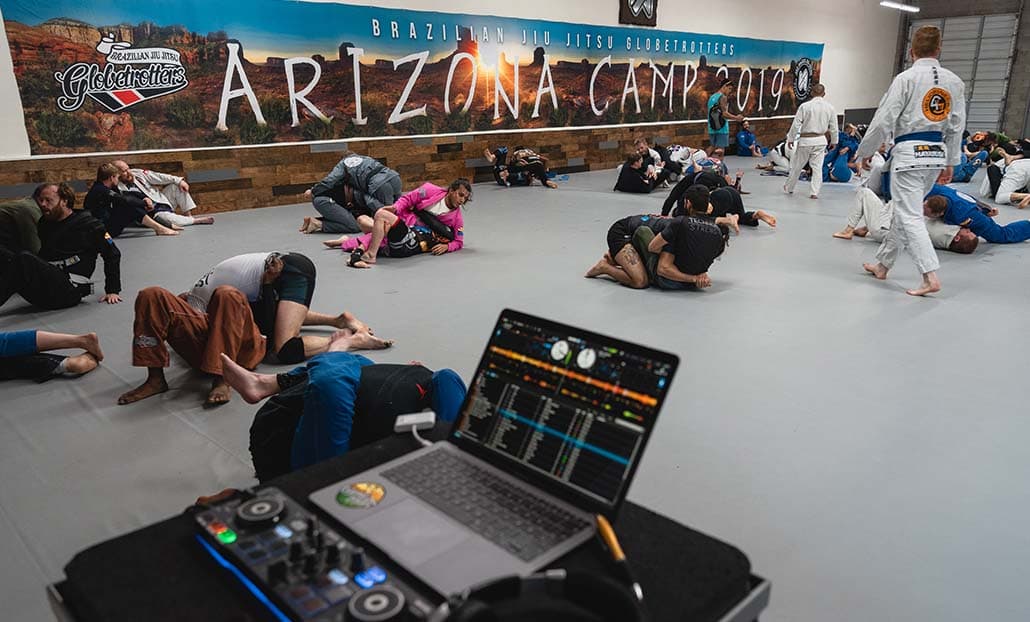
Main photo: BJJ Globetrotters; archive training-camp photograph.
The takeaway
Shift work calls for a repeatable decision process more than a fixed weekly timetable. Keep a short list of eligible classes, plan when the roster arrives, and carry one technical question between visits. Include the travel and transition time that makes an apparent opening usable.
When a week changes, revise the next class instead of trying to settle a debt to the previous plan. The next roster will arrive soon enough. A workable training system should be able to move with it.
Find the hours you can actually attend
Use Let's Roll's gym directory to build a shortlist, then confirm current class times and access directly with each school.
FAQ
Can I improve at BJJ with rotating shifts? An irregular timetable does not prevent you from practicing. Build around the sessions you can attend, ask for help maintaining continuity, and judge progress through specific skills rather than a perfect weekly streak.
Should I always train immediately after a shift? There is no universal answer. Consider whether you can travel and participate safely, along with the time needed for the rest of your day. Persistent fatigue or sleep concerns deserve professional guidance.
What if different class times cover different topics? Follow the class instruction and keep one small personal question for appropriate practice time. Ask your coach how to enter the current topic rather than trying to privately reproduce every missed lesson.
Do I need to make up every missed session? No. Reconsider the next available session using your actual schedule. Treating each absence as a debt can create a plan that becomes harder to follow every time work changes.

Owen Bellamy
Owen Bellamy writes for the person training twice a week around a job. Nothing he suggests requires quitting the job.
Related Posts

Mikey Musumeci gives up the belt to make room for MMA
Musumeci is vacating his UFC BJJ title to focus on MMA training. What he is leaving, what continues, and why the transition matters.

IBJJF membership: finish the paperwork before the deadline
IBJJF membership and tournament entry are separate steps. Plan documents, professor approval, renewals, and junior accounts before registration closes.

Choosing a BJJ seminar worth your time and travel
Choose a BJJ seminar by the subject, teaching format, access, and total cost. Know what to ask the host before buying a ticket.
Comments (0)
Loading comments...