
How to Choose the Right BJJ Gym
I spent two months visiting nine different BJJ academies before I committed to one. Not because I'm indecisive — because picking the wrong gym costs you more than money. It costs you time, motivation, and sometimes your love for the sport entirely.
As someone who's covered the BJJ scene professionally and trained at gyms on three continents, I've seen how dramatically culture varies from academy to academy. A gym that produces world champions might grind casual hobbyists into dust. A friendly neighborhood school might bore a driven competitor. The trick is knowing what you actually need.
Why Your Gym Choice Matters More Than Your Technique
Most people pick a gym based on proximity and price. Those are reasonable filters, but they shouldn't be your only ones. The academy you train at shapes your entire BJJ journey — the techniques you learn, the rolling culture you absorb, the community that keeps you coming back after hard weeks.
I've met countless blue belts who quit after two years, not because they lost interest in BJJ, but because their gym environment slowly wore them down. A hyper-competitive atmosphere, an unavailable instructor, or a clique-heavy culture can make training feel like a chore instead of a highlight.
Your gym is your second home. Choose it carefully.
The Research Phase: Doing Your Homework
Before you visit a single gym, do some preliminary research online. Check Google reviews, but read them critically — look for patterns rather than individual opinions. A single five-star review from the gym owner's friend tells you nothing. Twenty reviews that consistently mention friendly atmosphere, clean mats, and patient instruction tell you a lot.
Browse social media. Active gyms usually have Instagram or Facebook pages showing class footage, belt promotions, and community events. This gives you a window into the gym's culture before you walk through the door. You can also use our gym directory to compare academies in your area and read visitor feedback.
Make a shortlist of three to five gyms that meet your basic criteria — location, schedule, and price range. Then visit each one in person. Online research sets the stage, but mat experience makes the decision.
The Instructor: Credentials and Teaching Style
The head instructor's qualifications are non-negotiable. Look for:
Verifiable lineage: A legitimate BJJ black belt should be able to trace their lineage through a recognized chain of instructors. Ask who promoted them and verify it. This protects you from fake black belts, which are more common than you'd think.
Teaching ability: Some world-class competitors are terrible teachers, and some purple belt coaches are exceptional educators. Watch a class. Does the instructor break down techniques into clear steps? Do they circulate during drilling to give corrections? Can they adapt explanations for different learning styles?
Approachability: Can students ask questions without feeling awkward? Does the coach remember names? A good instructor makes every student feel seen, not just the competitors.
Class Structure and Schedule
Consistency is the biggest predictor of BJJ progress. A gym with world-class instruction won't help you if class times don't fit your life.
How many classes per week are offered at your level?
Are there dedicated beginner classes, or is everyone mixed in together?
What's the gi-to-no-gi class ratio?
Are there open mat sessions on weekends?
Does the schedule accommodate working professionals, parents, or students?
A gym offering 15 weekly classes is meaningless if none align with your availability. Three classes you can actually attend beat six you can't.
Mat Culture: The Invisible Factor
Mat culture is the hardest thing to evaluate from outside, but it's often the deciding factor in whether you stay or leave.
Visit during a regular class — not a trial class or a special event. Observe:
How do upper belts treat lower belts during sparring? Are they coaching or crushing?
Do students shake hands and chat between rounds, or does everyone keep to themselves?
Is the overall vibe intense and focused, relaxed and social, or somewhere in between?
How does the gym handle drop-ins and visitors? Welcoming or territorial?
Do students seem like they enjoy being there?
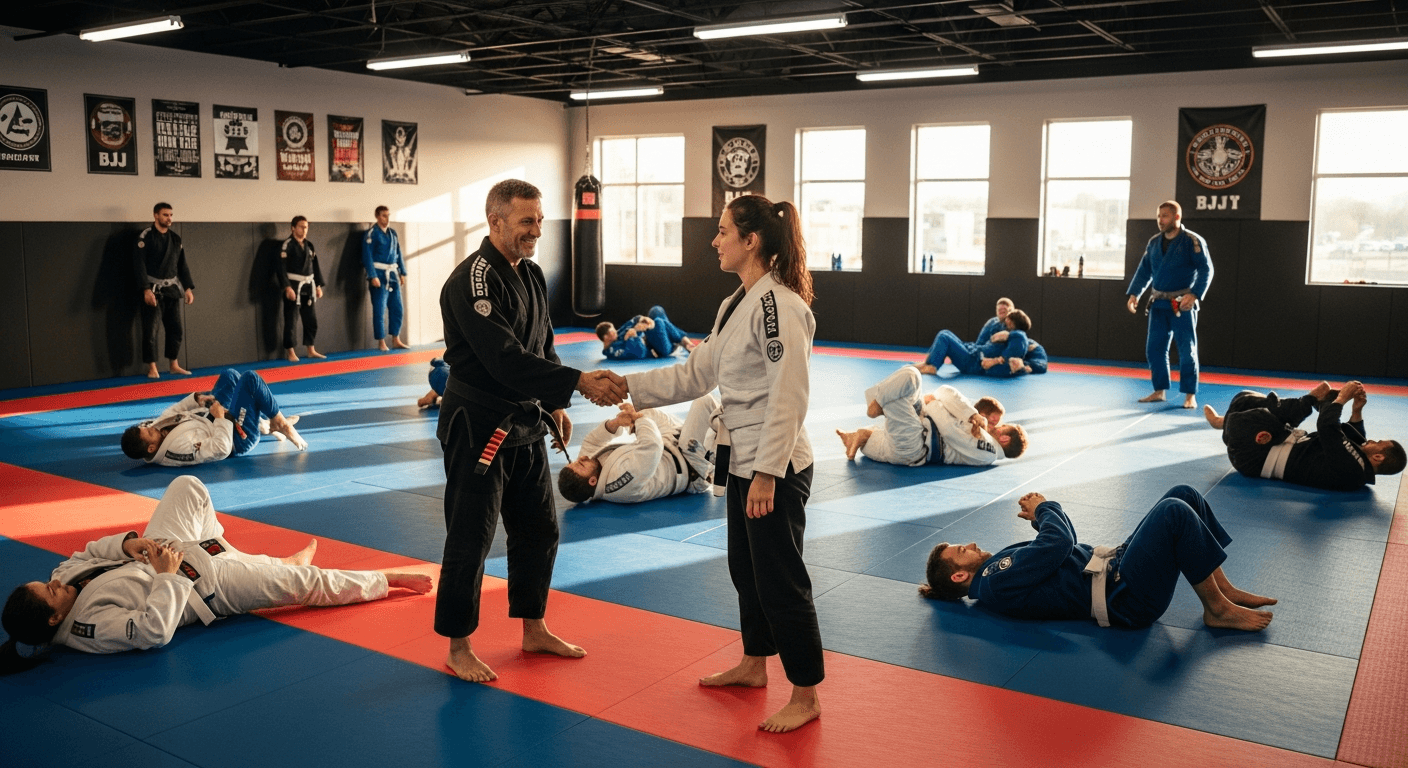
The faint squeak of bare feet on the mats, teammates high-fiving after a hard round, someone asking a purple belt to explain a detail — these small moments tell you more about a gym's culture than any website or Instagram page.
Hygiene and Facility Standards
This should be obvious, but hygiene failures are disturbingly common in martial arts gyms. Check:
Are the mats clean and disinfected between classes?
Is there visible cleaning product and a mop near the training area?
What condition are the changing rooms and restrooms in?
Does the gym have a clear policy on training while sick?
How quickly do they address skin infection concerns?
Staph infections, ringworm, and impetigo spread on dirty mats. A gym that skimps on cleaning is a gym that doesn't value its students' health. Walk away without hesitation.
Pricing: What's Fair and What's a Red Flag
BJJ is not cheap, but pricing varies wildly by region and academy. Some general benchmarks:
Average monthly dues: $100 to $200 per month for unlimited classes in most U.S. cities. Prices in major metros like NYC or San Francisco can exceed $250.
Contract vs. month-to-month: Be cautious of long-term contracts. If a gym insists on a 12-month commitment with no trial period, that's a red flag. Reputable gyms are confident you'll stay once you experience the training.
Registration fees: Some gyms charge a one-time registration fee ($50–$150). This is normal, but it should include at least a trial period.
Mandatory gi purchases: Some affiliations require you to buy their branded gi. This adds $100–$200 upfront. Ask about this before signing.
Affiliation and Competition Opportunities
If you plan to compete, ask about the gym's tournament track record and whether they actively prepare students for competition. Some gyms have dedicated competition classes with structured game plans, drilling rotations, and sparring intensity that mirrors tournament conditions.
For hobbyists, affiliation matters less. Focus on the quality of instruction and the rolling culture instead.
Trial Classes: How to Make the Most of Them
Most gyms offer a free trial — one or two classes with no obligation. Use this strategically:
Arrive early and introduce yourself to the coach and a few students.
Pay attention to how the class is structured, not just the technique taught.
Roll with different partners if sparring is included — one round doesn't tell the full story.
Ask students how long they've been training there and why they stay.
Take note of how you feel after class. Exhausted but excited? That's a good sign. Exhausted and demoralized? Maybe not the right fit.
You can browse academies and read visitor reviews through our BJJ gym search tool to shortlist places before visiting in person.
Red Flags to Watch For
Instructors who refuse to discuss their lineage or credentials
Gyms that don't allow visitors to watch classes
Excessive focus on self-defense marketing over sport technique
An atmosphere where tapping is seen as weakness
Pressure sales tactics during your trial visit
Students consistently injured or reluctant to spar
Green Flags That Signal a Great Gym
Students greeting each other by name when they walk in
A mix of belt levels training together constructively
Clean mats, organized space, and visible cleaning protocols
An instructor who watches rolls and offers feedback between rounds
Students who stay after class to drill or talk technique
A welcoming attitude toward visitors and drop-ins — check out open mat listings for gyms that embrace this culture
The Long-Term Perspective
Your relationship with a gym evolves over time. The school that's perfect for your first year — patient instruction, friendly partners, fundamental curriculum — might not challenge you enough at purple belt. That's natural. Some students train at one gym their entire career. Others switch after a few years. Both paths are valid.
What matters most is that your gym supports your growth at your current stage. A good coach will push you when you're ready and support you when you're struggling. If your gym stops doing both, it might be time to reevaluate — not out of disloyalty, but out of respect for your own development.
The best gym owners understand this. They want you to grow, even if that growth eventually takes you somewhere else. The mat culture that produces loyal students is one of genuine investment in each person's journey, not contractual obligation. Track where you've trained and how each environment shaped your game with your training passport.
Making Your Decision
After visiting two or three gyms, you'll likely have a gut feeling about where you belong. Trust it, but verify it against the checklist above. The best gym for you is the one where you'll actually show up week after week — where the schedule fits, the coach inspires, and the community makes you want to stay late and roll one more round.
If you're relocating or traveling and need to evaluate gyms quickly, our gym directory with reviews and open mat schedules can help you narrow down options before you visit.
Remote and Satellite Considerations
If you live in an area with limited gym options, your evaluation process shifts. Instead of comparing five gyms head-to-head, you might be choosing between one local gym and a longer commute to a second option. In this case, weigh the commute against the training quality gap honestly. A thirty-minute commute each way — one hour total — adds up to five hours per week if you train five times. Some practitioners handle this willingly because the gym quality justifies it. Others burn out within months.
Consider hybrid approaches. Some practitioners train primarily at a convenient local gym and supplement with weekly or biweekly sessions at a higher-level academy. This gives you consistent mat time close to home while still accessing advanced instruction periodically. Many instructors understand this arrangement as long as you communicate openly about it.
Online resources have also changed the equation. Gyms with strong online instructional programs can supplement your in-person training when your local options are limited. This is not a substitute for mat time, but structured video instruction from a qualified teacher can fill gaps between sessions and introduce concepts your local gym might not emphasize.
Frequently Asked Questions
How many gyms should I try before choosing one?
Visit at least two or three. Seeing how different gyms operate gives you a baseline for comparison. Don't rush the decision — spending a week or two evaluating is better than committing to the wrong place for months.
Is it okay to switch gyms after signing up?
Yes. Your training is your investment. If a gym isn't serving your growth — whether due to culture, instruction quality, or schedule — it's reasonable to switch. Most gyms understand that not every student is the right fit.
Should beginners choose a gi-focused or no-gi-focused gym?
For most beginners, a gym that offers both is ideal. Gi training builds a technical foundation with grip fighting and precise positioning, while no-gi develops speed, scrambles, and body awareness. Starting with gi is common advice, but training both accelerates your overall development.
Do online reviews accurately reflect a gym's quality?
Reviews are a starting point, not the full picture. Look for patterns — multiple mentions of cleanliness issues, instructor behavior, or welcoming culture are more reliable than individual opinions. Always visit in person before deciding.

Elena Torres
brown Belt
Brown belt and former sports journalist covering the BJJ competition circuit and gym culture.
Related Posts

Craig Jones's Mexico gym: the Zamaya plan in Tulum
Craig Jones's Mexico gym announcement places B-Team at Zamaya in Tulum. Read the July 2026 plans and the details visiting grapplers should confirm.

Cobrinha's 2017: five major titles at 37
Cobrinha's 2017 season brought five major titles at age 37. Follow his gi and ADCC results, the Mendes rivalry, and the wrestling work behind that run.

Rafael Mendes: six Worlds titles and a life after competing
Rafael Mendes won six featherweight Worlds titles and retired at 27. Explore his ADCC rivalry with Cobrinha and the academy he helped build.
Comments (0)
Loading comments...