
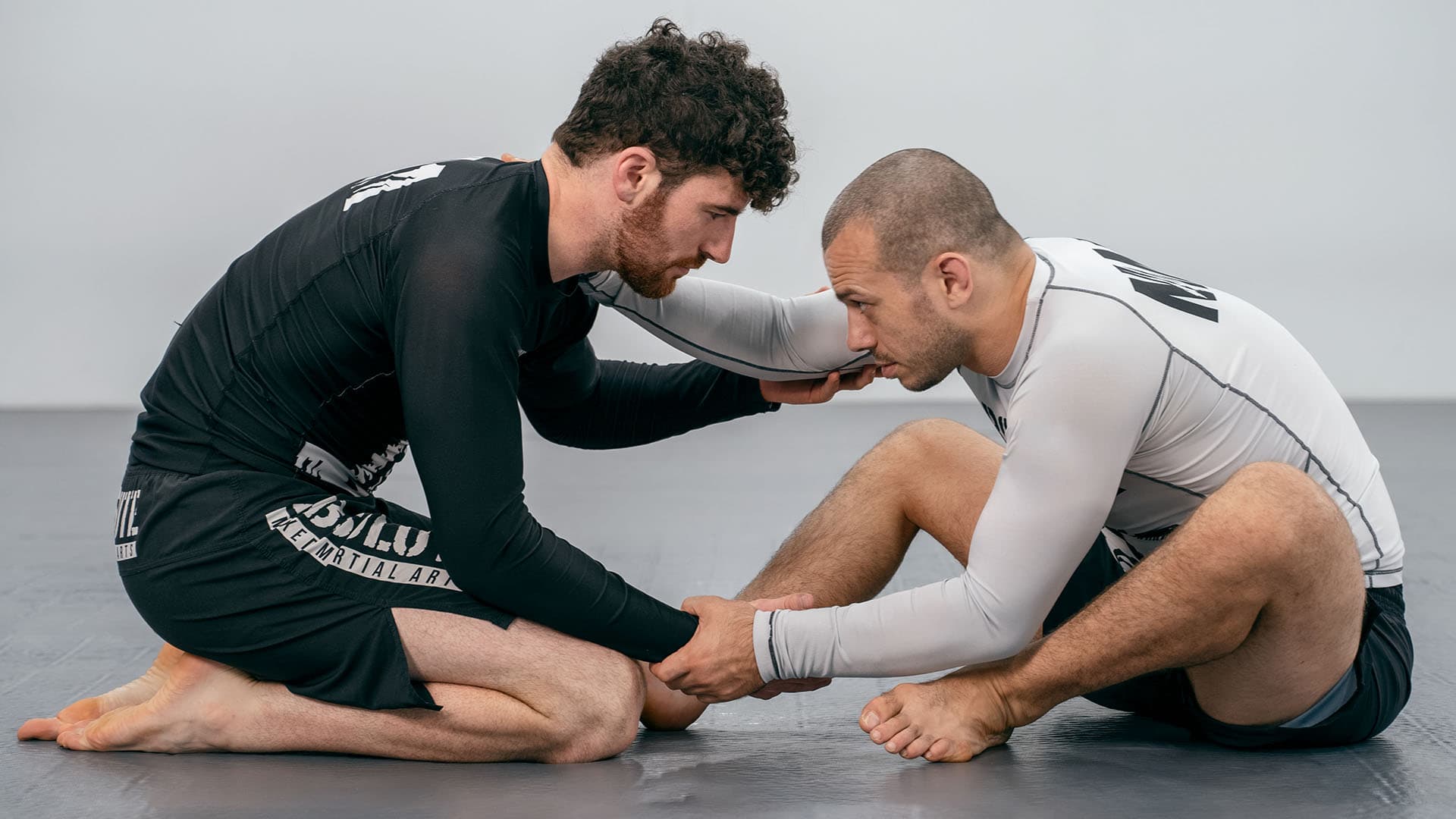
Seated or supine guard? Read the distance before choosing
Quick answer: Choose seated or supine guard according to distance, useful connections, and the direction your partner can move. Sitting up can help you reach and follow an opponent; lying back can let your legs manage an approaching passer when the right frames are in place. Practice moving between the two instead of treating either posture as a permanent identity.
Your partner stands just outside your reach. You lie back, lift your feet, and wait. They circle. Now you are turning on the floor while they choose when to come close.
A moment later, the opposite problem appears: you stay seated as they close the distance, and your hands are occupied holding you upright. These are different situations. Calling yourself a seated-guard player or a supine-guard player does not decide either one particularly well.
Begin with the distance you actually have
Before choosing a posture, notice whether you can establish a useful connection without reaching so far that you lose balance. A hand stretched toward a distant ankle may look active while doing very little to limit the passer's movement.
In a seated position, you can often adjust your distance by moving your hips and feet together. That does not mean chasing indefinitely. Your goal is to reach a position where a grip, frame, or entry becomes available while you remain able to respond to movement.
From your back, ask whether your legs can actually meet the passer. Feet lifted into empty space do not control someone who is still outside them. You may need to sit up, change angle, or make another appropriate adjustment rather than defending a position the opponent has not yet entered.
Distance is not a measurement you settle once at the start. Every step, grip, and retreat changes it. Treat posture as something you update when that relationship changes.
Know what your hands are doing
Seated guard gives your hands access to the opponent, but they may also be helping you balance. If both are trapped in ineffective grips, you can lose the ability to support a movement or frame an approach.
Ask what each contact achieves. Does it limit the opponent's step? Keep their upper body at a useful distance? Help you enter another position? A grip that has stopped doing its job may need to change before you move your whole body around it.
When practicing a new setup, have your coach check whether you are reaching from a stable position. Long arms are not a substitute for moving your hips closer when the entry requires it. Conversely, moving closer without accounting for the opponent's upper-body pressure can remove the space you needed.
The point is not to keep your hands in one prescribed place for every seated guard. It is to avoid discovering, during the transition, that neither hand can help with the problem arriving next.
Let the legs work before accepting pressure
Lying back can make the legs available to manage space, but only if you maintain useful orientation. If the passer has already moved your knees away and reached your upper body, arriving flat on your back is not the same as establishing a working supine guard.
Look for the relationship between your knees, hips, and the direction of the pass. Your legs should be doing a recognizable job: framing, connecting, tracking, or preparing an entry appropriate to the position. Simply pointing them upward is not a complete defensive plan.
A coach may teach several ways to recover that relationship. Practice the version suited to your level and mobility, without forcing a range of motion or turning onto your neck to imitate a flexible athlete. If the available movement feels unclear, stop and have the position checked.
The useful question is whether your legs are between the problem and your upper body in a way you can maintain. That is more informative than whether your shoulders happen to be touching the mat.
The change of posture is part of the position
The moment between sitting and lying can be where a passer gains ground. You remove one connection, shift your weight, and assume the next frame will appear automatically. An attentive partner can use that interval.
Lachlan Giles's published adaptive guard passing course outline explicitly includes attacking the transition between supine and seated positions. That is a useful prompt for the bottom player: the change itself deserves practice, rather than being treated as neutral time between guards.
Move slowly enough to identify what remains connected. If you sit up, what keeps the opponent from immediately closing over you? If you lie back, which contact prevents them from following your shoulders before your legs are organized? The answer depends on the starting arrangement, so ask your instructor to examine the actual position.
A transition that works against a cooperative partner may expose a gap as soon as they are allowed to advance. Introduce that response gradually. You are trying to find the missing connection, not prove that the posture is impossible.
Read the passer's commitment
An opponent standing far away presents a different problem from one already kneeling close. A passer gripping your pants presents another difference from one with no connection. These details should influence the choice before a favorite technique does.
Notice whether the passer is withdrawing, circling, or committing their weight toward you. Each movement changes the space available for your next action. You may be able to follow from seated guard, bring your legs into contact from supine, or transition into another position your coach has taught.
Avoid translating this into a rigid rule such as "always sit against a standing opponent." The opponent's grips and angle can matter as much as their height. A simple rule can help a beginner notice a pattern, but it should remain open to the actual exchange.
Our article on the toreando pass looks at one way a top player moves around the legs. From underneath, pay attention to the earlier moment when the passer begins controlling their direction, before the final position makes the problem obvious.
Separate a training exercise from an open round
You can learn the posture change without adding every possible submission, takedown, and passing option at once. Agree on a bounded exercise with your coach and partner. The purpose is to make the decision visible.
One possible format is:
Start with the top player at a distance agreed with the coach.
Let the passer approach or circle at a controlled pace.
Have the bottom player establish a useful connection and choose a posture.
Reset when the passer reaches an agreed control position or the bottom player completes the assigned entry.
The exact boundaries should match the lesson and the participants. This is a practice suggestion, not a competition ruleset. If standing up or wrestling is outside the agreed exercise, do not add it unexpectedly because it seems available.
After a short exchange, identify the decision. Did you lie back before your legs could help? Did you remain seated after your support disappeared? A specific answer gives the next repetition a purpose.
Do not turn comfort into a prohibition
It is reasonable to have a preferred starting posture. Familiarity can make it easier to organize your first grips and attacks. The trouble begins when preference becomes a rule that prevents you from responding to the opponent.
A seated player still needs a plan for being put on their back. A supine player still needs to recognize when there is nothing useful to control at the current distance. Neither has to develop an identical game, but both benefit from understanding the neighboring position.
Work on the less familiar transition in a setting where you can pause. Ask a trusted partner to supply one predictable response, then gradually vary it. If you immediately use full resistance, you may spend the whole round returning to the habit you already know.
Keep the scope small enough that success is recognizable. Establishing a frame before your shoulders reach the mat may be progress even if you do not sweep anyone. The technical change you are studying does not need to end in a dramatic result to be worth keeping.
Review the moment before the pass
When guard is passed, the final position attracts attention. It is easy to remember being pinned and forget the earlier choice that made the pin available. Review the transition rather than only the ending.
Ask which contact disappeared first. Did your partner move your feet away while your hands remained on unhelpful grips? Did you sit up directly into their control? Did you turn to follow them while leaving your hips behind? These questions describe actions you can examine with a coach.
If you have permission to film training, a brief clip may help, but you do not need a recording to reconstruct one exchange. Reset with your partner and show the point where you became uncertain. They may be able to describe what felt available from above.
Then change one part and repeat. A workable guard is built through those small adjustments: distance, connection, orientation, and timing. The label for the posture comes after those relationships, not before them.
Main photo: SUBMETA / Lachlan Giles; seated guard instructional image.
The takeaway
Seated and supine guard are useful ways to organize your body in relation to the passer. Neither posture solves distance or connection by itself, and the transition between them can become the decisive part of the exchange.
Practice noticing when the current arrangement stops helping. With your coach, build a controlled way to change posture while preserving a useful contact, then test it against one clear response at a time.
Bring the position to class
Find a training room through Let's Roll's gym directory, and ask an instructor to help you identify the distance and connections in your own guard transitions.
FAQ
Is seated guard better than supine guard? Neither is universally better. The useful choice depends on distance, grips, the passer's movement, and the positions you understand well enough to connect safely.
Should I lie back as soon as someone approaches? Check whether your legs and frames can manage the approach. Lying back without useful connections may simply allow the passer to follow you into control.
Why do I get passed while sitting up? Examine the transition with your coach. You may be releasing a connection, losing a frame, or entering the opponent's control before you have established a useful seated position.
Can beginners practice changing between the two? Yes, with an instructor-approved exercise and controlled resistance. Start with clear boundaries and reset when the position becomes unclear rather than forcing a fast recovery.

Nina Okada
Nina Okada explains positions the way a good training partner does: one problem at a time, with the limits of the explanation said out loud. She is careful about the difference between what footage shows and what it only suggests.
Related Posts
Jiu-jitsu in Montreal: build the visit around a real class
Plan BJJ training in Montreal around confirmed classes, language arrangements, winter travel, visitor policies, and equipment that is ready to use.
Competing in gi and no-gi on the same day takes two plans
Prepare for gi and no-gi competition on the same day with separate rule checks, complete outfits, schedule coordination, and a realistic second-bracket plan.
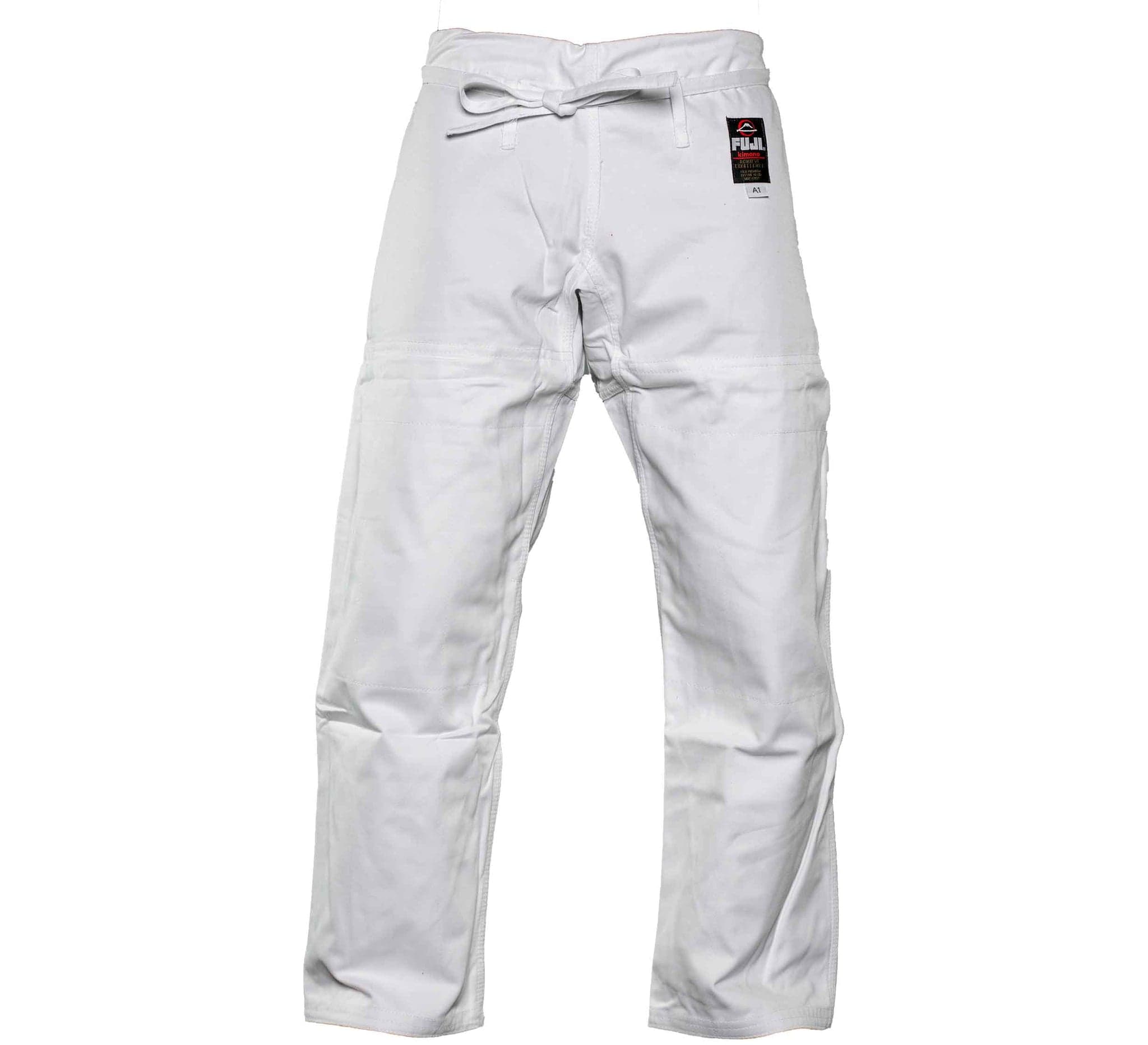
BJJ gi pants that fit standing up can still fail on the mat
Check BJJ gi pants at the waist, rise, knees, and cuffs so a good-looking size label becomes a uniform you can actually move in.
Comments (0)
Loading comments...