
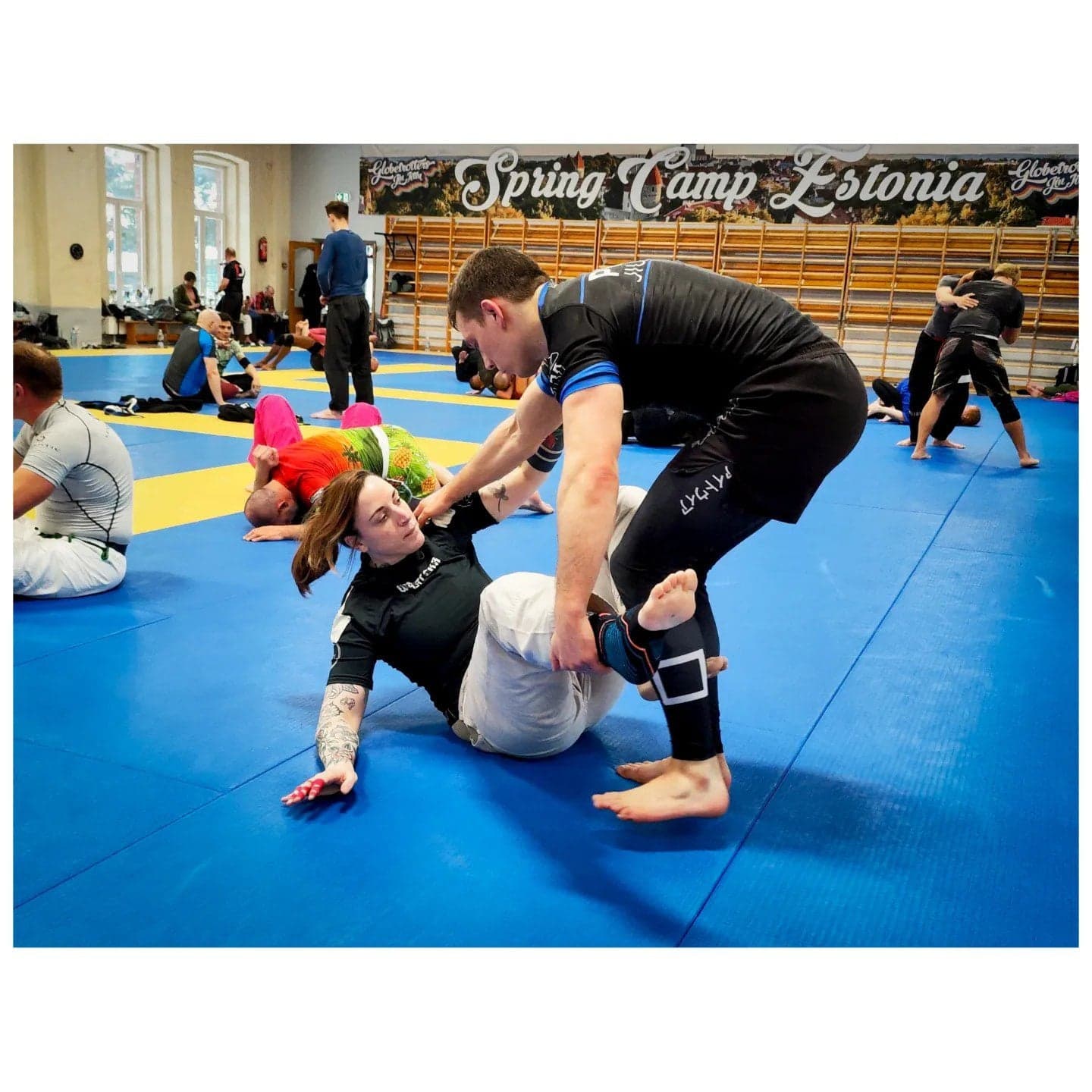
Starting every BJJ round in the same position can be useful
Quick answer: Repeating a starting position can make a training problem easier to examine, provided both partners agree on the setup and purpose. Use a short block of focused rounds, change roles, and finish with some freer practice to see what carries over. Repetition should give you more useful attempts, not permission to trap a partner in your private lesson plan.
Five rounds can contain five unrelated problems. That is part of the pleasure of rolling, but it can be inconvenient when you came to work on one specific position and barely reached it.
A repeated start offers a practical alternative. You and a willing partner choose the position in advance, work from it, and return to it under agreed conditions. Instead of waiting for a particular situation to emerge, you make room for it in the session.
This is a suggested way to organize practice with your coach's approval. It is not a promise that one format will improve every part of your jiu-jitsu, and it should fit the class rather than compete with the instructor's plan.
Pick a problem smaller than an entire guard
Getting better at guard is an ambition. It is too broad to tell a partner what you want to examine in the next round. Choose something you can describe without naming your whole game: keeping the space for a knee to return, recognizing when a grip has been lost, or settling a position after an initial pass.
The description does not need to sound technical. If you can show the coach where the problem begins, that may be enough to get help defining a useful start. A beginner's uncertainty is a reason to make the question clearer, not a reason to invent more sophisticated vocabulary.
Keep the first experiment short. You are trying to find out whether the setup gives you relevant attempts. A position that sounded useful in conversation may turn out to skip the moment you actually struggle with.
For example, starting after a partner has already established control may be appropriate for escape practice. It may be a poor choice if your real question concerns preventing that control. Both tasks can matter, but they are not the same task.
Agree on which one you are doing before the timer begins. Otherwise, each partner may be judging the round against a different purpose.
Make the starting position repeatable enough
The name of a position does not specify every detail. Two starts called half guard can differ in upper-body control, leg placement, and distance. If those details change each time without anyone noticing, you may be comparing different situations while believing you repeated one.
Ask the instructor to help choose the starting arrangement. Keep only the details needed for the question. You do not need to spend half the round placing every finger unless a particular grip is what you are studying.
A short agreement can cover the following:
Where each partner begins and which grips are already present.
What counts as reaching the intended goal.
When to reset and when to let the exchange continue.
When you will switch roles.
Check the setup again after a few attempts. If you are both gradually improving your starting position before the agreed signal, the practice is drifting. Reset honestly rather than winning the preparation.
This is also a good time to establish how either person can pause. Nobody should feel obliged to continue through discomfort because the exercise has rules. The ordinary expectations of cooperative training still apply, including releasing promptly and respecting the coach's boundaries for the pair.
Give the other person a useful job
Your partner needs more than the instruction to provide realistic resistance. That phrase can mean nearly anything. Describe what they are trying to accomplish and what actions the exercise includes. Let the coach decide suitable boundaries when experience or size differs substantially.
The partner's job should be worth doing. If one person spends the entire session supplying a predictable reaction, the arrangement may be useful demonstration practice, but it is not the same as a live positional round. Name the task accurately so neither person expects something else.
Change roles, or arrange a fair exchange of practice time. A generous teammate may agree to help with your problem, but that does not make their training priorities disappear. Ask what they want to work on and leave room for it.
If you have different goals, you may still find a shared position. One person can examine retaining a space while the other works on passing it. The coach can help make the two objectives compatible instead of letting one person's restrictions make the other's job meaningless.
This is the social part of positional training that gets missed in a neat diagram. An exercise works with a person who has chosen to participate, not a piece of equipment that happens to wear a rash guard.
Reset when the question has been answered
A reset rule determines how much of the round you spend near the intended problem. If you want repeated practice from one position, allowing every exchange to continue indefinitely may take you far away from it. If you reset too quickly, you may never learn what happens immediately afterward.
Choose the boundary with the purpose in mind. A practice block focused on arriving in a position might end once the arrival is stable. Another block could continue so both partners can explore what follows. Neither rule needs to govern your whole evening.
Be careful about ambiguous success. If you disagree over whether a goal was reached, pause briefly and make the rule clearer. Repeated arguments over the imaginary score are usually evidence that the exercise needs a simpler definition.
Avoid turning resets into punishment. Returning to the start is how the practice is organized, not a verdict on somebody's ability. You should be able to try an option, see it fail, and begin again without holding a small hearing about it.
For help designing the boundaries, the guide to BJJ training games offers a related question: what exactly is the exercise asking both people to solve? Use that question before adding more rules.
Compare attempts without building a courtroom
You do not need a spreadsheet to notice a useful change. After several attempts, ask what happened differently. Perhaps you recognized the grip earlier, kept a needed space for longer, or stopped repeating an action that led to the same dead end.
Ask the partner for an observation they could actually make. Did your movement force them to adjust? Did the starting grip feel different? Was the exchange over before you noticed the important change? Their answer can help you describe the next question to the coach.
Avoid asking them to certify that your technique now works. A few rounds with one person cannot establish that. The useful information is local: what happened in this arrangement, with these partners, under these conditions.
The training-partner feedback guide makes the same distinction between an observation and a sweeping judgment. You can learn something from a failed attempt without turning it into a statement about your entire game.
Keep any notes brief enough to use. One sentence about the starting position and one about the question remaining may be more helpful than a page of hurried technical language. The point is to remember where to resume, not to produce a transcript of the round.
Change one condition before changing everything
Once the first setup has become understandable, consider a small variation with the coach. Start slightly earlier, remove a preset grip, change partners, or let the exchange continue farther. Choose a change that tests the question you now have.
Do not make every adjustment at once. If you change the starting position, resistance, partner, and goal simultaneously, you may still get useful practice, but it will be harder to compare with the previous attempts. A new result will have several possible explanations.
Likewise, do not preserve the original setup forever simply because you became comfortable there. Familiarity with one arrangement can be valuable without covering every way the position arises. Leave room for the exercise to evolve when the coach thinks the next step is appropriate.
A different partner may bring a different reaction. Treat that as information about the problem rather than proof that the earlier practice was worthless. Ask what changed before deciding what to change yourself.
This is where a short block can be more practical than an elaborate weekly system. You can try something, review it, and adjust without needing the entire academy to adopt your new curriculum by Thursday.
Finish with a little room for the unexpected
After focused practice, use an appropriate freer round to see whether you recognize the situation as it develops. You may never reach the chosen position. That is still different information from starting there repeatedly, and it can point toward an entry or transition worth discussing next.
Do not force the round into your exercise without telling the other person. If they agreed to ordinary rolling, give them ordinary rolling within the class's expectations. You can look for your practiced situation without treating every alternative as an interruption.
Notice whether the earlier work changed what you saw. Recognition may be the first useful result: you identify the moment even if you do not handle it successfully. Bring that specific observation to the next lesson.
If the focused block felt frustrating, end the review narrowly. The setup may have been too difficult, poorly defined, or simply unrelated to the problem you intended to study. Ask the coach before concluding that you need more intensity or more repetitions of exactly the same thing.
You are allowed to enjoy a few unplanned exchanges as well. Training can have a purpose without making every minute resemble an appointment with your least cooperative project manager.
Main photo: BJJ Globetrotters; illustrative archive photograph.
The takeaway
Repeating a starting position is useful when it creates attempts at a clearly defined problem. Agree on the setup, give both partners a worthwhile role, and choose resets that keep the practice connected to its purpose.
Then change the conditions carefully and make space for freer rolling. The question is not how many times you can start in the same place. It is whether those starts help you notice and handle something more clearly when the position appears again.
Arrange focused practice with a willing partner
Find an open mat, confirm the host's format, and ask a partner whether they want to share a short positional practice block.
FAQ
Should every round begin in the same position? It can be useful for a short, agreed practice block. It need not replace the rest of the session or the instructor's plan.
How specific should the starting position be? Specific enough that both partners know which problem they are testing. Ask the coach which grips and body positions matter for that question.
What if my partner always wins the exercise? Review the setup and goals with the instructor. The task may need adjustment, and the outcome alone does not explain whether either person is getting useful practice.
How do I know whether the practice carries over? Look for the situation during appropriate freer rolling and note what you recognize. Discuss the result with your coach without treating a few rounds as proof of a universal improvement.

Owen Bellamy
Owen Bellamy writes for the person training twice a week around a job. Nothing he suggests requires quitting the job.
Related Posts

Mikey Musumeci gives up the belt to make room for MMA
Musumeci is vacating his UFC BJJ title to focus on MMA training. What he is leaving, what continues, and why the transition matters.
IBJJF membership: finish the paperwork before the deadline
IBJJF membership and tournament entry are separate steps. Plan documents, professor approval, renewals, and junior accounts before registration closes.
Choosing a BJJ seminar worth your time and travel
Choose a BJJ seminar by the subject, teaching format, access, and total cost. Know what to ask the host before buying a ticket.
Comments (0)
Loading comments...