
Waiting for a BJJ promotion without making every roll a test
Quick answer: If you are frustrated about a BJJ promotion, ask your instructor for specific feedback on your development and the academy's expectations. Do not treat individual taps, attendance comparisons, or another student's promotion as a complete assessment. Choose a few useful training tasks and agree on an appropriate time to revisit them.
A promotion ceremony ends, and the same belt goes back into your bag. You can be happy for the people who were recognized and still feel disappointed. Those two reactions can occupy the same car ride home.
The unhelpful part begins when disappointment becomes a private investigation. Every compliment becomes a clue. Every difficult round becomes evidence. Somebody else's attendance is suddenly your business. There is a more direct way to find out what needs work, and it begins with a conversation rather than a spreadsheet of teammates.
Admit that the belt matters to you
Pretending you are above caring about rank does not produce useful information. You may want the recognition, the sense of progress, or the chance to compete in another division. You can acknowledge that without declaring the academy unfair or demanding a date.
Be precise about the concern. Perhaps you do not understand what the next rank requires. Perhaps you have received conflicting feedback. Perhaps you expected a ceremony to include you because of something you thought the instructor implied. These are different situations and deserve different questions.
Separate what was said from what you inferred. A coach praising an escape may have meant exactly that: the escape was good. Turning the compliment into a promise of promotion gives it a meaning the conversation may not support.
You can take a day before raising the subject if that helps you ask clearly. The objective is to understand the training and evaluation, not to win an argument while the disappointment is freshest. A calm question can still be an honest one.
Ask for feedback that can change the next class
Request a brief conversation at a time the instructor can give it attention. Between two rounds, with another student waiting to ask something, may not be the right moment for a detailed review. Explain that you want to understand your development and the academy's expectations.
Ask what the coach wants to see improve. If the answer is broad, such as needing more consistency, request an example. Does that mean attendance, a particular position, decision-making, or something else? The same word can point toward very different work.
Useful questions include:
Which part of my jiu-jitsu most needs attention at the moment?
Can you point to a recent exchange that illustrates the problem?
What should I practice in class to work on it?
Are there academy requirements I have misunderstood?
When would it make sense to discuss my progress again?
Those questions do not prevent you from mentioning promotion. They give the conversation somewhere practical to go after you mention it. A list of things to work on is more useful than leaving with another ambiguous sentence to interpret for six weeks.
A tap is information about an exchange
Submitting a higher belt can feel significant. It still describes a particular round with particular starting conditions. The other person may have been working on something, choosing a position, or simply making a mistake. You do not need to invent an explanation either way.
Likewise, tapping to a lower belt does not settle your readiness for a promotion. Review what happened. Which grip or decision created the problem? What can you ask the coach about? The result can lead to technical work without becoming a verdict on your rank.
Using taps as an unofficial promotion score also changes how you approach teammates. A partner becomes somebody whose performance must support your case. That is a poor foundation for asking them to help with a weakness or try an unfamiliar position.
The article on tapping to a smaller partner addresses a related habit: turning an ordinary training result into a story that needs defending. Let the exchange provide the information it actually contains. It does not need to decide the entire month.
Another student's promotion is an incomplete comparison
You can see a teammate's belt and some of their training. You may not see every class, coaching conversation, competition, or piece of feedback that informed the decision. That makes them a limited comparison, even before considering that students can have different strengths and gaps.
Resist the temptation to build a case against the person who was promoted. Their recognition does not answer the question you need answered about your own work. Bringing a list of their supposed weaknesses to the instructor is unlikely to clarify what you should practice tomorrow.
If the academy's criteria seem unclear, ask about the criteria directly. You can seek consistency and transparency without making another student's achievement the subject of the discussion. Keep the examples focused on the feedback you have received and what you understand the requirements to be.
Congratulate the teammate if you want to congratulate them. Then return to your own conversation. You do not have to make your disappointment public for it to be real, and you do not have to turn a friendly room into a comparison chart.
Turn the feedback into a manageable training project
Choose a small number of tasks with your coach. If you were told to improve an escape, identify the starting position and the response you need to recognize. If the issue is how you connect positions, ask where the connection is breaking. Keep the task observable.
Then arrange suitable practice. Positional rounds can let you return to the same problem without spending most of the session trying to reach it. Explain the exercise to your partner and agree on the conditions for resetting. The aim is to study the weakness, not conceal it until promotion day.
A short note after class can record what happened: the position, the response, and the question that remains. Avoid turning the note into a daily prediction about rank. You are building something the instructor can discuss with you, not maintaining evidence for a future appeal.
When the work improves, describe the improvement accurately. Reaching the right position more often is progress even if the finish remains unreliable. You can take that observation back to the coach without asking them to translate every successful practice into a belt deadline.
Attendance should be discussed as it actually is
Tell the instructor what schedule you can sustain. If work, caregiving, or another commitment limits your attendance, state the practical constraint. Do not promise five classes a week to make the conversation end well and then spend the next month apologizing for a plan you could never follow.
Ask how to use the available sessions effectively. The coach may suggest a particular class, a focus for open training, or a way to maintain continuity when you miss part of a teaching sequence. The answer should fit the academy's actual program and your actual week.
A realistic schedule does not guarantee a particular promotion timeline. It does make the training discussion honest. Your instructor cannot help organize around a constraint you have hidden because you think an ambitious student is supposed to have unlimited time.
The shift-work training guide offers another way to think about variable attendance: plan for the schedule you have, with room to adjust. Counting the sessions somebody else attends will not create an extra evening in yours.
Revisit the conversation without conducting a weekly audit
If the instructor agrees to review your progress later, note the arrangement and do the work in between. Reopening the question after every promising round makes it difficult for either person to assess a meaningful change. Give the agreed practice time to produce something worth discussing.
At the next conversation, bring specific observations. Explain what has improved, what still fails, and where you need help. Ask whether the original priority remains the right one. A training plan can change as the coach sees more of the problem.
If you still cannot obtain a clear explanation of expectations, you can say that directly. Wanting understandable feedback is reasonable. Decide whether the school's communication and approach suit you based on the actual conversations, rather than imagining motives for an instructor who has not stated them.
Changing academies is a significant training choice, not a reliable shortcut to a belt. If you explore another room, ask about its teaching and expectations honestly. You are looking for a place to learn, not a promise that a different person will deliver the answer you wanted.
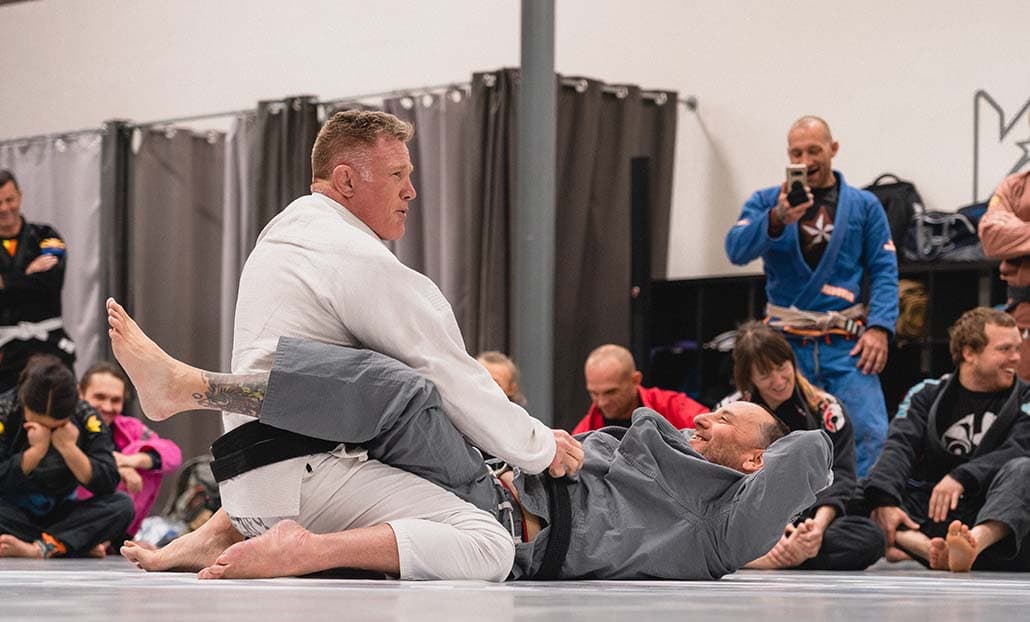
Main photo: BJJ Globetrotters; archive instructional photograph.
The takeaway
You can care about promotion without making every round an audition. Ask for concrete feedback, clarify the academy's expectations, and choose training tasks that let you address the answer.
The next belt remains the instructor's decision. The useful part under your control is how clearly you ask, how realistically you plan, and whether you return to class ready to work on something specific.
Explore the training around you
Browse gyms on Let’s Roll when you need a new training option, and ask about instruction and class structure before making a decision.
FAQ
Is it disrespectful to ask about a BJJ promotion? A respectful request for feedback and clarification is reasonable. Choose an appropriate time, explain the concern, and ask what needs improvement rather than demanding a date or comparing yourself with a teammate.
Does submitting higher belts mean I should be promoted? A tap describes one exchange. It can reveal useful technical information, but it is not a complete assessment of the skills and expectations your instructor is evaluating.
What if I cannot attend as often as other students? Explain your actual schedule and ask how to use it well. Avoid promising attendance you cannot sustain. A realistic plan helps the coaching discussion even though it does not guarantee a promotion timeline.
Should I change gyms because my promotion is taking too long? First seek clear feedback and understand the school's expectations. If the teaching or communication does not suit you, consider that carefully, but do not treat a move as a guaranteed route to a faster belt.

Owen Bellamy
Owen Bellamy writes for the person training twice a week around a job. Nothing he suggests requires quitting the job.
Related Posts

Mikey Musumeci gives up the belt to make room for MMA
Musumeci is vacating his UFC BJJ title to focus on MMA training. What he is leaving, what continues, and why the transition matters.

IBJJF membership: finish the paperwork before the deadline
IBJJF membership and tournament entry are separate steps. Plan documents, professor approval, renewals, and junior accounts before registration closes.

Choosing a BJJ seminar worth your time and travel
Choose a BJJ seminar by the subject, teaching format, access, and total cost. Know what to ask the host before buying a ticket.
Comments (0)
Loading comments...