
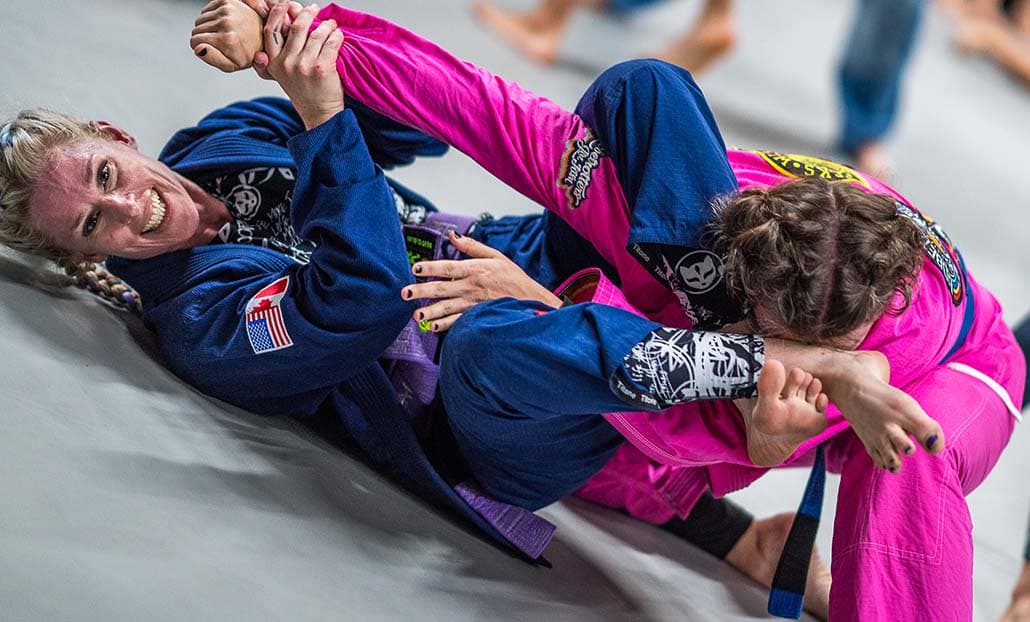
Tapping to someone smaller should not require an explanation
Quick answer: Tap promptly when you need to, regardless of your partner's size. You do not owe the room an explanation for a training submission, and your partner does not need their success qualified. If you want to learn from the exchange, ask a specific technical question after both of you have reset.
The tap takes a second. The explanation can take the rest of the round.
You were tired. You were trying something. You did not want to use your strength. Any of those statements might be true, but a smaller partner does not necessarily need to hear them immediately after a successful exchange.
There is a more useful way to spend that moment. Acknowledge the round, reset, and decide whether there is a technical question worth asking. The difference is small in wording and substantial in how it treats the person across from you.
The tap is a decision, not a public statement about your worth
A training tap tells the partner to release and lets the practice stop or reset. It does not require an account of your conditioning, work schedule, or place in the academy's imagined hierarchy.
Use it when you need it. If something hurts, feels wrong, or exceeds what you can manage safely, stop and communicate. A partner's size does not make a submission a sensible place to test how long you can refuse to acknowledge the position.
The same principle applies when the partner is less experienced or has a lower belt. Those facts do not turn the exchange into an obligation to escape at any cost. Training gives you another chance to investigate the mistake after the immediate problem has ended.
Treating the tap as ordinary makes the next action easier. You can breathe, check that both people are comfortable continuing, and return to the exercise. There is no need to convert every reset into a declaration about whether your last few years of training have been justified.
An unsolicited explanation can diminish the other person's work
Consider the difference between describing a problem and qualifying a result. Asking how your elbow became isolated directs attention to the exchange. Announcing that you were not really trying directs attention back to protecting your own image.
That distinction does not require pretending every round is a contest. It means allowing a partner's action to stand without immediately reducing it. They may have practiced that setup carefully. They may also have no interest in evaluating how hard you were trying.
If the round had an agreed constraint, both people already know it. You do not need to remind the room that you began in a difficult position after every outcome. The constraint was part of the practice, not a footnote to be read aloud whenever the exercise becomes uncomfortable.
A simple acknowledgment is usually enough. If there is relevant information about an injury, a misunderstanding, or an agreed limit, communicate it clearly. Necessary information helps the next round. An excuse mainly asks the partner to repair your interpretation of the last one.
Size matters without explaining every exchange
There is no need to claim size never matters in grappling. There is also no need to make size the complete explanation of what happened between two particular people. Experience, timing, position, and the task all belong in the conversation.
The useful question is specific. Where did you lose the connection you needed? Which movement created the opening? What response did the partner anticipate? Those questions can be investigated without deciding how much credit their body size permits them to receive.
Avoid the patronizing version of praise, too. Calling someone impressive for their size can sound as though the real compliment is being withheld. You can acknowledge a clean setup or effective control directly. The action does not need an asterisk.
This is especially worth remembering when the smaller person regularly trains with larger partners. They do not need every round turned into a discussion of the size difference. Let the exchange be technical when the technical exchange is what they came to practice.
Agree on intensity before it becomes an argument
A mismatch in size or experience can make a clear pre-round agreement useful. Ask what kind of round the partner wants and state any limits you need. Then behave in a way that matches the agreement.
If the intensity needs to change, pause and discuss it. Do not silently increase the pace because being caught felt embarrassing. A partner who agreed to controlled practice should not discover that the terms changed when a submission began working.
Nor should a larger partner announce that using strength is always forbidden or always acceptable. The practical question is how both people can perform the agreed exercise with control. The instructor can help establish that standard, especially when the partners have different expectations.
A difficult pairing does not have to become a character judgment. You can choose another partner or ask the coach for a better match. The goal is a useful session for both people, not proving that every combination of students must work under every set of conditions.
Ask about the moment before the finish
If you want feedback, choose a question the partner can answer. Asking why you keep losing may invite a broad reassurance. Asking when your arm became available invites a technical explanation.
Look one step earlier than the final submission. By the time the finish is fully established, the more useful mistake may already be behind you. Your partner or coach might identify a grip, an angle, or a decision that made the later position difficult to avoid.
You could ask:
Which movement gave you the opening?
Was there a point where I could have changed the position earlier?
Can we show the coach the starting position and check the response?
Then listen without turning the answer into a debate about what you intended. Intention is useful context, but the partner is describing what they felt or saw. You can test the explanation in controlled practice rather than resolving it through a longer argument at the edge of the mat.
Do not appoint yourself the smaller partner's examiner
A common awkward response to being caught is to decide that the other person now needs a harder test. The next round becomes an attempt to establish whether the technique works when you apply a more punishing version of yourself.
That is not an assignment you get to make unilaterally. If both partners want a more competitive round and the coach considers it appropriate, agree on it. Otherwise, continue the practice that was actually arranged.
The smaller student also does not owe you an explanation of their entire game because something worked. A brief question is reasonable; a demand for repeated demonstrations after class may not fit their time or interest. Ask, and accept the answer.
Respect goes both directions. Neither person needs to boast, collect public results from training, or narrate the pairing as a victory over a category of human being. A good round can remain between the participants, with whatever useful learning they choose to carry into the next session.
Make the next round about a task you can control
After an uncomfortable tap, choose one small technical aim. You might focus on maintaining the frame that disappeared or recognizing the grip before the attack developed. Ask the instructor to help if you do not know what to prioritize.
Do not define success as making sure the same partner never catches you again. That target can encourage avoidance of the very position you need to understand. A more useful target is noticing the problem earlier and responding with a plan you have actually practiced.
If you visit another room through the open-mat listings, carry the same approach with you. Introduce yourself, agree on the round, and allow unfamiliar people to be skilled without making their success an interruption to your self-image.
Over several sessions, review the technical question rather than keeping a private submission ledger. Did you recognize the setup? Did your response change the position? Those are observations you can use. The number of explanations you managed to avoid giving will not appear on a medal, but your partners may appreciate the quieter reset.
Main photo: BJJ Globetrotters; archive training-camp photograph.
The takeaway
A smaller partner is a training partner, not a test of whether your size has fulfilled its obligations. Tap when you need to, communicate any relevant limits, and allow the exchange to end without an automatic defense of your reputation.
If there is something to learn, ask about the position. A precise question gives both people somewhere useful to go. An explanation of why the result should not count usually leaves them standing in the same place for longer.
Find training that supports useful partnerships
Explore the gym directory and look for a class environment where expectations, pairing, and questions are handled clearly.
FAQ
Is it embarrassing to tap to someone smaller? You may feel embarrassed, but the tap does not require an explanation. Treat it as part of training and investigate the technical exchange when you are ready.
Should I avoid using all strength with a smaller partner? Agree on the task and intensity with the partner and coach. The aim is controlled practice that fits both participants, not a universal rule that ignores the context.
What if I was deliberately practicing a bad position? If that was the agreed exercise, the partner already has the relevant context. You can reset and continue without qualifying every outcome for the room.
Can I ask how the submission worked? Yes, ask briefly and specifically after resetting. Focus on the opening or earlier positional mistake, and respect the partner's time if they cannot stop for a longer explanation.

Rafael Moura
Rafael Moura profiles competitors as people with lives outside the bracket. Some of those stories are comebacks. Most are not, and he does not force them.
Related Posts

Mikey Musumeci gives up the belt to make room for MMA
Musumeci is vacating his UFC BJJ title to focus on MMA training. What he is leaving, what continues, and why the transition matters.
IBJJF membership: finish the paperwork before the deadline
IBJJF membership and tournament entry are separate steps. Plan documents, professor approval, renewals, and junior accounts before registration closes.
Choosing a BJJ seminar worth your time and travel
Choose a BJJ seminar by the subject, teaching format, access, and total cost. Know what to ask the host before buying a ticket.
Comments (0)
Loading comments...