
The submission can wait while you learn to hold the position
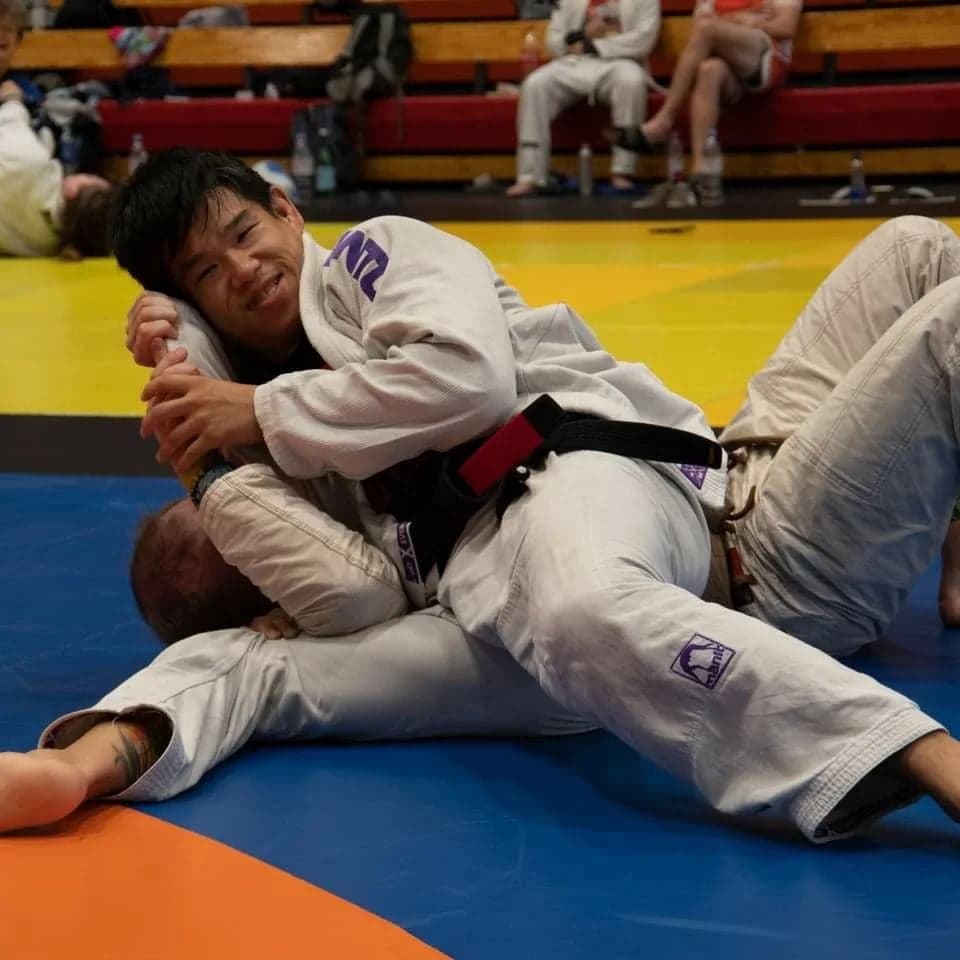
Quick answer: If you repeatedly lose a good position as soon as you attack, practice maintaining and adjusting the pin before adding the submission. Give the defender a clear escape task and observe what changes when you move a hand or shift your weight. The aim is usable control, not holding somebody motionless indefinitely.
Reaching mount and staying in mount are different skills. Adding an attack introduces another problem: something that was helping you hold the position may now be needed elsewhere.
That is why a submission can disappear before the finishing mechanics become relevant. The attempt may fail at the hand change, the shift in balance, or the moment a defender recovers space. Squeezing harder at the end cannot answer a question that arose earlier.
Name the pin more precisely than its position
Side control is a broad label. It does not tell a coach exactly where your hands are, which direction the defender is facing, or what movement you are trying to prevent. Begin with those details before asking why the attack failed.
BJJ Mental Models' alignment-over-position explanation emphasizes that the quality of a position matters beyond its name. Two arrangements called side control can offer very different amounts of control. The label alone is not a complete technical description.
For practice, choose a familiar variation with your coach. Agree on the starting contacts and the defender's first task. That creates a position you can return to, rather than a loose approximation that changes every attempt.
Then ask a narrow question. Can you remain balanced while the defender attempts to turn? Can you stop the agreed escape without abandoning the position? Those questions provide observable outcomes. Saying that you want a better top game is a reasonable ambition, but it is too broad to organize the next two minutes of practice.
Make holding the position a separate exercise
You can temporarily remove submissions from the task. The top player maintains the agreed pin while the bottom player attempts a familiar escape. Reset when the escape succeeds or when the coach's chosen interval ends.
This is a suggested training exercise, not a claim that matches should always proceed in a fixed order. Its purpose is to reveal a part of the exchange that can be hidden when both partners immediately chase every available attack.
Set the pace so both people can participate and observe. The defender should not remain completely passive once the starting arrangement is understood, but neither person needs to turn the first comparison into a maximum-effort contest. Increase the difficulty with the coach's guidance.
Ask the defender what changed before the escape became possible. They may have felt a knee leave space or noticed a hand stop controlling a useful point. That feedback can direct the next attempt without requiring either partner to invent a full explanation on the spot.
Correct the arrival before adding a new task
Stephan Kesting's article on correcting the position describes taking time to improve the details after arriving in a position rather than assuming the first arrangement is already complete. That is a useful distinction for a student who reaches a pin and immediately begins the next movement.
Ask the coach what needs checking in your particular variation. Do not substitute a general command to stay tight for a specific adjustment. Tightness can describe effort without explaining where the control comes from.
In a practice round, notice whether the escape begins during arrival or only after the attack starts. These are different problems. If you never establish the intended pin, delaying the submission may help expose the issue. If the pin holds until you change grips, the transition deserves closer examination.
Write the distinction in your notes. A brief description of the moment control changed is more useful than recording that your armbar failed again. The finish may be technically fine in a position you did not manage to maintain long enough to use it.
Add the first movement of the attack
Once the pin can be maintained against the agreed response, add only the first part of the attack your coach is teaching. That might involve moving a hand or changing a contact. Stop before applying a submission and examine what the defender can now do.
The smaller task makes comparison possible. If control disappears immediately, you have found a transition to work on. If the position remains usable, the coach can help you add the next part. There is no need to rush to a finish just to make the exercise feel complete.
Use a short set of checks:
Which contact changed when the attack began?
What movement became available to the defender?
Could the top player return to the previous arrangement?
Did the new position create a different useful option?
Treat these as observation prompts rather than universal technical rules. Different attacks require different controls. The guide to BJJ pressure and weight can help you describe what the contact is accomplishing instead of judging the position only by how heavy it feels.
Keep a way to recover when the attack closes
An unsuccessful attempt does not have to end the positional exchange. BJJ Mental Models' position-over-submission model stresses the value of maintaining a position that allows another attack after the first one fails. That is one reason to study what remains when an opening disappears.
Ask the coach where you should return if the defender blocks the entry. The answer may be the original pin, another controlled position, or a transition that fits the specific technique. Learn that route alongside the attack rather than treating it as a consolation lesson afterward.
During the exercise, let the defender give the expected block at a controlled pace. Practice recognizing that the original opportunity has closed and moving to the agreed alternative. Do not keep forcing a submission simply because it was the plan at the start.
The observation to record is whether you retained a useful next action. A round can contain a good decision without a tap. Learning to stop pursuing a closed route is different from giving up on the exchange.
Control must leave room to move
Holding a pin more securely is not the same as freezing every part of your body. BJJ Mental Models discusses the paradox of control: sometimes maintaining or advancing a position requires loosening an existing control. A grip that prevents all movement can also prevent your own next action.
This is why the training task should eventually expand. After studying a stable position, work with the coach on the transition out of it. The aim is to preserve useful relationships while the arrangement changes, not to remain in the first shape forever.
Do not use the slogan about position before submission to reject every moving attack you see. It is a learning priority that can help identify a weakness, not a complete description of all successful grappling. The context and the athlete's control of the exchange matter.
For a newer student, the practical response is to study the variation being taught and ask where movement belongs in it. You can learn a stable pin without deciding that mobility is a mistake, and learn a transition without pretending that control no longer matters.
Let the defender learn something too
A pinning exercise should give the bottom player a meaningful task. Agree on the escape or movement being examined and rotate roles where appropriate. The defender is a training partner, not equipment for testing how long the top player can hold on.
Invite specific feedback after the attempt. Ask when space appeared or which movement was available. If the partners disagree, reset and check with the coach instead of increasing intensity to settle the argument.
The partner-feedback article explains how to separate an observation from a guessed correction. That distinction is useful here because a defender may accurately feel an opening without knowing which top-position detail caused it.
Finish the practice block by returning to a broader round if the session permits. See whether the studied detail remains recognizable when there are more options. If it disappears, that gives you another question for the next class. The small exercise has served its purpose by making one part of a complicated exchange easier to notice.
Main photo: BJJ Globetrotters; illustrative archive photograph.
The takeaway
If an attack repeatedly costs you the position, separate the problem into parts. Establish the pin, examine the first transition, and learn where to return when the opening closes. Compare one change at a time with a partner who has a clear defensive task.
Do not turn control into stillness or a submission attempt into an obligation to finish. The useful goal is a position you can maintain, adjust, and leave deliberately. A coach can help you connect those stages without asking either partner to endure an uncontrolled experiment.
Work on the exchange with instruction
Find a suitable class through the gym directory, and ask the coach to help identify where control changes during your attack.
FAQ
Should beginners always hold a pin before attacking? Learning to establish and maintain a position is useful, but there is no universal pause required before every attack. Ask the coach what control the particular technique needs and practice the transition at an appropriate pace.
Why do I lose mount when I attempt a submission? The cause depends on the position. A grip change, balance shift, or opening for the defender may occur before the finish. Recreate the exchange with a coach and examine the first moment control changes.
Can I practice pinning without submissions? Yes, when it fits the coach's session. Give the defender a clear escape task, agree on the pace and reset conditions, and rotate roles appropriately. The exercise should provide useful work for both partners.
Does better pressure automatically mean better control? No. Discomfort alone does not show that an escape has been prevented. Evaluate what the defender can move and whether the top player can stay balanced, adapt, and continue the exchange.

Nina Okada
Nina Okada explains positions the way a good training partner does: one problem at a time, with the limits of the explanation said out loud. She is careful about the difference between what footage shows and what it only suggests.
Related Posts

Mikey Musumeci gives up the belt to make room for MMA
Musumeci is vacating his UFC BJJ title to focus on MMA training. What he is leaving, what continues, and why the transition matters.
IBJJF membership: finish the paperwork before the deadline
IBJJF membership and tournament entry are separate steps. Plan documents, professor approval, renewals, and junior accounts before registration closes.
Choosing a BJJ seminar worth your time and travel
Choose a BJJ seminar by the subject, teaching format, access, and total cost. Know what to ask the host before buying a ticket.
Comments (0)
Loading comments...