
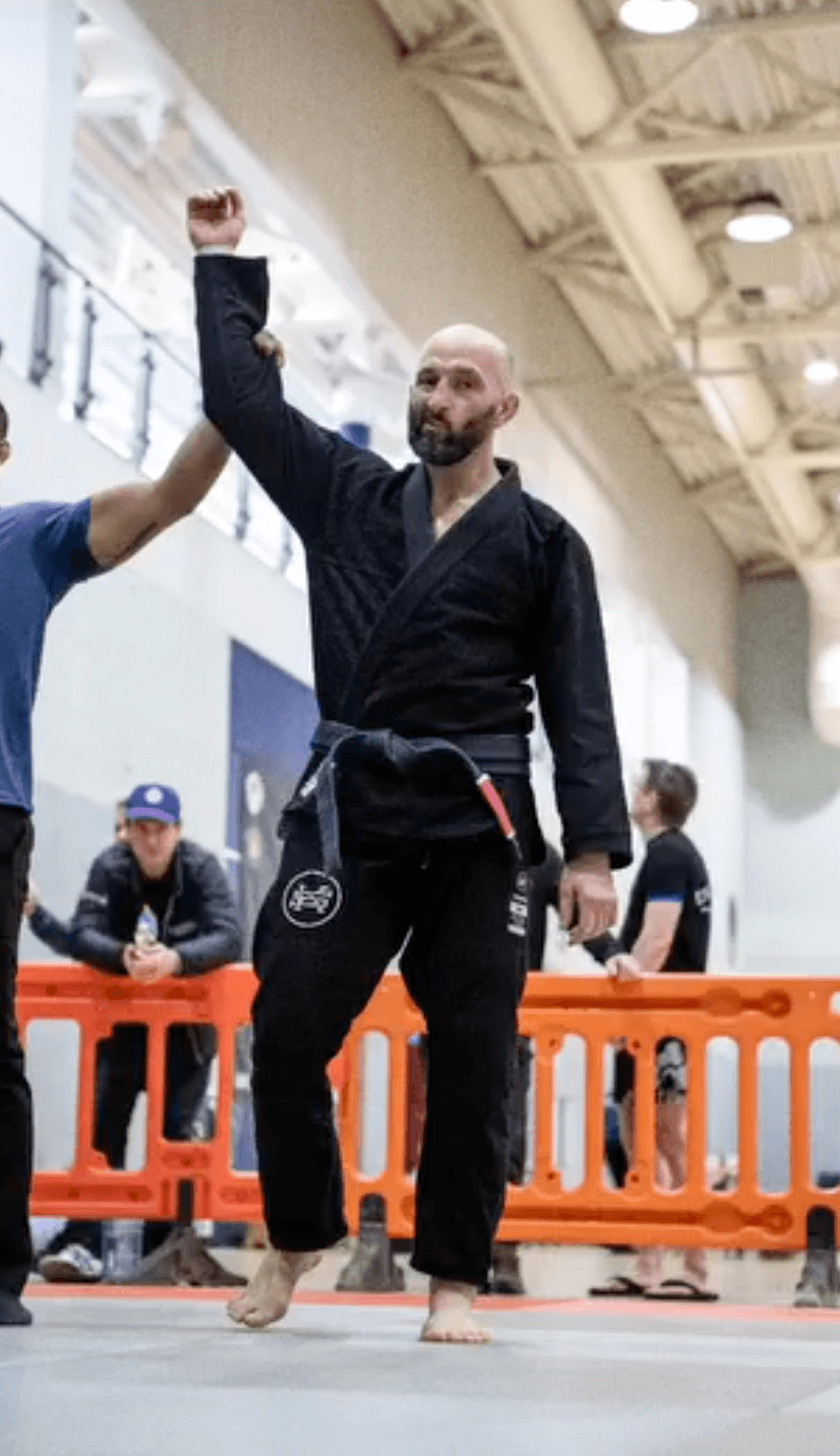
The BJJ masters divisions, explained
Quick answer: In IBJJF competition, masters divisions start at 30 and step up every five years: Master 1 at 30, Master 2 at 36, Master 3 at 41, Master 4 at 46, Master 5 at 51, Master 6 at 56 and Master 7 at 61 and over. Other organizations cut it differently, with NAGA using Master (30-39), Director (40-49) and Executive (50+), and ADCC starting masters at 35. Masters is the fastest-growing part of competitive jiu-jitsu, and also the part most likely to hand you a two-person bracket.
At the 2025 IBJJF World Master Championship in Las Vegas, medals were handed out in 472 separate divisions. According to the results tracked at BJJ Metrics, that produced 1,748 medals for 1,542 athletes, and those are only the people who placed. The total field was considerably larger.
Every one of them was at least 30 years old.
That's the part worth a second look. The over-30 championship is one of the biggest events on the jiu-jitsu calendar, and it's full of people with jobs, kids, mortgages and a knee that clicks. If you've been telling yourself competition is for the 22-year-olds, the entry lists disagree.
Where the age lines fall
IBJJF sorts masters by birth year rather than by the day you turn a number, which trips people up. For a 2026 event, Master 1 is anyone born in 1996 or earlier, Master 2 is 1990 or earlier, then 1985, 1980, 1975, 1970 and 1965 for Masters 3 through 7. In plain terms:
Master 1: 30 to 35
Master 2: 36 to 40
Master 3: 41 to 45
Master 4: 46 to 50
Master 5: 51 to 55
Master 6: 56 to 60
Master 7: 61 and over
At International Opens, white belts can enter Masters 1 through 5, while Master 6 and 7 start at blue. And you can always compete down: a Master 3 athlete can enter Master 2, Master 1 or the adult division. You just can't go up.
Every organization draws it differently
Masters is not a standardized concept, and assuming it is will put you in the wrong bracket.
NAGA uses its own vocabulary: Adult is 18 to 29, Master is 30 to 39, Director is 40 to 49, and Executive is 50 and over. Their masters, director and executive matches run four minutes regardless of skill level, shorter than the adult ones. You can also register for your own age group and a younger one, which counts as two divisions.
ADCC Opens set masters at 35 and up, with five-minute matches where the first two and a half minutes are scoreless. Grappling Industries splits at 30 for masters and 40 for seniors, and its merger rules are worth reading if you're worried about being alone: they move you up a weight class first, and only merge masters down in age if nothing is available at the heavier weight. Their weigh-in policies diverge just as sharply as their age lines do, which we went through in the weight-cutting guide.
Masters Worlds is the biggest bracket party in the sport
The IBJJF launched the World Master Championship in 2012 to give more experienced athletes a competition environment of their own. It's been held annually in the United States ever since, and it has quietly become one of the largest gatherings in the sport.
The 2026 edition runs September 3 to 5 at the Las Vegas Convention Center, with registration priced at $143, $175 and $184 across its three windows. It's a blue belt and up event, so there's no white belt masters world title, and it runs alongside Jiu-Jitsu CON, which turns the week into a strange and enjoyable convention of people your age comparing knee braces.
Worth knowing before you book flights: 813 of those 2025 medals were bronzes against 472 golds, because IBJJF awards two bronzes in larger brackets. A Masters Worlds medal is real, and also more available than the word "worlds" suggests.
What changes in your 30s, 40s and 50s
The version without the sports-science theater goes like this.
Your capacity to do hard rounds barely changes for a long time. What changes is how long it takes to be ready to do them again. A 24-year-old can have three brutal sessions in a week and feel fine. At 40, that same week costs you the following one. Nearly every masters competitor describes the same thing: not less capability, less tolerance for back-to-back stress.
Connective tissue is the second theme, and it's the one that ends competition careers. Fingers, elbows, knees and the lower back accumulate history. The advice that comes back from masters black belts is consistent: warm up longer than feels necessary, and stop treating the first round as the warm-up.
Sleep becomes a training variable rather than a lifestyle preference, and so does stress from outside the gym, because a hard week at work genuinely shows up in your rolls. None of this makes you worse at jiu-jitsu. Plenty of people are better at 45 than they were at 30. It changes how you build a training block, which is the actual subject.
Training for a comp on three sessions a week
Most masters competitors get two or three sessions a week and that's the whole budget. It's enough. It just can't be spent randomly.
Give yourself eight weeks and give each session a job. One session is technique and drilling for the specific positions you plan to use. One is hard rounds, and only one, because that's the session you have to recover from. If you get a third, make it positional sparring from your two or three key positions rather than another set of full rounds.
Narrow your game hard. A masters competitor with three sessions a week does not have time for a broad repertoire, and doesn't need one. Pick one guard, one pass, one takedown or pull you will still do under adrenaline, and two finishing paths from your best position. Then drill the entries until you're bored of them, because bored is the state you want on competition day.
The last two weeks should get easier, not harder. Volume down, intensity roughly the same, and no new techniques. Cardio work should be mostly done by then; our guide to conditioning for BJJ covers how to build it earlier in the block without stealing recovery from your mat time.
The injury math is different now
Younger competitors train through things. That strategy stops paying somewhere in your late thirties.
The practical rule most masters settle on: if something is worse at the end of a session than at the start, it's an injury, not soreness. Train around it instead of through it, which usually means dropping the hard round rather than dropping the week. We wrote a longer piece on training BJJ with an injury that covers the triage.
And withdraw when you need to. No one remembers you pulled out of a local tournament. Everybody remembers the eight months you spent off the mat after competing on a knee you knew was wrong. See a physio, not a forum.
"Am I too old?" — go look at the podium
The Master 7 black belt division at the 2025 World Masters crowned champions in nearly every weight class. According to FloGrappling's results roundup, Richard Jan Byrne of Unity took the light-feather title and Marylin Renee Jenson of Siri Brazilian Jiu-Jitsu won both feather and the open class. That's a world championship bracket for people 61 and over.
The male Master 6 brackets, 56 to 60, produced a champion in every weight class from rooster to ultra-heavy. Master 4 and Master 5 are stacked with people who took up jiu-jitsu in their thirties and forties.
If the question underneath "am I too old to compete" is really "am I too old to start", we answered that one separately in am I too old to start BJJ. The short version is no, and the entry lists at Masters Worlds are the evidence.
Your bracket might have two people in it
Now the unglamorous part. Masters brackets get thin, especially at the older end, at heavier weights, in the women's divisions, and at any belt above blue. You can pay $175, book a hotel, and end up with one match. Or none.
IBJJF handles this with three options if you're alone in your division at the event's Registration Checkday. Stay put, make weight, and take the gold. Move up or down in age or weight to find an opponent, with no guarantee one exists. Or withdraw for a full refund. The default if you say nothing is option one, which means a medal and no match.
There are better plays than accepting that. Enter the open class if your division offers one, since medaling makes you eligible. Register for the adult division alongside your masters division at organizations that allow it. Pick larger events, where masters brackets fill. Or pick a round-robin format like Grappling Industries, where a pool of five gives you four matches and your age group is nearly irrelevant to how much mat time you get.
Check the athlete list by division before the correction deadline. It's published, it's free, and it tells you exactly what you bought.
The takeaway
Masters jiu-jitsu is not a consolation category. It's the part of the competitive sport that's growing, and the divisions run deep enough that a Master 7 world title is contested by an actual bracket rather than awarded by default.
What it asks of you is different from what adult competition asks. Fewer sessions, spent more deliberately. A narrower game. More warm-up, more sleep, and a willingness to withdraw from an event rather than compete on something that's already hurt. Do those four things and you'll compete into your fifties without wrecking anything.
The one thing to go in knowing: check your bracket size before you book the flight. A two-person division is a fine day out if you expected it and a miserable one if you didn't.
See what's in your bracket before you commit
Masters divisions fill unevenly by region and by event, and the athlete lists go up before the deadline. Find upcoming tournaments on Let's Roll → and pick one that will give you matches.
FAQ
What age do BJJ masters divisions start? At IBJJF events, masters starts at 30. The brackets step up every five years: Master 1 at 30, Master 2 at 36, Master 3 at 41, Master 4 at 46, Master 5 at 51, Master 6 at 56 and Master 7 at 61 and over. Eligibility is set by birth year rather than your birthday, and you can always compete in a younger division if you want a bigger bracket.
Can you compete in BJJ over 50? Yes, and thousands of people do. IBJJF runs Master 5 (51-55), Master 6 (56-60) and Master 7 (61+) at its World Master Championship, with full black belt brackets across weight classes. NAGA's Executive division covers 50 and up, and its masters matches run four minutes rather than five or six.
How often should a masters competitor train for a tournament? Two or three quality sessions a week is enough for most people with jobs and families, provided each one has a purpose: one technique and drilling session, one hard sparring session, and if there's a third, positional rounds from the positions you plan to use. The limiting factor over 35 is recovery, not effort.
Why are masters BJJ brackets so small? Because the field gets split many ways at once: age group, belt, weight class and gender. That's fine at Master 1 blue belt and brutal at Master 6 brown belt. Check the published athlete list by division before the correction deadline, and if you're alone, IBJJF lets you take the gold, move divisions, or withdraw for a refund.
Related Posts
Mikey Musumeci gives up the belt to make room for MMA
Musumeci is vacating his UFC BJJ title to focus on MMA training. What he is leaving, what continues, and why the transition matters.
IBJJF membership: finish the paperwork before the deadline
IBJJF membership and tournament entry are separate steps. Plan documents, professor approval, renewals, and junior accounts before registration closes.
Choosing a BJJ seminar worth your time and travel
Choose a BJJ seminar by the subject, teaching format, access, and total cost. Know what to ask the host before buying a ticket.
Comments (0)
Loading comments...