
Am I Too Old to Start BJJ? (An Honest Answer for the 30s, 40s, 50s, and Beyond)
Quick answer: No — you're almost certainly not too old. People start BJJ in their 30s, 40s, 50s, and beyond every day, and there's a whole "Masters" competition world (divisions from age 30 up) built for exactly that. The difference between a great experience and a short one isn't age — it's training 2–3× a week, tapping early, leaving your ego off the mat, and picking a gym where a midlife beginner is normal.
Short answer: almost certainly not. The longer answer is more useful — because "can I start?" isn't really the question. The real questions are "how do I start smart so I don't get hurt?" and "how do I find a gym where a 45-year-old beginner is normal, not a novelty?" This is the honest version, written for adults who are excited and a little anxious in equal measure.
The honest truth about age and BJJ
Brazilian jiu-jitsu has one of the largest "later starter" populations of any martial art, for a simple reason: it's built on leverage and technique, not explosive athleticism. The whole premise of the art is that a smaller, weaker, or older person can control a bigger, stronger one through positioning. That's not marketing — it's the actual mechanics of the sport.
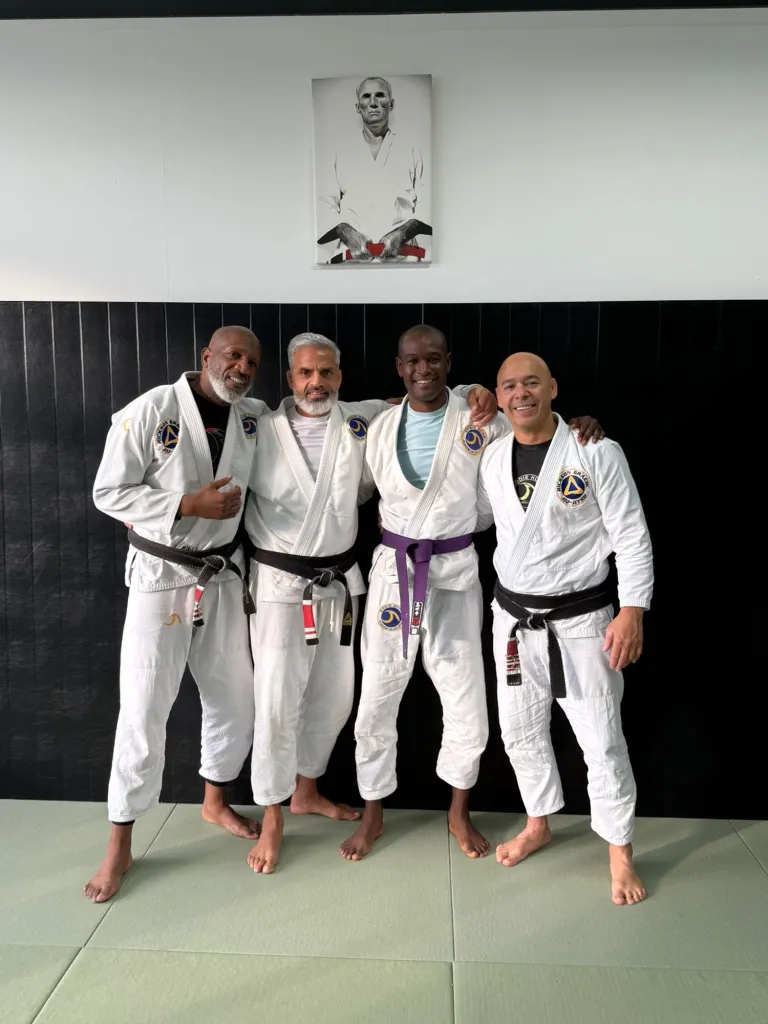
Gyms have a formal name for adult age divisions: Masters. In IBJJF competition, Masters brackets start at 30 and run upward in five-year bands well into the 50s and 60s. There is an entire competitive ecosystem of people who started — and compete — in midlife. You will not be the only gray belt-and-beard in the room.
People routinely start BJJ in their:
30s — extremely common; you'll likely be in the demographic majority of the beginners' class.
40s — very common; most gyms have a healthy 40-something crowd.
50s and 60s — less common but far from rare, especially at gyms with strong fundamentals and a recreational culture.
What changes with age isn't whether you can train — it's how you should.
What actually changes when you start older
Being honest about the trade-offs is how you train for years instead of months:
You recover slower. Two or three sessions a week with rest days beats five hard sessions and an injury. Consistency over intensity is the entire game.
You're more injury-aware — use it. Your job isn't to win the room; it's to leave every session healthy enough to come back. That mindset is a superpower, not a weakness.
Ego is your biggest risk, not age. The vast majority of beginner injuries come from refusing to tap and from "spazzing" — going 100% on every roll. Tap early, relax, and let technique do the work.
Leg locks deserve respect. Heel hooks in particular can damage a knee before you feel pain. As a beginner, ask your gym's rules, and tap immediately to any leg entanglement you don't understand.
None of this is a reason not to start. It's a blueprint for starting in a way that lasts.
How to start smart (the 5 rules)
Pick a gym with a real fundamentals class and a visible recreational/Masters crowd — not just a room full of 22-year-old competitors. (See the section below on finding one.)
Train 2–3 times a week and protect your rest days. Your tendons and joints adapt slower than your enthusiasm.
Tap early and often. It is the single best longevity habit in the sport.
Communicate. Tell partners and coaches about old injuries — bad shoulder, cranky knee — so they can roll accordingly. Good partners adjust happily.
Warm up and recover like an adult. Mobility before, light stretching after, sleep and protein in between. The boring stuff is what keeps 45-year-olds on the mat.
The case for starting older
It's not just "you can do it anyway." There are real advantages:
Patience. BJJ rewards people who can lose, learn, and come back — and that's a skill that often improves with age.
Discipline. Adults who choose to start something hard tend to actually stick with it.
Perspective. You're not chasing a teenage fantasy of being unbeatable. You're there for the fitness, the problem-solving, the stress relief, and the community — and those are exactly the things that keep people training for decades.
Plenty of people get their black belts in their 40s and 50s. The clock isn't your opponent. The only thing that ends a jiu-jitsu journey is quitting — and you get to decide that.
Finding a gym where you'll fit in
This matters more for older beginners than anyone. The wrong gym — all young competitors, hard rolls, no fundamentals — can break a 40-year-old's confidence (and body) in a month. The right gym makes it the best decision you've made in years. Look for:
A dedicated fundamentals / beginners' class.
A visible mix of ages, sizes, and genders on the mat.
A culture of controlled rolling, where upper belts flow with beginners instead of smashing them.
Masters or recreational language in their schedule or community.
The takeaway
You're almost certainly not too old to start BJJ — people begin in their 30s, 40s, 50s, and beyond every day, and there's a whole Masters world built for exactly that. The difference between a great experience and a short one isn't your age. It's training a few times a week, tapping early, leaving your ego at the door, and choosing a gym where a midlife beginner is completely normal.
Find a gym that fits how you want to train
Find a beginner- and Masters-friendly BJJ gym near you on Let's Roll → — filter for fundamentals classes and free trials, and read the community's notes so you can pick a room where starting in your 30s, 40s, or 50s is the rule, not the exception. New to all of it? Here's what to expect at your first class.
FAQ
Am I too old to start BJJ at 40? No — starting in your 40s is very common. BJJ is built on leverage and technique, not explosiveness, and most gyms have a healthy 40-something beginner crowd plus Masters competition divisions.
Can I start BJJ in my 50s? Yes. It's less common than in your 30s and 40s but far from rare. Choose a gym with a fundamentals class and a recreational culture, train 2–3 times a week, and prioritize tapping early and recovering well.
Is BJJ safe for older beginners? It can be very safe if you train smart: tap early, avoid ego-driven hard rolls, respect leg locks, communicate old injuries to partners, and pick a gym with controlled rolling. Most beginner injuries come from refusing to tap, not from age.
How often should an older beginner train BJJ? Two to three times a week with rest days is the sweet spot for most adults starting later — enough to improve steadily without outrunning your recovery.
Can you get a black belt if you start BJJ later in life? Absolutely. Plenty of people earn black belts in their 40s and 50s. It takes roughly a decade of consistent training regardless of starting age — the only thing that stops you is quitting.
Related Posts

Mikey Musumeci gives up the belt to make room for MMA
Musumeci is vacating his UFC BJJ title to focus on MMA training. What he is leaving, what continues, and why the transition matters.
IBJJF membership: finish the paperwork before the deadline
IBJJF membership and tournament entry are separate steps. Plan documents, professor approval, renewals, and junior accounts before registration closes.
Choosing a BJJ seminar worth your time and travel
Choose a BJJ seminar by the subject, teaching format, access, and total cost. Know what to ask the host before buying a ticket.
Comments (0)
Loading comments...