
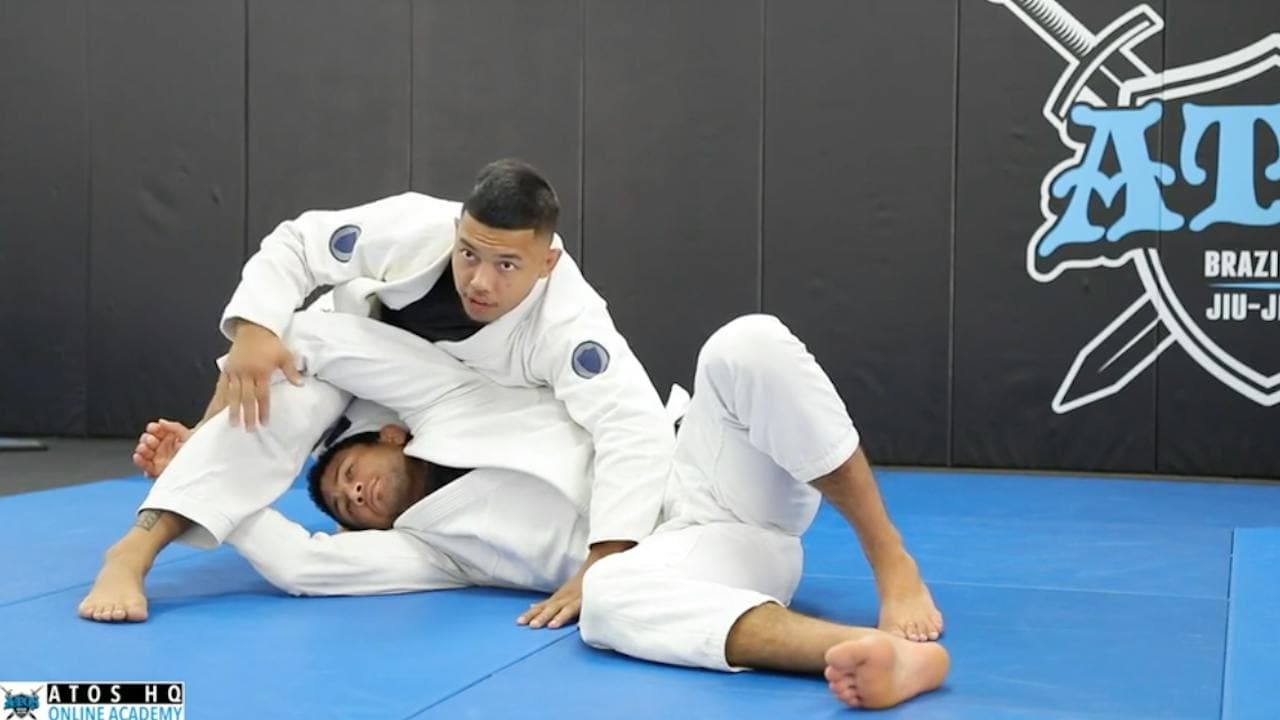
Knee on belly is a place to move from
Quick answer: Treat knee on belly as a position from which you can maintain control while responding to the bottom player's movement. Establish balance and useful upper-body contact, then move to the next position when the reaction makes it available. Practice the transition with controlled pressure rather than using discomfort as the measure of success.
You reach knee on belly and stop thinking. The position has a name, your knee is in the expected place, and the pass appears finished. Then your partner turns, your hands chase the wrong thing, and the space underneath you becomes an escape route.
The useful question is what the position lets you do next. Knee on belly can connect parts of a top game, but that connection has to survive movement. Holding the shape while losing the person underneath is not much of a transition plan.
Arrive with a way to balance
Start with the version your instructor teaches and have the placement checked. Your supporting foot, knee contact, and hand positions work together. If the arrangement only stays upright while the bottom partner lies still, you have not yet tested the balance you will need.
Use controlled pressure during learning. Do not jump onto the torso or suddenly transfer your weight while the partner is unprepared. Agree on the exercise, respond immediately to taps or requests to stop, and ask the coach to modify or replace the task if either person has a relevant limitation.
Before adding a transition, try a modest balance check under supervision. Can you respond to the partner's agreed movement without collapsing onto them or having to make a hurried post? If not, examine the starting arrangement first.
The purpose is not to make yourself immovable in every direction. It is to know where your support is and which movement you can make without losing the control you intended to keep.
Know which part of the body you control
A knee placed on the torso does not automatically control the shoulders and hips together. Your partner may still turn, frame, or move their lower body. Notice what your other contacts are doing before deciding that the position is secure.
Ask your instructor which connection limits the particular escape being studied. A grip or frame should have an identifiable task. If both hands are occupied with contacts that no longer help, changing position may require you to rebuild the upper-body control first.
This is also where gi and no-gi versions can differ. Cloth grips may provide options that are absent without a jacket. Do not assume that an identical hand placement will perform the same job across both formats.
Keep the explanation tied to the exercise in front of you. You do not need to memorize every possible control at once. Understand what prevents the assigned escape, then test whether that contact remains useful as your partner begins to move.
Let the reaction choose the route
A partner turning toward you presents a different arrangement from one turning away or recovering a knee between the bodies. Observe the direction before committing to a memorized next step.
Your coach may connect knee on belly to mount, a return to side control, or another appropriate top position. The important point is that the route should fit what the opponent makes available. Reaching for a favorite finish while the underlying control disappears can turn an attacking opportunity into a scramble.
Atos's published shin-to-shin and top-position lesson includes transitions involving mount and knee on belly. Its class description offers a useful reminder that these positions can be taught as connected movements rather than isolated photographs.
For your own practice, choose one reaction and one destination with the instructor. Learn where the new control begins before widening the options. A small, understandable connection is a better starting point than spinning through several positions without knowing why you moved.
Move the support before you need it
A transition often fails when the upper body commits to a direction before the base can support it. You reach, lean, or turn, then discover that the foot you need is still carrying a different job.
Slow the movement down enough to identify the order. Which contact stays? Which one changes? Where will your weight be when the supporting limb moves? These questions belong in a coached repetition, where the partner can pause and the instructor can see the arrangement.
Do not turn "move the support" into a universal sequence detached from the position. Different transitions require different placements. The principle is to understand how the next base becomes available rather than hoping it appears after your body is already committed.
If you cannot pause partway through without falling or creating uncomfortable pressure, reduce the task. Return to the earlier position and have the coach check the movement. Speed can conceal uncertainty from your own perception while making the consequences harder for your partner to manage.
Returning to side control is a real choice
A top player can become attached to progress that appears to move in only one direction. After reaching knee on belly, returning to a familiar control may feel like giving something back. In a training round, it can instead be a sensible response to the position changing.
If the intended next step is unavailable, preserve a control you understand rather than forcing the transition. Ask your coach which return fits the opponent's movement. You can remain active without insisting that every exchange ends in mount or a submission.
Our guide to switching sides from top control discusses the same need to keep useful contact while moving. Knee on belly adds another arrangement to that problem; it does not remove the need to track the partner underneath.
For competition, learn the relevant scoring criteria separately from this training exercise. A position's name does not guarantee points, and different organizers can use different requirements. Let the rulebook and coach clarify the competitive task before using a training habit as a scoring assumption.
Practice one transition at a time
Ask the instructor for a constrained drill that makes the connection visible. Both people should know what movement is being tested and when to reset. Keep the initial resistance low enough that you can identify the moment control changes.
A possible practice structure is:
Begin in the coach-approved knee-on-belly arrangement.
Have the bottom partner give one agreed movement.
Transition to the assigned destination while preserving the required contact.
Pause to check balance, then reset and change roles.
This is a suggested learning format, not a replacement for instruction. The instructor should choose the position, pressure, and response appropriate to the pair. Avoid adding unexpected submissions or explosive escapes while the other person is working through the sequence.
Once the connection is clear, the coach can introduce a second response or more realistic movement. The exercise becomes more demanding because the decision changes, not because someone suddenly drops more weight onto the other person.
Judge control by the response it survives
Discomfort is a poor scoreboard for this drill. A partner may tolerate pressure while you remain easy to dislodge, or ask to stop despite your movement being technically controlled. Respect the stop in either case and evaluate the technique through the task you agreed to practice.
Look at what the bottom player can do. Can they recover the space you intended to close? Can they turn while your contacts stay behind? Does your transition follow their movement or briefly lose them altogether? These observations give the coach something useful to correct.
The receiving partner can offer factual feedback without diagnosing the whole technique. "I could bring my knee through when your hand moved" identifies a moment. "You need more pressure" may be too vague to help and can encourage a response that does not address the actual gap.
Keep the technical goal separate from proving toughness on either side. The top player is learning to move with control. The bottom player is helping create a readable response, not volunteering to endure unlimited pressure.
Add the position to a small chain
Once one transition is reliable at the agreed level, connect it to an entry and a return. For example, a coach may have you move from a familiar side-control arrangement into knee on belly, respond to a specific turn, and settle in another top position.
The chain should remain short enough to understand. If you cannot explain where control changes hands, adding another position may only make the sequence longer. Pause at the uncertain point instead of memorizing your way past it.
In live practice, aim to recognize the relevant reaction. You do not need to force the chain to occur in its classroom order. The partner's movement may make a return or a different destination more sensible.
Afterward, review the first point where the connection became unclear. That may be the entry rather than the transition itself. Fixing the earlier contact can make the next movement easier without requiring more speed, more force, or a larger collection of techniques.
Main photo: Atos BJJ OnDemand / Rolando Samson; instructional still from Top Spin Transition Concepts.
The takeaway
Knee on belly becomes more useful when you understand the balance, contacts, and reactions that connect it to the rest of your top game. Learn one route with a coach, preserve control through the movement, and keep a sensible return available.
Practice with a partner whose comfort and stop signals remain part of the exercise. The goal is a transition you can explain and adjust, not a position whose success is measured by how unpleasant you can make it.
Work on the connection with a coach
Browse BJJ gyms on Let's Roll, and ask an instructor to help you connect knee on belly to the top positions you already practice.
FAQ
Is knee on belly only a holding position? It can be used for control and as part of transitions. Work with your coach on how the opponent's reaction creates an appropriate next position rather than assuming one fixed destination.
Should I use more pressure when a transition fails? First check balance, contacts, and timing. More pressure may not solve the missing connection, and the partner's comfort and stop signals still take priority during practice.
Is returning to side control a mistake? Not necessarily. Preserving a control you understand can be a sensible response when the intended transition is unavailable. Ask your coach which return fits the position.
How should beginners practice knee on belly? Use direct instruction, controlled pressure, and a clearly bounded drill with an appropriate partner. Avoid jumping onto the torso or adding speed before the setup and stop communication are clear.

Nina Okada
Nina Okada explains positions the way a good training partner does: one problem at a time, with the limits of the explanation said out loud. She is careful about the difference between what footage shows and what it only suggests.
Related Posts
Competing in gi and no-gi on the same day takes two plans
Prepare for gi and no-gi competition on the same day with separate rule checks, complete outfits, schedule coordination, and a realistic second-bracket plan.
Jiu-jitsu in Montreal: build the visit around a real class
Plan BJJ training in Montreal around confirmed classes, language arrangements, winter travel, visitor policies, and equipment that is ready to use.
BJJ gi pants that fit standing up can still fail on the mat
Check BJJ gi pants at the waist, rise, knees, and cuffs so a good-looking size label becomes a uniform you can actually move in.
Comments (0)
Loading comments...