
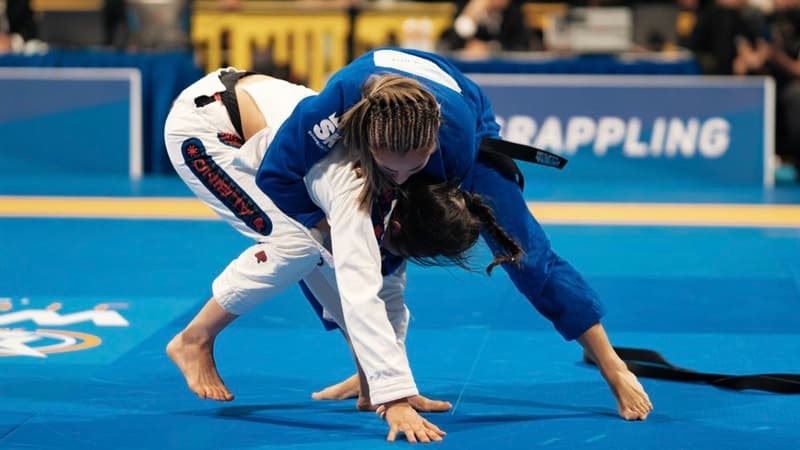
Changing your BJJ stance changes the opening exchange
Quick answer: Changing your lead leg changes the starting relationship between you and your partner, including which side is nearer and which grips feel immediately available. Study that change with a coach through controlled movement and grip practice before adding takedowns. A useful stance is one you can move from and recover, not just one that looks correct while you stand still.
Moving one foot can make a familiar opening feel unfamiliar. The grip you expected is farther away, your preferred entry no longer appears at the same angle, and your partner is approaching a different side.
That is a useful reason to study stance before collecting another takedown. If the starting relationship is unclear, it is difficult to know whether an entry failed because of the technique, the distance, or the arrangement you began from.
This article offers questions and a controlled practice structure to discuss with an instructor. It is not a complete takedown lesson. Keep standing practice within the coach's instructions, your experience, and the space available.
Name which leg leads before judging the exchange
Begin with a simple observation: which foot is forward for each person? Then notice whether that relationship stays the same as you move. You may discover that the position you thought you were practicing disappears before either partner establishes a grip.
USA Wrestling's introductory folkstyle curriculum includes both staggered and square stances, followed by motion. That structure is a useful reminder that stance and movement belong together. A wrestling curriculum does not settle every BJJ choice, but it provides a clear starting vocabulary.
For your own practice, ask the coach what arrangement suits the exchange being taught. Do not choose a lead solely because it resembles a favorite athlete's photograph. The photograph cannot explain what happened immediately before or after it.
If you change sides, make the change deliberate during the exercise. Notice what now feels different instead of rushing to restore the familiar arrangement. You are gathering information about the starting relationship, not proving that both sides must feel equally comfortable today.
The first useful result may be recognizing your habit. An unnoticed change of lead can otherwise make several attempts look inconsistent for reasons you have not identified.
Study the relationship between two stances
Your stance exists in relation to another person. Looking only at your own feet leaves out half the arrangement. The other person's lead, distance, and orientation affect the opening you are trying to understand.
BJJ Mental Models' discussion of mirrored stances treats stance as a relationship affecting available angles and attacks. Its model is one teaching framework; use it as a subject to discuss with your coach rather than as an instruction to override the situation being demonstrated.
A straightforward comparison is to hold your own starting lead constant while your partner changes theirs. Without attempting a takedown, identify which side is closer and what you can reach without overextending. Then ask the instructor to explain the opening relevant to that arrangement.
Avoid attaching a universal good or bad label to a stance after one attempt. The question is what the arrangement permits or makes difficult in the specific exercise. A position that supports one action may require adjustment for another.
This is also why changing your own lead can alter the exchange even when your partner does nothing new. You changed a relationship, not simply the appearance of your posture.
Connect your hands to the position of your feet
An opening grip should be considered alongside the position from which you reach for it. If changing your lead makes you stretch or turn differently, ask the coach whether the intended grip still fits the setup. Do not preserve the hand movement while ignoring everything that changed beneath it.
Start slowly enough to notice the sequence. Where were your feet when you reached? Did you move first or extend your arm first? What did the partner do in response? Those observations are more useful than deciding that your grip fighting is generally poor.
For gi practice, compare the particular cloth grips being taught. For no-gi, use the contacts the instructor specifies. Do not assume an opening transfers unchanged between formats merely because the bodies begin in a similar outline.
A partner can help by describing what they noticed rather than correcting your entire stance. Perhaps they could reach a side you thought was protected, or perhaps your attempt pulled you out of the arrangement you intended to keep. Take that observation to the coach.
The article on useful partner feedback offers a practical boundary: report the exchange you experienced, then separate that report from a technical conclusion you are not qualified to make.
Move before adding a finish
A stance that feels comfortable when still may be harder to maintain while approaching, retreating, or turning. Ask the instructor for a movement exercise appropriate to your level before trying to solve that difficulty inside a full standing round.
The purpose is to observe whether you can keep moving from the chosen arrangement without becoming stuck or hurried. Follow the coach's cues on posture and steps. There is no need to improvise a new set of movement rules from a written description.
Keep the pace low enough that either partner can stop the exercise easily. If you are repeatedly running out of room, change the practice area or task with the instructor's approval. Crowded mat space is a reason to adjust the exercise, not a test of determination.
Do not add surprise takedowns to an agreed movement-only drill. The partner has consented to a particular task, and changing it without warning changes the conditions of practice. Agree on each progression before beginning it.
If falling skills or standing experience are limited, tell the coach. The appropriate next step may be more instruction before live takedown work. There is plenty to examine about distance and lead position without turning the first comparison into a contest.
Compare two openings under the same conditions
Choose one narrow question with the coach. For example, you might compare how comfortably you reach a specified contact from each lead, or how well you recognize the partner changing sides. The exact task should fit the lesson and the pair.
Keep the comparison simple:
Use the same partner and agreed starting distance.
Change only the lead arrangement being examined.
Keep the allowed actions and pace consistent.
Pause to describe what changed before adding complexity.
These are suggested organizational rules, not a validated test of athletic ability. A few attempts can help you formulate a better question. They cannot establish that one stance is objectively superior for you in every situation.
If the exercise becomes confusing, return to the starting arrangement and ask what you are measuring. Perhaps one partner is trying to win a grip exchange while the other thinks the task is only to maintain distance. The result will be difficult to interpret until the objectives match.
Our guide to repeating a starting position addresses this problem more generally. Repetition is easier to learn from when the setup and stopping point are clear enough to repeat honestly.
Separate unfamiliarity from a reason to switch permanently
Your less familiar lead may feel awkward. That observation does not by itself prove that it is a bad choice, nor does it prove that you should rebuild your entire standing game around it. Ask what the coach wants you to learn from the comparison.
There can be value in understanding an arrangement without making it your preferred start. Recognizing what your partner has changed may be the immediate purpose. Developing another option may be a longer project. Those goals call for different expectations.
Avoid making a permanent decision after a single successful exchange. One partner's reaction, the pace of a drill, or a familiar grip may have influenced the result. Keep the conclusion as narrow as the evidence: this attempt felt different under these conditions.
Likewise, do not treat several awkward attempts as a personal limitation. Identify the specific difficulty. If the issue is where your feet finish after a step, that is a clearer teaching question than announcing that you cannot use the other side.
The coach can then decide whether to adjust the setup, simplify the movement, or leave the variation for later. Useful practice includes choosing what not to add yet.
Return to the full exchange without forcing the experiment
When the instructor considers it appropriate, return to a broader exchange and look for the arrangement you studied. It may appear only briefly. Notice whether you recognize it earlier or understand why your preferred opening is unavailable.
Do not insist on switching stance simply because the practice block concerned switching. A training idea should help you interpret the situation, not oblige you to perform a particular action regardless of what your partner is doing.
Afterward, describe one exchange to the coach. State which leg led, what contact you attempted, and where the arrangement changed. That gives the conversation enough detail to move beyond a general complaint that standing feels difficult.
If the relevant situation never appeared, that is worth mentioning too. You may need to work on reaching the starting relationship rather than making the next action more elaborate. The experiment can reveal an earlier problem than the one you expected.
Leave the session with a manageable next step. One movement correction or one clearer observation is sufficient. You do not need a complete theory of every stance combination before the next class, and a successful practice block does not require pretending you have one.
Main photo: IBJJF; illustrative archive photograph.
The takeaway
Changing your lead leg changes the opening relationship with your partner. Look at both people, connect the hand position to the foot position, and examine movement before judging the success of an entry.
Use controlled comparisons to ask better questions of your coach. The aim is to understand what changed and what action fits the new arrangement, then recognize that situation when it appears during appropriate live practice.
Find coaching for your standing game
Use the gym directory to ask about classes that include standing instruction suitable for your experience.
FAQ
Should my dominant leg always lead in BJJ? Do not make that decision from dominance alone. Ask your coach which lead fits the actions you are learning and the situation being practiced.
Should I learn both lead arrangements? Discuss that with your instructor. Understanding a less familiar arrangement can be useful without requiring you to make it your preferred start immediately.
Can I study stance without doing takedowns? Yes. With the coach's approval, controlled movement and specified grip or contact exercises can help you examine the opening relationship before adding takedowns.
How should I judge a stance change after practice? Describe the specific exchange, including both partners' leads and the attempted action. Avoid turning a few attempts into a universal conclusion about which stance is best.

Nina Okada
Nina Okada explains positions the way a good training partner does: one problem at a time, with the limits of the explanation said out loud. She is careful about the difference between what footage shows and what it only suggests.
Related Posts

Mikey Musumeci gives up the belt to make room for MMA
Musumeci is vacating his UFC BJJ title to focus on MMA training. What he is leaving, what continues, and why the transition matters.
IBJJF membership: finish the paperwork before the deadline
IBJJF membership and tournament entry are separate steps. Plan documents, professor approval, renewals, and junior accounts before registration closes.
Choosing a BJJ seminar worth your time and travel
Choose a BJJ seminar by the subject, teaching format, access, and total cost. Know what to ask the host before buying a ticket.
Comments (0)
Loading comments...