

ADCC 2026 heavyweight results: Griffith and Hugo take gold
Quick answer: Luke Griffith won ADCC 2026 at −99 kg, while Victor Hugo won +99 kg. Kaynan Duarte and Josh Saunders took the respective silver medals. ADCC’s October awards announcement confirms that Hugo won all four of his weight-division matches by submission.
The two heaviest men’s weight divisions ended with different champions. Luke Griffith finished above Kaynan Duarte at −99 kg. Victor Hugo finished above Josh Saunders at +99 kg, then received official recognition for a four-submission title run.
Putting those results beside one another is useful because heavyweight coverage often compresses several separate achievements. A weight-class gold, an absolute medal, and the superfight are different records. The 2026 championship produced crossovers between those assignments, but it did not merge them into one title.
Two divisions, two podiums
The official ADCC 2026 brackets list Griffith and Hugo as the heavyweight champions at TAURON Arena in Kraków. The event ran on September 12–13.
Men’s −99 kg: Luke Griffith, gold; Kaynan Duarte, silver; Daniel Schuardt, bronze.
Men’s +99 kg: Victor Hugo, gold; Josh Saunders, silver; Mark Macqueen, bronze.
These are weight-division results. They do not describe the absolute bracket, where athletes can meet outside their regular weight categories. Nor do they describe the scheduled superfight, which had its own pairing and result.
The distinction gives each result its proper size. Griffith’s championship came in the −99 kg bracket. Hugo’s came in the +99 kg bracket. Saunders’ silver and Macqueen’s bronze belong to that second division, even though the absolute competition offered another set of potential meetings during the same championship.
Methods should also remain attached to the correct competition. ADCC later confirmed four submissions for Hugo’s +99 kg run. That statement is about those four weight-class matches, not every match he may have contested elsewhere on the card.
Griffith’s path to the −99 kg title
Griffith’s published route began against Marcin Maciulewicz. It continued through Steffen Banta in the quarterfinal and Achilles Rocha in the semifinal. Duarte was the opponent in the championship match. Four wins made the gold-medal run.
That order provides a straightforward viewing plan. The Banta quarterfinal takes the viewer into the last eight, the Rocha semifinal into the medal rounds, and the Duarte final into the longer championship format. It also prevents a later absolute match from being mistaken for a step in Griffith’s weight division.
The semifinal and final connected Griffith with athletes who had their own substantial tournament records. The bracket itself, however, is the source for advancement rather than a complete technical explanation. It does not justify assigning the same method, score, or pacing to each win.
A useful review would watch the start and end of each contest with the round clearly identified. What position existed when positive points became available? What did the scoreboard require late? Those questions can be answered from the match. A claim about what Griffith privately intended would need direct reporting.
Duarte and Schuardt’s medal routes
Duarte advanced through Nicholas Maglicic, Javier Zaruski, and Daniel Schuardt before meeting Griffith. His silver therefore includes three earlier wins and the final defeat. Schuardt went from the semifinal loss to a bronze match against Achilles Rocha, which he won.
The third-place contest is a useful part of this division’s account. Rocha and Schuardt reached it through opposite semifinals, then met to decide the final medal. Bronze was settled by that contest rather than by a comparison of how each had lost to a finalist.
Duarte’s result is particularly easy to mislabel because he also appeared in the superfight. His −99 kg silver does not turn that separate match into the weight-class final. A replay title needs the division or superfight designation as well as the athlete names.
The ADCC historical record lists Duarte as −99 kg champion in 2022 and 2024. Griffith’s 2026 gold changes the division’s recent title sequence. It does not erase Duarte’s earlier championships or imply that a different event’s standings have changed.
Hugo’s four opponents at +99 kg
Hugo opened against Heikki Jussila, advanced through Ruslan Abdulaev in the quarterfinal, and defeated Macqueen in the semifinal before meeting Saunders for gold. That is the four-match route in the official bracket.
ADCC’s 2026 best-of awards announcement, published on October 19, adds a significant detail: Hugo won all four of those matches by submission. The announcement named him Best Fighter for the championship. This article uses that later confirmation rather than trying to derive methods from bracket lines.
Four submissions in four matches is a complete finishing record for that weight-class run. It still does not specify every technique or finishing time. Naming four opponents and confirming four submissions is accurate; supplying an unsourced list of particular locks and chokes would not improve the account.
The award is also separate from the gold medal. The title came from winning the bracket. The Best Fighter selection was an additional official judgment announced afterward. Both belong in Hugo’s 2026 record, with their different dates and purposes intact.
Saunders’ route and Macqueen’s bronze
Saunders reached the +99 kg final through Francis Pana, Roosevelt Sousa, and Felipe Pena. Those three wins placed him opposite Hugo. His silver medal records a run through the draw, rather than merely a supporting role in the champion’s final match.
Macqueen lost the semifinal to Hugo and then defeated Pena for bronze. Pena had lost the other semifinal to Saunders. The bronze match thus joined the two semifinal losers and produced the final place on the +99 kg podium.
Pena’s name is another reason to preserve category labels. His later absolute gold does not make him the +99 kg champion, and the +99 kg bronze result does not describe his absolute final. Two different brackets can produce very different placements for the same athlete without any inconsistency.
If the aim is to watch the +99 kg medal rounds, begin with Hugo–Macqueen and Saunders–Pena, then add Macqueen–Pena and Hugo–Saunders. That order explains the podium before a viewer expands into the earlier rounds or the separate absolute competition.
The heavyweight history behind the change
The official historical statistics list Pena as +99 kg champion in 2024, Gordon Ryan in 2022, Duarte in 2019, and Marcus Buchecha Almeida in 2017. Hugo adds his name to that recent sequence with the 2026 title.
Across the two heavyweight categories, 2026 therefore changed both names at the top compared with 2024. Griffith replaced Duarte in −99 kg, and Hugo replaced Pena in +99 kg. This is a comparison between championship editions, not a claim that each new champion defeated the previous titleholder in the final.
That last distinction is concrete. Griffith did face Duarte for gold. Hugo’s final opponent was Saunders, while Pena’s route ended in the bronze match. A sentence that simply calls both titles victories over defending champions would distort the +99 kg bracket.
The ADCC explainer gives the wider format. These heavyweight records add the details needed to distinguish title changes, actual final pairings, and the separate opportunities that the absolute bracket creates.
Read heavyweight exchanges with the rules in view
A heavyweight contest can look slow in a short clip and become much clearer in the full match. The ADCC championship rules set different regulation lengths for qualifying rounds and finals, and divide matches into scoring phases. The visible scoreboard needs to be read alongside the clock.
That is especially relevant when comparing a submission win with a match that reaches a decision. The official result tells you the outcome; the replay shows the positions, restarts, warnings, and available time that preceded it. Neither type of result alone establishes that an athlete was careless or unwilling to engage.
For training study, a narrow positional question is more productive than trying to copy the entire competitive style of a champion. Watch how an exchange starts, when control becomes established, and what creates the next legal choice. A coach can help choose a suitable version for a normal practice round.
The same care belongs in future comparisons. Write down event, year, category, round, opponent, and confirmed method. That small record is enough to stop Hugo’s four +99 kg submissions, Griffith’s title, Pena’s absolute result, and Duarte’s superfight from collapsing into one misleading heavyweight summary.
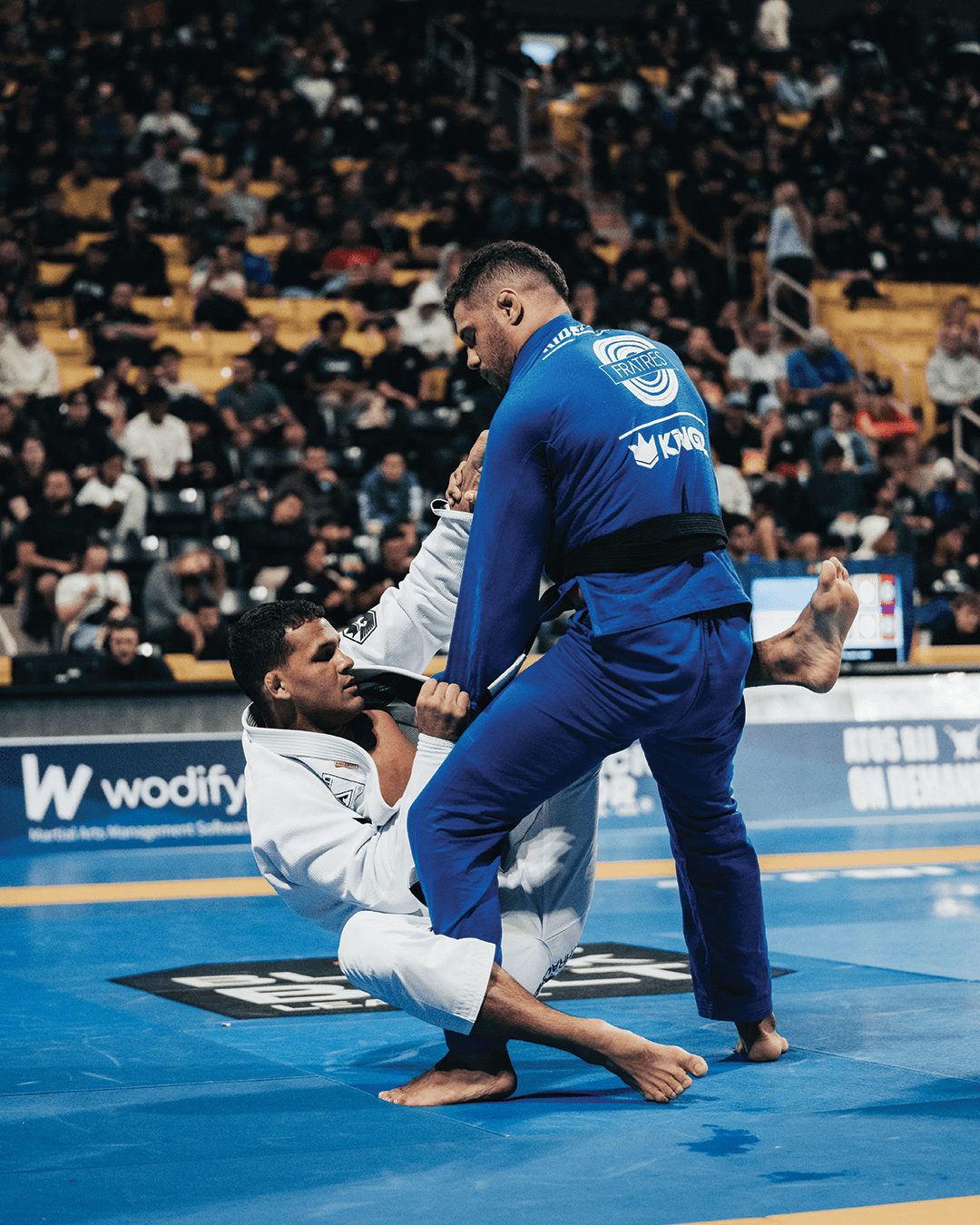
Main photo: Luke Griffith at ADCC 2026 — ADCC / FloGrappling; public highlight frame.
The takeaway
Griffith won −99 kg through Maciulewicz, Banta, Rocha, and Duarte. Hugo won +99 kg through Jussila, Abdulaev, Macqueen, and Saunders, with ADCC later confirming four submissions and naming him Best Fighter.
Both heavyweight titles changed hands from the previous championship edition. The full picture also includes two distinct silver medalists, two bronze matches, and separate absolute and superfight records that should retain their own labels.
Follow the next bracket
Use the tournament directory to find events, then check the organizer’s official schedule and category information before making plans.
FAQ
Who won the ADCC 2026 heavyweight divisions? Luke Griffith won men’s −99 kg, and Victor Hugo won men’s +99 kg. They are separate weight-class champions.
Did Victor Hugo submit all four opponents? Yes. ADCC’s October 19 awards announcement confirms four submissions in four +99 kg matches and names Hugo Best Fighter.
Who earned the heavyweight bronze medals? Daniel Schuardt won −99 kg bronze against Achilles Rocha. Mark Macqueen won +99 kg bronze against Felipe Pena.
Was Kaynan Duarte’s superfight the −99 kg final? No. Duarte faced Griffith in the −99 kg final and Yuri Simões in a separate superfight. Those results should not be combined.

Miles Serrano
Miles Serrano writes about competitors and the decisions that shaped their careers. He is more interested in the adjustment someone made in the third minute than in the medal count afterward.
Related Posts

IBJJF athlete rankings: read the points behind the place
Read IBJJF athlete rankings through category, placing, event weight, and season weight, with a clearly labeled calculation example.
The IBJJF double guard pull puts both players on a clock
Understand the IBJJF double guard pull, its 20-second countdown, and why coming on top is a different decision under another ruleset.

BJJ overtime: check what changes after the clock runs out
Overtime depends on the event and round. Read the duration, scoring phase, and restart procedure before planning the extra minutes.
Comments (0)
Loading comments...