

ADCC 2026 awards: the matches behind the official selections
Quick answer: ADCC named Victor Hugo its 2026 Best Fighter, Achilles Rocha the Best Takedown winner, and Marlon Tajik the Fastest Submission winner. Best Fight went to Rocha against Roberto Abreu. The October 19 announcement is an official awards selection, separate from the championship podiums.
A gold-medal list and an awards list answer different questions. The first identifies who won the brackets. The second identifies performances the organizer chose to recognize afterward. At ADCC 2026, those lists overlap, but they are not identical.
Victor Hugo’s +99 kg title run earned the Best Fighter award. A −99 kg quarterfinal supplied both Best Takedown and Best Fight. The fastest submission came from an absolute quarterfinal. The category labels are what make the selections understandable.
The official selections
ADCC’s 2026 best-of announcement, published October 19, identifies four awards from the September championship in Kraków:
Best Fighter: Victor Hugo.
Best Takedown: Achilles Rocha against Roberto Abreu, −99 kg quarterfinal.
Fastest Submission: Marlon Tajik against Javier Zaruski, absolute quarterfinal.
Best Fight: Achilles Rocha against Roberto Abreu, −99 kg quarterfinal.
These are the organizer’s official selections. They should not be presented as a unanimous vote by every viewer, a statistical ranking of all athletes, or a replacement for the division results. Each has its own stated basis and competitive context.
The announcement also adds specific details useful for a results archive: Hugo’s four submissions in four weight-class matches, a timestamp for Rocha’s takedown, and a technique and time for Tajik’s finish. Those details belong to the named performances rather than to every match involving the athletes.
Why Hugo was named Best Fighter
The awards report credits Hugo with winning all four +99 kg matches by submission. The official event bracket places Heikki Jussila, Ruslan Abdulaev, Mark Macqueen, and Josh Saunders along his route to gold.
Together, the two sources establish a complete finishing record for that weight-class championship run: four opponents, four wins, four submissions. The bracket supplies the route; the later announcement supplies the all-submission confirmation and award.
That is more precise than calling Hugo the winner of every heavyweight competition at the event. Luke Griffith won −99 kg, and Felipe Pena won the absolute. Hugo’s +99 kg gold and Best Fighter selection are substantial results without borrowing those separate titles.
The award report does not require a guessed list of finishing techniques to become useful. It confirms the four submissions but does not provide every method and finishing time in that statement. A technique-by-technique breakdown should use the relevant full matches rather than fill those gaps from memory.
The takedown award belongs to a specific quarterfinal
Rocha’s Best Takedown came against Roberto Abreu in the men’s −99 kg quarterfinal. The official awards report places it at 0:38 of overtime. That clock detail is part of the reported award, not a claim that the whole match lasted only thirty-eight seconds.
The overtime label matters. A reposted clip can retain the action while losing the match phase. If the caption then calls it an opening-round takedown or a thirty-eight-second match, the description has changed the record even though the footage itself is authentic.
The award also identifies a moment, rather than automatically establishing a universal technical lesson. A high-level takedown occurs within a match with its own grips, boundary position, fatigue, and score. A useful replay review needs that surrounding sequence before deciding what might be relevant to training.
For practice, the sensible question is how a coach would adapt the entry and landing to a controlled exercise. The award is not permission to recreate a large-amplitude movement with an unprepared partner. Competitive recognition and a suitable training progression are separate judgments.
Fastest Submission came from the absolute
Tajik’s recognized finish was a footlock against Javier Zaruski at 1:13 in an absolute quarterfinal. Those are the technique category, opponent, time, and round named by the official announcement.
The absolute designation prevents confusion with Tajik’s −88 kg silver-medal run. His weight-class final was against Pawel Jaworski. The Zaruski match belonged to another bracket, so the fast finish should not be attached to the −88 kg final or described as the method of that championship result.
Fastest Submission is also narrower than best submission. The former award identifies speed within the organizer’s selection. It does not establish that every viewer would choose the same finish as the most technically difficult or most impressive of the tournament.
The official wording here is footlock. Replacing it with a more specific lock name without another reliable source would add a claim the announcement does not require. A precise result archive can retain the organizer’s term and leave a finer technical classification to the match footage and qualified analysis.
Best Fight recognizes both athletes
The same Rocha–Abreu −99 kg quarterfinal received Best Fight. That award names a contest involving two athletes. It should therefore retain both names rather than crediting only the athlete who also received the takedown award.
A best-fight selection is an editorial judgment by the awarding organization. It can be reported clearly without pretending that every match has been reduced to a single objective score for excitement. Viewers may value different exchanges, but the official selection is still a verifiable part of the event record.
The overlap between Best Fight and Best Takedown makes the quarterfinal an obvious replay candidate. It does not mean the takedown alone explains the entire award. Watching the full match preserves the earlier exchanges, resets, and overtime context that a short award clip may omit.
For a reader with limited time, the useful first step is to find the correct quarterfinal and establish its clock. The takedown timestamp can then guide a second look at the recognized moment. Beginning with the whole contest avoids mistaking a highlight for a complete account of the match.
Awards and podiums should have different fields
A competition archive works better when title, placement, and award are stored separately. Hugo can be listed as +99 kg champion and Best Fighter. Tajik can be listed as −88 kg runner-up and Fastest Submission winner for an absolute match. Neither needs a blended title that the event never awarded.
The ADCC historical statistics organize championship results by category and year. The October awards announcement adds another layer. The publication date matters because an article written before October 19 should not claim that the later awards had already been announced.
This separation also makes future comparisons fairer. A gold medal comes from winning the required bracket. An award comes from an additional selection. The absence of an award is not evidence that another champion performed poorly, and an award does not change the official medal placements.
The ADCC overview explains the event’s larger structure. The awards are a useful companion to that structure, pointing viewers toward particular performances after the full results are already established.
Build a short viewing session around the selections
Start with one of Hugo’s +99 kg matches, then watch Rocha–Abreu in full, and finish with Tajik–Zaruski in the absolute. That is a recommendation for variety, not a claim that three replays can represent everything important from the championship.
Keep the round and match phase visible. The ADCC rules give Worlds qualifying matches and finals different regulation lengths, and scoring phases affect the meaning of an exchange. An overtime timestamp should remain an overtime timestamp in the notes.
For each match, record one question that can be answered from footage: what position preceded the finish, what happened before the awarded takedown, or how control was maintained through a reset. A narrow question is more useful than a general claim that the award proves a universal style is superior.
Then separate observation from application. The replay may be excellent study material while a particular finish or throw remains unsuitable for an unsupervised practice attempt. Ask a coach for a controlled version and agree on the legal techniques with a partner before using the position in a round.
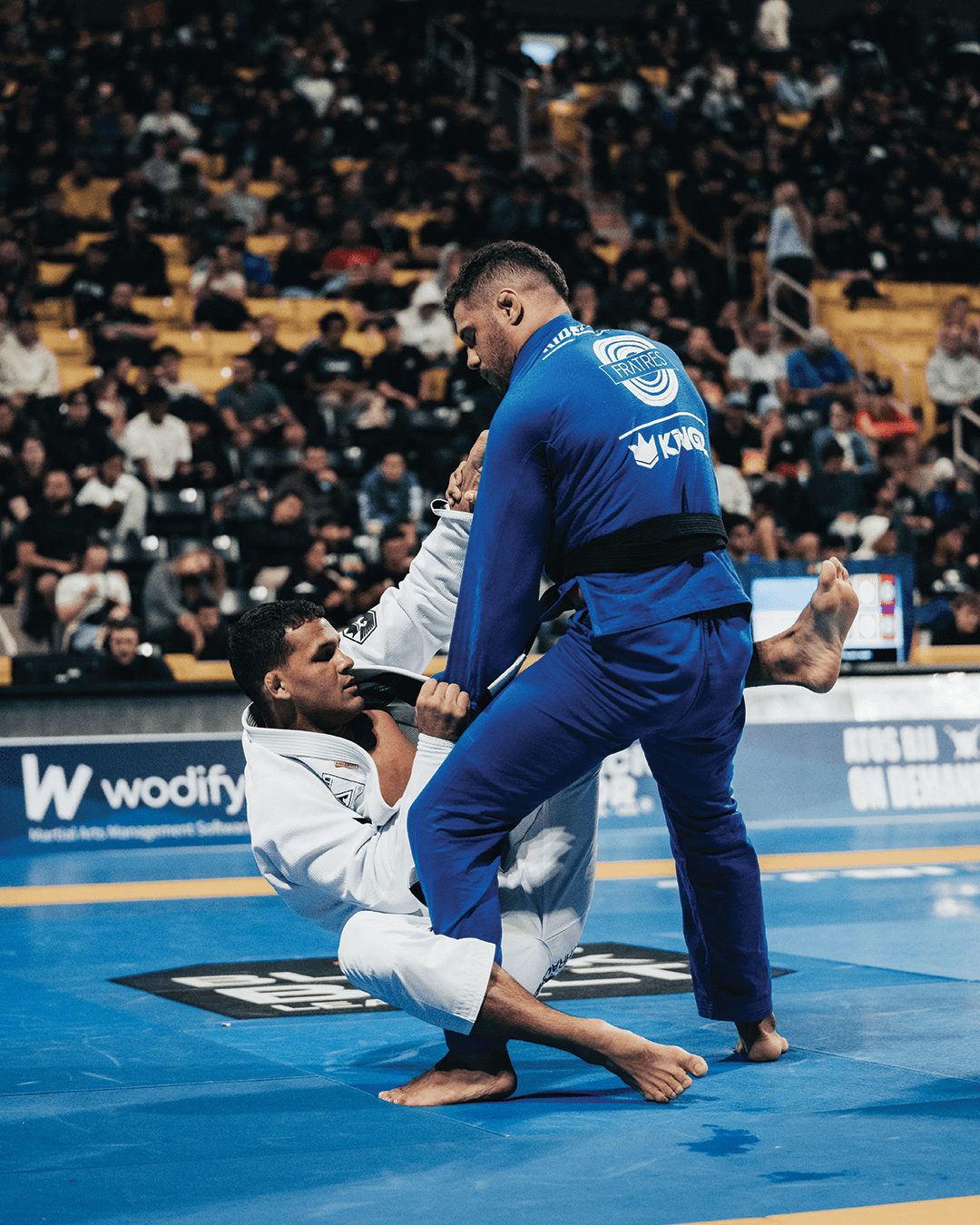
Main photo: Victor Hugo at ADCC 2026 — ADCC / FloGrappling; public highlight frame.
The takeaway
The official 2026 awards recognize Hugo’s four-submission +99 kg run, Rocha’s overtime takedown against Abreu, Tajik’s 1:13 absolute footlock against Zaruski, and the Rocha–Abreu quarterfinal as Best Fight.
Each selection becomes more informative when its category, opponent, round, and announcement date stay attached. The awards offer a focused replay list alongside the podiums, without replacing the championship results or pretending that an organizer’s choice is a universal ranking.
Find the next tournament
Browse upcoming competitions, then use the organizer’s official page to confirm schedules, divisions, and viewing information.
FAQ
Who was ADCC 2026 Best Fighter? Victor Hugo. The official announcement credits him with four submissions in four matches on his way to the +99 kg title.
Who won Fastest Submission? Marlon Tajik, for a footlock against Javier Zaruski at 1:13 in an absolute quarterfinal.
Which match won Best Fight? Achilles Rocha against Roberto Abreu in the men’s −99 kg quarterfinal. Rocha also received Best Takedown for an exchange in that match.
When were the awards announced? ADCC published the official selections on October 19, 2026, after the September championship. The award date is separate from the date the matches occurred.

Miles Serrano
Miles Serrano writes about competitors and the decisions that shaped their careers. He is more interested in the adjustment someone made in the third minute than in the medal count afterward.
Related Posts

ADCC 2026 heavyweight results: Griffith and Hugo take gold
Luke Griffith won minus 99 kg and Victor Hugo won over 99 kg at ADCC 2026. Their routes, medalists, and the meaning of Hugo’s four submissions.

IBJJF athlete rankings: read the points behind the place
Read IBJJF athlete rankings through category, placing, event weight, and season weight, with a clearly labeled calculation example.
The IBJJF double guard pull puts both players on a clock
Understand the IBJJF double guard pull, its 20-second countdown, and why coming on top is a different decision under another ruleset.
Comments (0)
Loading comments...