
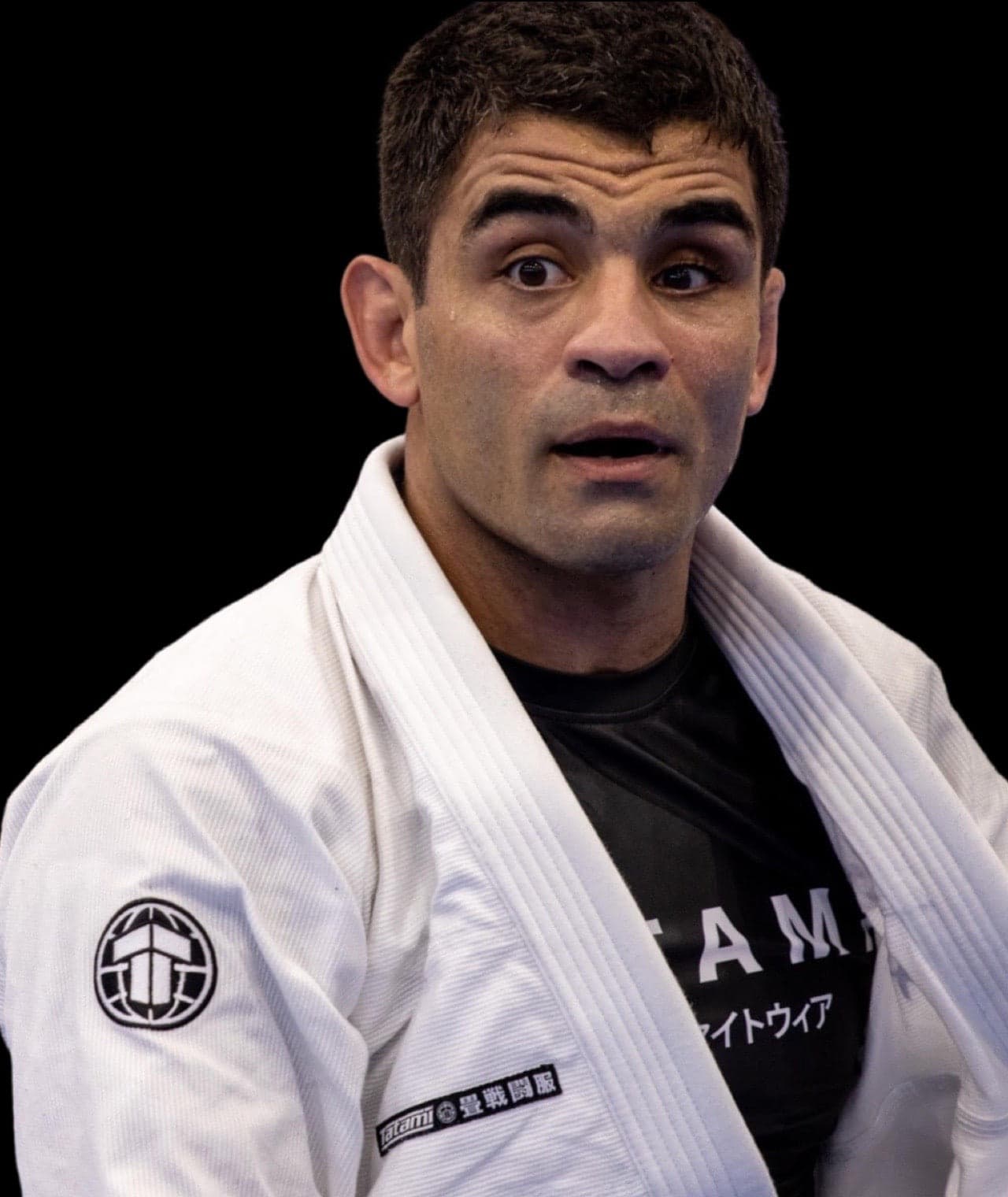
Vitor Shaolin Ribeiro: three Worlds titles, two weight classes
Quick answer: Vitor "Shaolin" Ribeiro won adult black belt Worlds gold in 1999, 2000, and 2001, taking the first two titles at lightweight and the third at middleweight. He also earned ADCC bronze in 2003 and became a Shooto champion in MMA. The change of division inside that three-year Worlds run is a detail worth remembering alongside the nickname.
Three consecutive championships can look tidy on a biography. Put the years next to the divisions and Shaolin's run becomes more interesting: light, light, middle. The sequence did not simply repeat itself.
Vitor Ribeiro's name belongs in several versions of combat-sports history. For a BJJ reader, the best starting point is the stretch when the Worlds results kept putting him first. There is enough substance in those records without decorating them with an invented locker-room speech or a story about what he must have been thinking.
Start with the first lightweight title
The IBJJF's 1999 Worlds results place Vitor Ribeiro of Nova União first in the adult male black belt lightweight division. Márcio Feitosa is second; Renato Barreto and Wellington Dias occupy the bronze positions. That is the official outline of the first title in the sequence.
A podium is not a complete match report. It tells us where the athletes finished, but it does not supply every exchange that put them there. The distinction matters when looking back at a career whose results can circulate much more easily than full footage.
For a newer reader, begin with the names and the division rather than a claim that the entire era was stronger or weaker than today's. Different generations do not need to be placed in a fictional bracket before their achievements become worth understanding. Winning the event in front of you is already a concrete accomplishment.
That first line gives the story an anchor. The next year gives it repetition, which is where a single result begins to look like a sustained presence.
The next year kept the same top two
In 2000, the official lightweight podium again lists Ribeiro first and Feitosa second. Leonardo Santos and Leonardo Vieira take the bronze places. The headline is another championship; the surrounding names give it a little more shape.
It is tempting to turn consecutive titles into a single uninterrupted highlight. That can erase the difference between winning once and returning to another event that still has to be contested. A previous result is part of the background. It does not perform the next match on an athlete's behalf.
That is the value of reading the seasons separately. You can recognize the repeated outcome without pretending that the second tournament was merely a formality. The record supports consistency in the result, not a claim that every moment along the way was easy.
For an ordinary competitor, this is a useful way to think about repeat appearances too. You may arrive with a medal from last time. The new bracket still contains actual people with their own preparation, and the old medal remains in your bag.
The third title changed the category
The 2001 Worlds archive moves Ribeiro's name to the top of adult male black belt middleweight. Fernando Augusto is listed second, with Bruno Severiano and Bruno Fernandes third. Shaolin's third consecutive gold therefore came in a different division from the first two.
That small change is easy to miss in the phrase "three-time world champion." It is also the most useful reason to slow down over the résumé. The years describe continuity; the division describes a change within it. Both are needed to understand what the record actually says.
We do not need to invent a reason for the move. A results page cannot tell us whether a weight change was a long-term plan, a practical decision, or something else. It can tell us which category he won. Keeping those boundaries clear leaves room for real reporting instead of replacing it with a plausible-sounding explanation.
Three gold medals across three years is the central fact. Two weight classes is the detail that makes the sequence more specific than a number beside his name.
Keep the title count precise
Combat-sports biographies often combine achievements from different belts, age groups, formats, or events. That can be reasonable if the categories are explained. It becomes confusing when a broad total is silently treated as one particular championship record.
For this part of Shaolin's career, the clean description is narrow:
Adult black belt Worlds lightweight champion in 1999.
Adult black belt Worlds lightweight champion in 2000.
Adult black belt Worlds middleweight champion in 2001.
This is not a claim that nothing else on his résumé matters. It is a way of identifying exactly which three championships are under discussion. A reader should not have to guess whether a number includes colored-belt or masters results.
The same care improves almost any athlete profile. Keep the competition name, category, and year attached to the achievement. Once those are clear, a reader can appreciate the result without relying on a large, ambiguous label. Specificity gives a career more texture than a bigger total with its explanation removed.
ADCC adds another kind of podium
Shaolin's record also reaches beyond the gi. The official 2003 ADCC results list him third at under 77 kilograms, behind champion Marcelo Garcia and runner-up Otto Olson. Chris Brown is fourth. It is a separate achievement under a different competition format.
That bronze deserves its own sentence rather than being used only as a bridge between the Worlds titles and MMA. A career can contain important results that do not all share the same medal color. Reducing every athlete to gold medals leaves much of the competitive record unread.
It also helps to resist writing backward from later fame. If a reader already knows one name on a historical podium, that familiarity can pull attention away from everyone else. Read all four positions before deciding that the event is only a chapter in one person's story.
For a related look at the period, our profile of Ricardo Arona's ADCC run follows another athlete whose grappling results deserve attention in their own right. The overlap is a reminder that an era contains several stories at once.
The MMA record has its own evidence
The official Shooto fighter record identifies Ribeiro as a former world champion in its historical welterweight division. It records his December 2003 submission victory over Joachim Hansen, a July 2004 decision win over Mitsuhiro Ishida, and a December 2004 TKO loss to Tatsuya Kawajiri.
Those entries establish that the MMA chapter was substantive. They also deserve their own context. A division label in one promotion and period should not automatically be read as the identically named weight class used elsewhere. The opponent, event, and date matter alongside the word "champion."
Moving from grappling results to MMA results changes the questions a viewer should ask. Strikes alter the consequences of distance and posture. A position that is useful for a sporting objective in one ruleset may carry a different tradeoff in another. A championship résumé does not remove those differences.
That is why a crossover career is more interesting than a simple claim that one sport proves another. Each format gives the athlete a different task, and each result belongs to the task actually contested.
Study the footage without borrowing the legend
A famous athlete's name can make every movement in an old clip seem like a hidden lesson. Approach the footage more patiently. First identify the event and rules, then watch a complete exchange before extracting a technique from it.
Ask what is visible. Where are the grips? Which person controls the distance? What happens immediately before the position changes? If the camera cuts away, leave the missing part missing rather than filling it with a confident explanation.
When a coach helps you study an older match, choose one manageable question. You might follow how a particular connection is established or how an opponent's response changes the next decision. That is more useful than trying to adopt an entire champion's game after a highlight compilation.
The athlete's achievement provides a reason to pay attention. It does not exempt a technical claim from needing evidence. You should be able to point to the exchange you are discussing, describe what you can actually see, and acknowledge where the view or your understanding runs out.
Let the name contain more than one career
There is a common shortcut in sports memory: the phase you encountered first becomes the main identity, and everything else becomes background. A viewer arriving through MMA may read the BJJ championships as an introductory credential. A grappler may treat the fighting record as an appendix.
Shaolin's record rewards a wider frame. The Worlds sequence has its own internal development. The ADCC podium belongs to another format. The Shooto results establish a further competitive chapter. None needs to be stretched into proof that every part of the career followed one inevitable plan.
That wider frame also makes room for readers with different interests. A gi competitor can begin with the change in weight class. A no-gi viewer can start with the ADCC field. An MMA fan can follow the Shooto opponents and then work backward toward the grappling record.
The nickname is the easy part to remember. The dates and divisions give it depth. They turn a familiar name into a career you can actually explore, one supported result at a time.
Main photo: Tatami Fightwear; archive portrait of Vitor Shaolin Ribeiro.
The takeaway
Shaolin's three consecutive adult black belt Worlds titles came across two weight classes. Keeping that detail attached to the total makes the achievement more informative, while the ADCC and Shooto records show how much else belongs beside it.
Start with the official results, then follow the matches that interest you. A strong sporting record does not need a manufactured inner monologue. It needs enough attention for the details to survive the summary.
Take one question to training
Find a place to practice through the gym directory, and bring your coach a specific exchange or technical question from the footage you study.
FAQ
How many consecutive adult black belt Worlds titles did Shaolin win? The IBJJF records show three, in 1999, 2000, and 2001. This count refers specifically to the adult black belt divisions in those events.
Did he win all three in the same weight class? No. The first two are listed at lightweight, while the 2001 championship is listed at middleweight.
Did Vitor Ribeiro medal at ADCC? Yes. ADCC's official 2003 results place him third in the under-77-kilogram division, behind Marcelo Garcia and Otto Olson.
Was Shaolin also an MMA champion? Yes. Shooto's official profile identifies him as a former world champion in its historical welterweight division and records his bouts against Joachim Hansen, Mitsuhiro Ishida, and Tatsuya Kawajiri.

Miles Serrano
Miles Serrano writes about competitors and the decisions that shaped their careers. He is more interested in the adjustment someone made in the third minute than in the medal count afterward.
Related Posts
Competing in gi and no-gi on the same day takes two plans
Prepare for gi and no-gi competition on the same day with separate rule checks, complete outfits, schedule coordination, and a realistic second-bracket plan.
Jiu-jitsu in Montreal: build the visit around a real class
Plan BJJ training in Montreal around confirmed classes, language arrangements, winter travel, visitor policies, and equipment that is ready to use.

BJJ gi pants that fit standing up can still fail on the mat
Check BJJ gi pants at the waist, rise, knees, and cuffs so a good-looking size label becomes a uniform you can actually move in.
Comments (0)
Loading comments...