
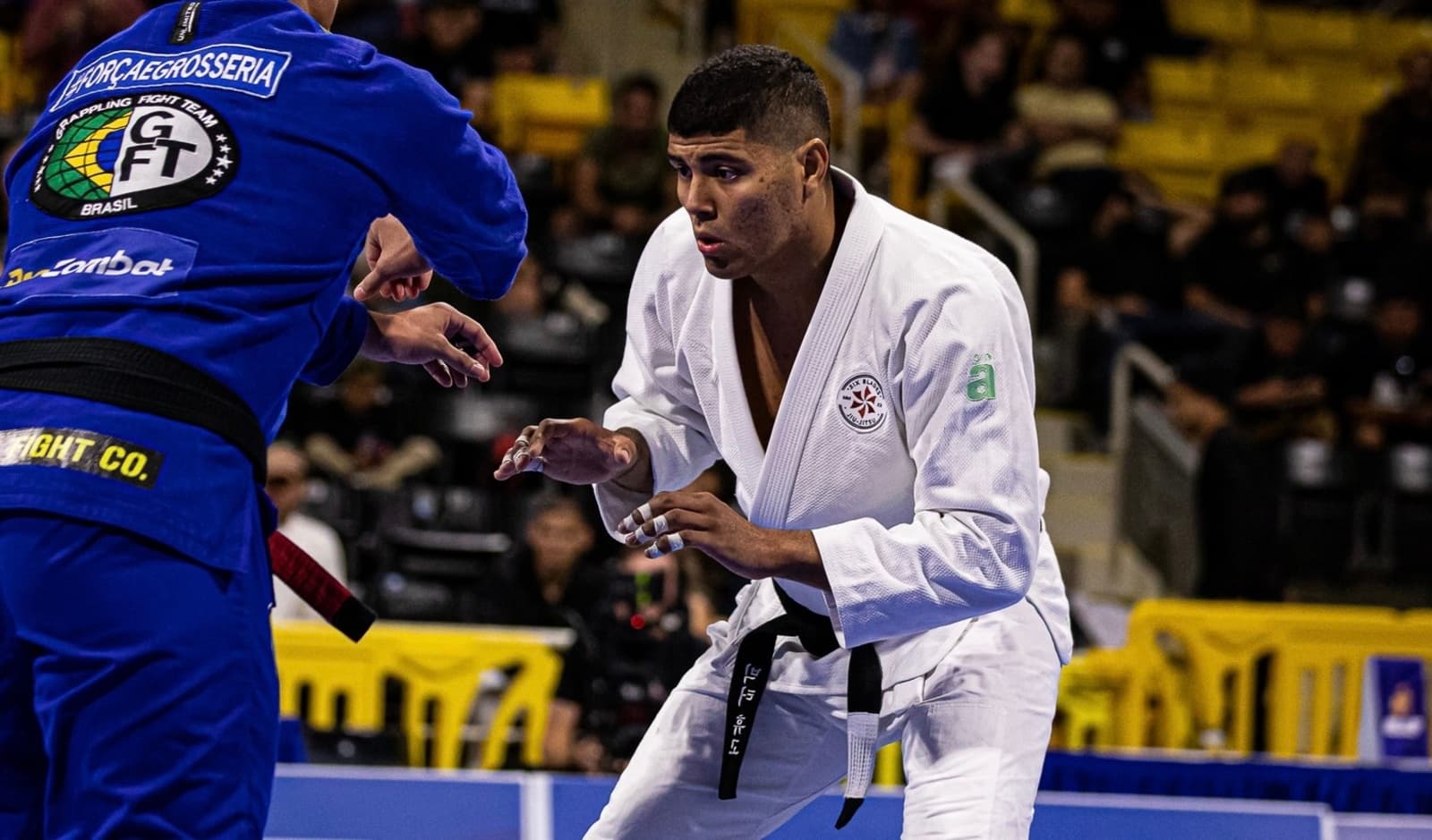
Victor Hugo: the 2019 double that announced a heavyweight
Quick answer: Victor Hugo won ultra-heavy and open-class gold at the 2019 IBJJF Worlds as a brown belt, then built a separate championship record at black belt. His early results are worth revisiting because the later success involved several different tests: changing rank, competing without the gi, recovering a losing score, and winning the absolute division. This profile follows that development through his 2023 Worlds double.
The 2019 results sheet gives Victor Hugo two first-place lines. Neither belongs to the adult black-belt division. Both belong to the brown belts, where his full name, Victor Hugo Costa Marques, appears above the ultra-heavy and open-class fields.
That detail makes the story more interesting, not smaller. A prospect had completed one level of competition. The question was what would survive the next. Reading his later titles backward can make the transition look inevitable, but the earlier medals did not decide the matches that followed.
Hugo offers a useful way into heavyweight jiu-jitsu because his record resists the easiest summary of it. Size identifies the division. It does not explain how a losing score becomes a win, or why a championship ends in a particular submission.
The brown-belt double deserves its own line
At the 2019 IBJJF World Championship, Hugo took adult brown-belt ultra-heavy gold ahead of silver medalist Matheus Luna. In the open class, Marcus Vinicius Ribeiro de Siqueira finished second. The official record lists Hugo under Ribeiro Jiu-Jitsu.
Those results establish the achievement without borrowing importance from his future. He won his weight category and the category that removed that particular boundary. Double gold describes two successful entries at the same championship, not a second name for one medal.
It is tempting to treat lower-belt competition only as advance publicity for black belts. That approach discards the thing the athlete actually won. The brown-belt field was the competitive assignment in front of Hugo, and its outcome belongs in the account on its own terms.
A careful profile therefore keeps two questions apart: how good was the result at the time, and what did the athlete do afterward? The second can add context to the first. It cannot turn a brown-belt medal into a black-belt medal retroactively.
The interest lies in the transition between them. A successful prospect still has to compete against people whose experience and records were built at the next rank.
The next chapter changed both rank and clothing
BJJ Heroes' career profile dates Hugo's promotion under Saulo and Alexandre Ribeiro to June 2019. Later that year, he won the black-belt open class at Worlds No-Gi. The IBJJF's retrospective before his 2023 Brasileiro debut identifies the final's decisive result: a kneebar against Roberto Abreu, known as Cyborg.
The chronology prevents a misleading shortcut. The brown-belt gi double and the black-belt no-gi absolute title were different competitions with different conditions. Putting them in one undifferentiated pile would make the collection larger on paper and less informative to the reader.
A no-gi result also gives the spectator another set of matches to study. The absence of cloth grips changes what is available to the athletes. That does not require an argument about which version of the sport is superior. It requires paying attention to the version being played.
For a viewer approaching Hugo's career for the first time, these distinctions make a manageable starting point. One athlete, two formats, and a promotion between major results: enough context to know what you are watching without pretending the early record predicts every later outcome.
A nine-to-two score hides a reversal
The final score of Hugo's 2022 Worlds ultra-heavy final was 9–2. On its own, that number can suggest a comfortable match. The sequence tells a different story.
The IBJJF's 2022 year in review describes Gutemberg Pereira taking the lead with a sweep and adding advantages while attacking Hugo's guard. Hugo then escaped the threatening upper-body control, used a grip on the far trouser leg, and put together a sweep, pass, and mount. The federation included the final among its matches of the year.
The useful viewing question is where the change became possible. Replaying only the final position answers how the match ended. Watching the preceding exchange asks how Hugo got there while his opponent was pursuing a different ending.
That is a better basis for appreciating a competitor than assigning a personality trait to a score. We cannot read determination directly from a results table. We can identify a deficit, the actions that changed it, and the outcome those actions produced.
The comeback also complicates the idea that successful heavyweight jiu-jitsu consists only of holding an early advantage. In this particular match, the eventual winner had work to do from behind.
Seven matches made the 2023 Brasileiro double
Hugo's 2023 Brasileiros campaign produced seven wins, six by submission, across ultra-heavy and open class. The IBJJF's breakdown records four different submission types across his four open-class victories. This was his first major gi championship double at black belt.
The variety matters because a title count compresses distinct problems into one result. An athlete can reach the same place on a podium by following very different paths. Here, the match record provides more to examine than the fact of two gold medals.
It also gives a spectator a sensible way to organize the footage. Choose a question before watching: how does the winning position develop, what response changes the attack, or where does a finishing opportunity appear? Without a question, a succession of taps can become a highlight reel that explains very little.
A recreational student does not need to copy every finish. The more modest task is to recognize that an opponent's response can change the available continuation. Ask a coach to explain one exchange rather than trying to import a tournament's worth of technique into the next open mat.
The result is impressive without making it a promise about anyone else's progress.
The Worlds double arrived at black belt
At the 2023 Worlds, Hugo won both ultra-heavy and open class. According to the official championship recap, he finished Marcus “Scooby” Ribeiro with a violin armlock in the weight final and Erich Munis with a kneebar in the absolute final. The open-class win followed a close semifinal against Kaynan Duarte, decided by an advantage.
The contrast within that run is useful. A narrow semifinal and submission finishes belong to the same championship. The medal does not distinguish between them, but an account of the athlete should.
That is also why double gold needs the year and rank attached. The phrase now describes a different competitive achievement from the one on the 2019 brown-belt sheet. Repeating the words does not make the circumstances identical.
The story has reached another threshold: early success followed by success under new conditions. It does not need to declare every previous step a rehearsal for this weekend. Each event had its own opponents and uncertain result before the final match ended.
For readers who know Hugo mainly through later highlights, this earlier sequence gives those clips a place. A finish becomes easier to understand when it sits inside a bracket rather than floating free of one.
Watch the transitions before choosing a signature
A profile can reduce an athlete to a preferred move too quickly. The matches above suggest a better viewing exercise: follow how Hugo changes the problem before the finish or score arrives. That is an editorial recommendation for studying the footage, not a claim that every match follows one pattern.
Keep the first pass through a match simple:
Identify who is ahead and how much time remains.
Notice when top and bottom positions change.
Separate the setup from the final scoring or submission action.
Then return to one exchange with a narrower question. If you cannot explain the grip or body position, write down what you can see and ask an instructor. An incomplete but accurate observation is more useful than a confident name attached to the wrong movement.
The discussion of positional control offers a related lens for your own practice: arriving somewhere and being able to use it are separate tasks. Competition footage can make that distinction visible, but it does not replace supervised instruction.
There is no need to convert a champion into a universal template. Study an action because it addresses a problem you understand, then check whether the relevant conditions exist in your training.
Keep the record specific enough to mean something
This account is deliberately centered on 2019 through 2023. It is not a live total of every medal Hugo has won, and it does not use later results to rewrite the uncertainty of those earlier seasons. The endpoint is a defined piece of competitive history.
That approach makes comparison more honest. When somebody cites a world title, ask which event, format, rank, and division they mean. The clarification does not diminish the athlete. It tells the reader what was accomplished.
The same care helps when comparing competitors with visibly different approaches. Our Jeff Glover profile concerns another set of competitive problems and another record. Enjoying one athlete does not require dismissing the other or forcing both into the same technical category.
Hugo's early championship progression is strong enough to stand without superlatives about inevitability. A brown-belt double, a black-belt no-gi absolute title, a comeback in a gi final, and later major doubles provide concrete material. The interest is in how those results differ as much as in the fact that he won.
That gives a reader somewhere to begin watching, rather than only another name to place on a ranking list.
Main photo: IBJJF; Victor Hugo at the 2022 Worlds.
The takeaway
Victor Hugo's 2019 brown-belt double is a useful opening to his story because it shows an achievement before the later black-belt record could make it appear routine. Following the separate events reveals a competitor succeeding across different formats and match situations.
Watch the close exchanges alongside the finishes. The comeback against Pereira and the narrow semifinal against Duarte help explain what a collection of gold medals leaves out: the changing problems inside the matches that produced them.
Follow the sport beyond the highlight
Explore BJJ tournaments and check each organizer's divisions and format to understand the competition being contested.
FAQ
What did Victor Hugo win at the 2019 gi Worlds? He won adult brown-belt ultra-heavy and open-class gold. Those titles should be distinguished from his later black-belt championships.
Did he also win a major no-gi title in 2019? Yes. He won the black-belt open class at Worlds No-Gi, defeating Roberto Abreu in the final by kneebar, as documented in the IBJJF's retrospective.
Why is his 2022 final against Gutemberg Pereira worth watching? The 9–2 result followed a period in which Hugo trailed. The sequence that changed the score offers more context than the final number alone.
What period does this profile cover? It follows selected results from 2019 through the 2023 Worlds double. It is a historical profile, not a continuously updated count of all career titles.

Miles Serrano
Miles Serrano writes about competitors and the decisions that shaped their careers. He is more interested in the adjustment someone made in the third minute than in the medal count afterward.
Related Posts
Mikey Musumeci gives up the belt to make room for MMA
Musumeci is vacating his UFC BJJ title to focus on MMA training. What he is leaving, what continues, and why the transition matters.
IBJJF membership: finish the paperwork before the deadline
IBJJF membership and tournament entry are separate steps. Plan documents, professor approval, renewals, and junior accounts before registration closes.
Choosing a BJJ seminar worth your time and travel
Choose a BJJ seminar by the subject, teaching format, access, and total cost. Know what to ask the host before buying a ticket.
Comments (0)
Loading comments...