
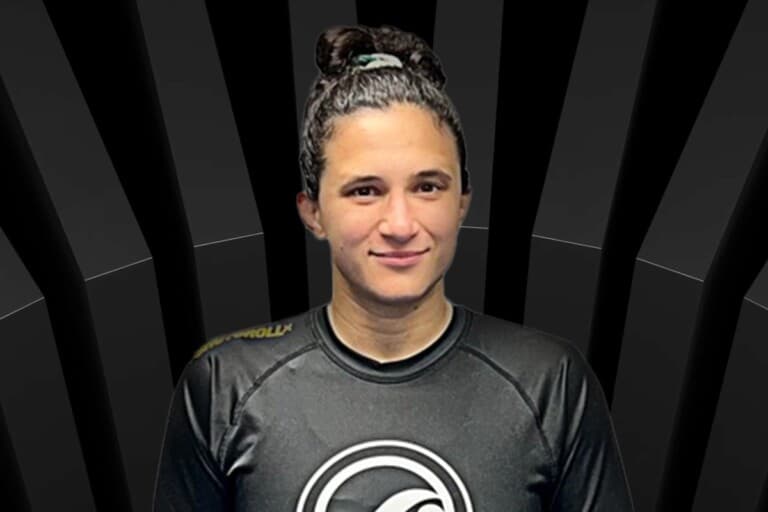
Tammi Musumeci: the title belongs to her own story
Quick answer: Tammi Musumeci built a world-class grappling record in both gi and no-gi while pursuing a legal career. Her story includes a 2019 gi world title, repeated no-gi success, and a clear public insistence that ambitions outside jiu-jitsu mattered to her, too.
In September 2019, Tammi Musumeci appeared in a law-school student spotlight. The questions covered grappling, studying law, a summer in family court, and her favorite band. In the same year, she was an IBJJF black belt world champion.
Those facts make a better introduction than a family connection. Her surname is familiar to grappling fans, and her training relationship with her brother Mikey belongs in the account. It does not need to do the work of establishing why she matters.
The record already does that. What makes it worth looking at more closely is the life around the record: serious competition without a public claim that everything else had to be discarded for it.
A law-school interview gives the story another starting point
The William S. Boyd School of Law's 2019 interview asked Musumeci how she had become proficient in BJJ. She described beginning at six, setting smaller goals around competitions, and studying opponents. Asked about law school, she explained that it required a different kind of thinking from college.
That is a useful detail because it resists the easy claim that being good at one difficult pursuit makes another effortless. In her account, the new environment required adjustment. Prior success did not remove the need to learn.
The interview also recorded her interest in family law after working with a judge in family court over the summer. It was a statement about her interests at that point, not evidence of a particular legal specialty throughout her later career.
A short university profile offers only a narrow window. Still, it preserves something a results page cannot: a person describing another field as worth her attention. The mat was already important. It was not the only place she wanted to become capable.
The medals belong to more than one chapter
Musumeci's adult black belt record had substance well before her arrival on a major broadcast grappling card. The 2014 IBJJF Worlds results list her second at featherweight, behind Michelle Nicolini. That placing sits beside her later championship success rather than disappearing beneath it.
IBJJF's 2022 women's Worlds preview identifies her as the 2019 world champion. It also records the 2021 light-feather final, in which Ana Rodrigues beat her 4–2. These are different points in a competitive career, with winning and losing both part of the evidence.
There is a temptation to summarize an athlete as a finished collection of titles. The intervening results are more informative. They show that the next event still had to be contested, even after the athlete had already proved she could win a major one.
For a newer viewer, keep the event and category attached to a medal. Gi Worlds, No-Gi Worlds, and a professional submission-grappling match answer different competitive questions. Combining them into one large championship number can obscure the range that makes the record interesting in the first place.
No-gi success was a long-running part of the record
IBJJF's 2022 No-Gi Worlds preview lists Musumeci's earlier titles in 2013, 2015, and 2016. Its historical breakdown places the first two at featherweight and the third at lightweight. This was established success across several seasons, not a sudden discovery prompted by a later promotion's spotlight.
The federation's 2023 event preview then includes 2022 among her winning years. Its 2023 recap names her as that year's light-feather champion.
Read those dates slowly and the scale changes. A one-paragraph biography can make a decade look like a continuous afternoon. The results instead ask the reader to recognize separate seasons, changing brackets, and repeated returns to competition.
No individual medal tells us how her week was organized or how a particular training session felt. It does establish that the sporting part of the story deserves to be assessed on its own terms. The legal career makes the picture wider; it should not become a reason to describe the grappling as a charming secondary activity.
The professional debut brought a different audience
At ONE Fight Night 8 in March 2023, Musumeci beat Bianca Basilio by unanimous decision in a strawweight submission-grappling match. The result appears in ONE's official event record.
The promotion's bout recap describes Musumeci attacking from guard with leg-lock attempts while Basilio sought passing opportunities and attacks of her own. That is the organizer's reported account of the exchange, rather than a reconstruction from an imagined ringside seat.
A decision win is worth describing accurately. Submission grappling does not mean every successful performance ends in a tap. In this case, the official outcome was a judges' decision after the match ran its course.
For someone discovering Musumeci through that card, the useful next step is to watch the full exchange rather than expect a single spectacular finishing clip. Look at the attempts that force reactions and the work that prevents the other athlete from settling into an advantage. The absence of a finish leaves more of that work visible, if the viewer is willing to follow it.
Winning did not settle her own assessment
Musumeci followed the Basilio result with a decision win over Amanda Alequin at ONE Fight Night 12 in July 2023. In ONE's post-match interview, she discussed useful positions she had reached while saying her overall performance fell short of her expectations. She also credited Alequin's aggressive approach.
The same interview records her awareness that grapplers on the card were performing for people who might be unfamiliar with BJJ. She wanted viewers to see the technical interest in a contest without strikes.
Those are two different assessments of the same evening. One concerns her own execution. The other concerns what the audience could understand. Neither cancels the official win, and the win does not make either question irrelevant.
That tension is recognizable without assuming we know her private feelings. An athlete can get the result and still identify unfinished work. The useful part for a reader is the specificity of that distinction, not a demand to become dissatisfied with every good performance.
A recreational competitor can borrow a modest version of the question: what did the result tell you, and what did the match give you to practice? Those answers need not be identical.
A training partnership can matter without becoming the headline
In a March 2023 interview with ONE, Musumeci described the importance of regularly training with Mikey, including additional work outside their classes. Her account gives the partnership a practical shape: time together working on jiu-jitsu, rather than simply a shared surname.
The same interview records her wish to continue pursuing professional goals outside the sport and her acknowledgment that combining work and training could feel overwhelming. That statement belongs to the time of the interview. It is not a claim about her current employer or daily schedule.
The partnership and the independent ambitions can both remain in view. Giving another person credit does not make one's own achievement disappear. Having a career outside grappling does not require describing sporting success as accidental.
For readers who train with a sibling or close friend, the relevant questions are ordinary ones:
Can you make a reliable arrangement to practice together?
Does each person have space to ask their own technical questions?
Can the relationship accommodate different goals and available time?
Our guide to siblings in BJJ looks at that broader training relationship. A famous example can make the subject interesting without becoming a script every family is expected to follow.
An exceptional schedule is not a prescription
It would be easy to end this profile with a demand that everyone organize life better. That would turn an unusual record into an unhelpful comparison. Readers have different responsibilities, resources, and reasons for training.
Musumeci's career makes a narrower point possible: a serious sporting identity can exist alongside another serious ambition. It does not tell us how many sessions a parent, shift worker, or student ought to fit into a week.
Nor does the record authorize a guess about what she would have achieved had she chosen a different life. Speculation that removing work would automatically have produced more medals treats the rest of a person's interests as an obstacle to the version of them a sports fan prefers.
The documented story is already substantial. It includes a university interview about adapting to law school, years of world-level grappling results, and public accounts of what she valued beyond competition. There is no need to invent a conflict in which one pursuit must defeat the other.
For a reader trying to keep training in a crowded week, that leaves room to make an individual decision. You can admire the athlete without trying to reproduce the athlete's calendar.
Main photo: ONE Championship; promotional portrait.
The takeaway
Tammi Musumeci's results deserve a profile that begins with her own work. The gi world title, repeated no-gi championships, and professional grappling wins provide ample reason to watch. Her public accounts of studying and practicing law add another dimension without supplying a simple formula for balancing everything.
The enduring interest is that both pursuits were allowed to matter. Read the results accurately, hear the ambitions she actually described, and leave room for a life that cannot be reduced to the number of hours spent on the mat.
Make room for the training you can use
Find local jiu-jitsu academies on Let's Roll and compare the classes that fit your own week before building a schedule around someone else's.
FAQ
Is Tammi Musumeci a BJJ world champion? Yes. IBJJF identifies her as a 2019 gi world champion and documents multiple No-Gi Worlds titles, including the 2023 light-feather championship.
Did Tammi Musumeci attend law school? Yes. UNLV's Boyd School of Law published a student interview with her in 2019. Her later ONE interviews discussed combining legal work with elite grappling.
Did Tammi Musumeci win her ONE debut? Yes. ONE's official Fight Night 8 results record a unanimous-decision submission-grappling win over Bianca Basilio in March 2023.
How is Tammi related to Mikey Musumeci? They are siblings and longtime training partners. Tammi has publicly credited their shared practice, while maintaining a substantial competition record of her own.

Rafael Moura
Rafael Moura profiles competitors as people with lives outside the bracket. Some of those stories are comebacks. Most are not, and he does not force them.
Related Posts
Mikey Musumeci gives up the belt to make room for MMA
Musumeci is vacating his UFC BJJ title to focus on MMA training. What he is leaving, what continues, and why the transition matters.
IBJJF membership: finish the paperwork before the deadline
IBJJF membership and tournament entry are separate steps. Plan documents, professor approval, renewals, and junior accounts before registration closes.
Choosing a BJJ seminar worth your time and travel
Choose a BJJ seminar by the subject, teaching format, access, and total cost. Know what to ask the host before buying a ticket.
Comments (0)
Loading comments...