
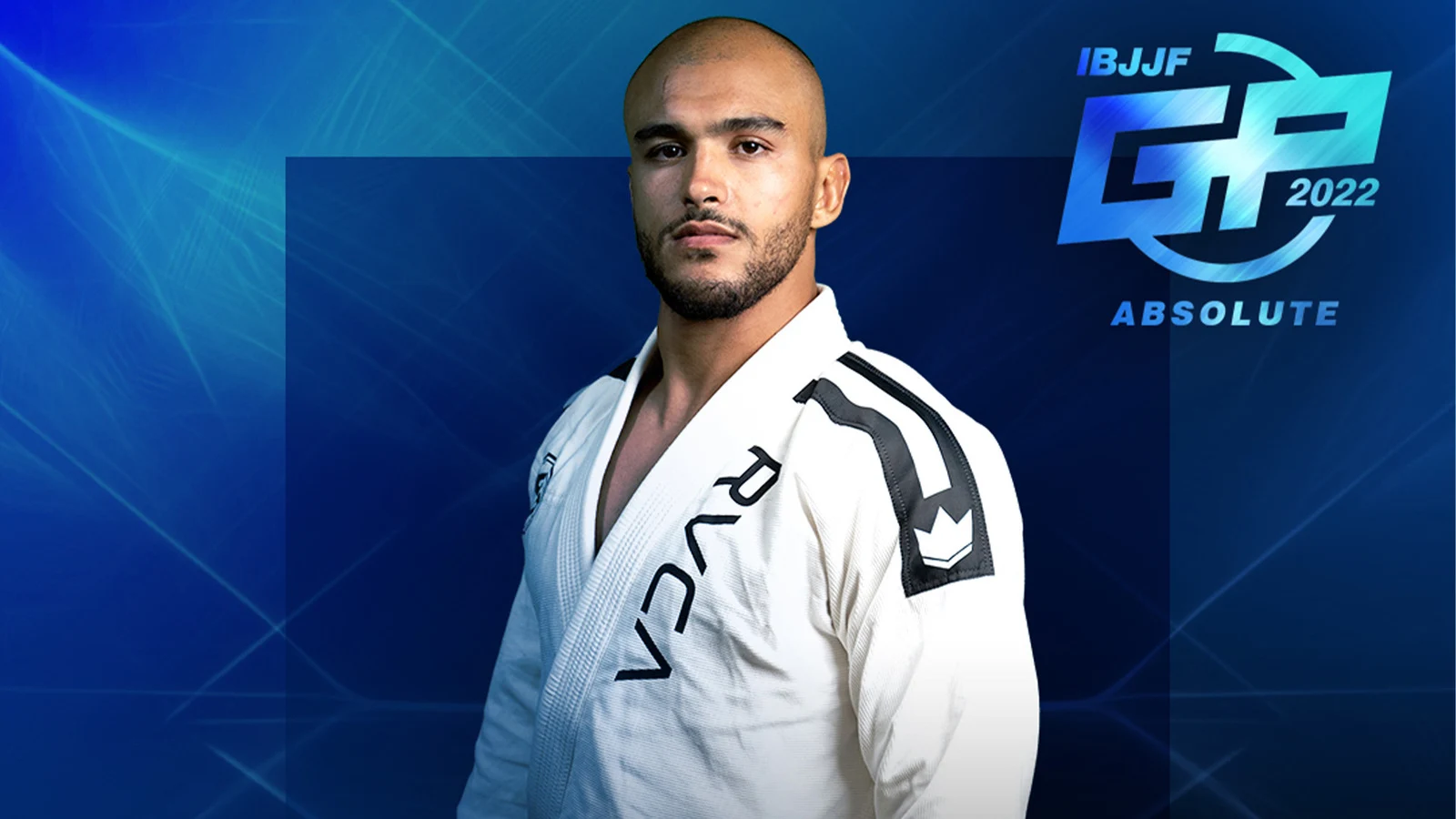
Kaynan Duarte’s 2022 Grand Prix was three separate sweeps
Quick answer: Kaynan Duarte won the 2022 IBJJF Absolute Grand Prix with three 2–0 victories, each built around a different sweep. Set beside his seven-submission European double gold in 2023 and his 2024 ADCC double gold, that night reveals the breadth of a game often remembered through its biggest finishes.
Three matches. The same final score. Three different opponents who could not recover the two points Kaynan Duarte put on the board.
At the 2022 IBJJF Absolute Grand Prix, Duarte beat Elder Cruz, Roberto Abreu, and Gutemberg Pereira, all by 2–0. The official event report recorded a $40,000 prize and a sequence of victories that looked considerably more controlled than explosive.
That version of Duarte belongs beside the athlete who later submitted everyone on his way to two European titles and won two divisions at ADCC. The contrast is the story. A dangerous finisher can also understand when one successful scoring action creates a match worth protecting, and when the next opening is too good to leave alone.
Elder Cruz had to solve the first sweep
Against Cruz in the Grand Prix quarterfinal, Duarte pulled into de la Riva guard and swept for the two points that decided the match. He subsequently forced Cruz toward turtle before the position was recovered. The match finished with Duarte also ahead on advantages.
The sweep and the follow-up created different problems. Coming on top changes the score and forces the opponent to work from underneath. Making an opponent turn away can create a route toward the back, but that route must still be completed against active defense. Duarte obtained the first reward without automatically receiving the second.
This is part of what makes a 2–0 match easy to underestimate. The scoreboard compresses a long contest into one completed scoring action. It does not show every defensive exchange that prevented the next score. Cruz’s recoveries mattered. Duarte’s ability to keep the initial lead mattered too. A narrow margin is still a margin the trailing athlete has to overturn.
Roberto Abreu faced a different set of grips
In the semifinal, Duarte used double-sleeve control to sweep Abreu for another two-point lead. He later defended a single-leg attempt and used closed guard. The result stayed 2–0.
The grip change is worth noticing. The quarterfinal and semifinal did not require an identical entry. A sleeve connection can make it difficult for the top player to post in the direction needed to preserve balance. The bottom player is trying to coordinate that missing support with the movement of the hips and legs.
Once ahead, Duarte still had to deal with a formidable opponent trying to reverse the direction of the match. A sweep is not a promise of ten comfortable minutes on top. The athlete can face another standing exchange, a wrestling attack, or a return to guard. The semifinal required Duarte to manage more than the movement that first produced the lead.
That is a fuller picture of control than simply counting passes. Sometimes control means deciding which contest is available next and preventing the opponent from reaching the one he wants.
Gutemberg Pereira could not turn the final around
The Grand Prix final produced the third 2–0 result. Following a standing reset, Duarte pulled guard and swept Pereira using a collar-and-elbow connection. Pereira later attempted to work from single-leg X, while a late back-taking opportunity did not become another Duarte score.
A sweep can look like a short burst of effort. Its significance changes once the athlete has the lead. The opponent now needs a meaningful response rather than a visually busy exchange. A near pass, a nearly completed back attack, and a successful recovery can all consume time without changing the point total.
Duarte’s final therefore has two stories running together: the action that established the difference, and the sequence of exchanges that kept Pereira from erasing it. The second story is quieter, but the trophy depended on both.
Our BJJ rules guide explains the scoring behind these positions. The Grand Prix supplies a practical example of why understanding the score improves the experience of watching a close match.
Paris brought seven submissions instead
At the 2023 European Championships, Duarte won super-heavyweight and the open class with seven submissions. The IBJJF’s account of the double gold describes an event in which his top-position attacks repeatedly became finishes.
Among them were an armbar from mount against Thomas Bracher, a back choke against Harryson Pereira, and a mounted armbar in the weight final against Luis Cantareira. In the open class, he submitted Mason Fowler from the back and finished Rider Zuchi in the final after a sequence involving a sweep, pass, and back attack.
The difference from the Grand Prix is substantial. In one event, the decisive scoring action remained the only point score. In the other, Duarte repeatedly continued from a good position into the next attack. Neither performance cancels the other. They show a competitor able to finish when the opening becomes available and win when an opponent prevents the finish.
Mount does more than earn points
The European finishes also explain why mounting an elite opponent is about more than arriving at the position. Mount places the bottom athlete under an immediate demand to recover some freedom of movement. A bridge may create enough space to escape; it can also expose an arm if the top athlete follows the movement effectively.
Duarte’s mounted armbar against Cantareira came as his opponent bridged, according to the federation’s recap. That detail connects positional pressure to a finishing opportunity. The attack was not separate from the defense. It developed through the movement the defender needed to make.
The same logic helps explain a transition to the back. A player turning to avoid a pass may briefly solve the problem of being flattened underneath. The turn can create another problem if the passer can stay connected and control the torso.
At elite level, those trade-offs happen quickly. A strong top player does not need the defender to stop resisting. He needs to recognize which part of the resistance has made the next route available.
ADCC 2024 added another double gold
The official ADCC results list Duarte as both the under-99-kilogram champion and the absolute champion in 2024. The finals ended against two different opponents: Rafael Lovato Jr. at weight and Roberto Abreu in the open class.
According to the event broadcaster’s finals report, Duarte submitted Lovato with a rear-naked choke and Abreu with a guillotine. These finishes provide another useful comparison with the gi Grand Prix against Abreu two years earlier. The opponent’s identity was familiar; the setting and outcome were different.
Without jacket grips, the available controls change. There is no double sleeve to hold or collar-and-elbow fabric connection to reproduce. The athlete still needs to manage posture, establish useful angles, and keep the defender from recovering. Duarte’s results across these events show a game that can do that through different resources rather than depending on one particular grip.
A complete game can change the pace
There is a temptation to sort successful grapplers into finishers and tacticians. Duarte’s sequence makes that split unhelpful. A finishing opportunity still requires sound tactical judgment, while a points lead still depends on winning a technical exchange against a skilled opponent.
The stronger comparison is between the problems each event posed:
The 2022 Grand Prix required three victories in close scoring matches.
The 2023 Europeans produced repeated opportunities to continue from dominant positions into submissions.
The 2024 ADCC run required success without the jacket and in two separate divisions.
What connects them is the ability to stay effective after the initial action. A sweep has to become a stable top position. A pass has to survive the defender’s turn. A choke has to remain connected through the escape attempt.
That continuity is less obvious in a highlight collection than a spectacular finish. It is also what makes the collection possible. Duarte’s strongest performances do not stop being interesting once the first movement is identified.
Main photo: ibjjf.com. Archive image published by ibjjf.com. The photograph is not an image of every event discussed in the profile.
The takeaway
Duarte’s 2022 Grand Prix is worth revisiting because its three matching scores conceal three different routes to the lead. Against Cruz, Abreu, and Pereira, he created the decisive difference and then dealt with the attempts to remove it.
His subsequent European and ADCC double golds show the other side of the same skill set: the ability to keep advancing when an opponent’s defense exposes another opening. The sweep and the submission are connected by everything the athlete can control in between. That is where this part of Duarte’s career becomes especially revealing.
Follow the positions more closely
Browse the Let’s Roll learn library for guides to the scoring, positions, and competition formats behind the matches.
FAQ
How did Kaynan Duarte win the 2022 IBJJF Absolute Grand Prix? He defeated Elder Cruz, Roberto Abreu, and Gutemberg Pereira by 2–0, using a sweep to establish the decisive lead in each match.
Did Duarte submit every opponent at the 2023 Europeans? Yes. The IBJJF reported seven submissions across his super-heavyweight and open-class championship runs.
Which divisions did Duarte win at ADCC 2024? He won the men’s under-99-kilogram division and the absolute division, finishing both finals by submission.
Does Duarte use the same grips in gi and no-gi? No. Jacket-based sleeve and collar connections are unavailable in no-gi. His results show effective control through different grips and positions across both formats.

Miles Serrano
Miles Serrano writes about competitors and the decisions that shaped their careers. He is more interested in the adjustment someone made in the third minute than in the medal count afterward.
Related Posts
Gianni Grippo’s 2022 return had two finish lines
An Open gold and a No-Gi world title were separate steps in Grippo’s 2022 season. Read the return through the results he actually completed.
Erich Munis won Worlds, then named what still needed work
Munis used a return to competition to test takedowns and passing after world titles. His public explanation gives a useful way to read an Open.
Fabricio Andrey’s first Worlds ended with a triangle
Andrey’s 2021 black-belt world title began a featherweight story worth reading beyond the nickname and the finishing clip.
Comments (0)
Loading comments...