

Guilherme Mendes: four titles before the coaching story
Quick answer: Guilherme Mendes won four black-belt World titles before concentrating on the Art of Jiu Jitsu team. His career is worth studying as two connected projects: solving problems as a competitor and making technical knowledge usable for other athletes.
The dates are unusually compact: 2009, 2011, 2012, 2014. Four World titles, followed by a career that is still discussed through the people learning from him. Guilherme Mendes did not need an endless competitive record to give the next phase substance.
For a student encountering Gui through an instructional clip, the chronology matters. The instructor did not appear from nowhere beside a white mat. There was a competitor first, and a deliberate shift in where the work would be directed. Understanding both makes the teaching more interesting without requiring a student to copy the whole life behind it.
Four titles make a clear starting point
Art of Jiu Jitsu's biography of Gui Mendes lists his black-belt World titles in 2009, 2011, 2012, and 2014. It identifies Rio Claro as his hometown and describes a competitive career that led into a full focus on building the AOJ team after 2014.
Those facts provide a firmer introduction than a broad claim that somebody changed the sport. A title has a date. A competitive career has decisions and limits. The reader can begin with the record before deciding what larger interpretation it supports.
Four championships also do not explain everything about an athlete's game. They tell you that the game succeeded at the highest level of that competition. To understand the technical work, a viewer still needs complete sequences, opponents, rules, and the exchanges that did not end neatly.
That is a useful boundary for admiration. A successful athlete is worth studying closely. Success does not make every isolated movement a universal instruction, and a highlight does not carry all the context needed to reproduce it in another body against another opponent.
AOJ overlaps with the competitive years
AOJ's account dates the academy's founding to 2012, with Gui, Rafael Mendes, and PM Tenore as co-founders. The timing matters: the academy began before Gui's final listed World title. Competition and building the school were overlapping responsibilities, not two completely separate lives divided by a single retirement announcement.
That overlap offers a more realistic way to think about transitions in jiu-jitsu. A new role can begin before an older one ends. Teaching, planning, and creating an organization do not wait automatically until an athlete has finished competing.
For someone considering instruction, the practical implication is not to rush into opening a gym. It is to recognize that teaching can be developed through specific responsibilities. Explaining a drill, helping a beginner understand a position, or preparing a coherent class are tasks that can be improved on their own terms.
Competitive skill may supply material for those tasks. It does not perform them by itself. A student needs an explanation they can follow, a suitable place to begin, and feedback that tells them what to change. The instructor's achievements create interest; the instruction has to do the rest.
The second job is making decisions understandable
A competitor can solve a problem without narrating the solution. An instructor has to help someone else recognize the problem before the answer becomes useful. That difference is easy to overlook when an expert's movement appears effortless.
Consider a guard pass as a learning problem. A student may remember where the instructor's knee finished but miss the grip that made the entry possible. Another may copy the grip and fail to notice the opponent's defensive frame. Both can reproduce a shape without understanding the decision that gave it value.
A good way to study any detailed lesson is to separate those layers. Identify the starting situation, the control being established, the opponent's available response, and the point at which the plan changes. The method makes a technical explanation easier to use without pretending the student can acquire the instructor's timing from one viewing.
Gui's official teaching catalog includes material on guard passing and finishing passes. Those subjects provide a natural place to apply this approach. The catalog tells you what is offered; learning still requires watching the actual lesson, practicing responsibly, and asking your own coach about the parts that remain unclear.
Watch the work before the recognizable finish
An appealing final position can pull a viewer's attention away from the preceding exchange. The passer reaches side control, and the sequence is remembered as a successful pass. The difficult work may have happened earlier, when a grip was cleared or the opponent's hip movement was limited.
When studying match footage, return to the moment before the obvious action. Ask what changed. Was a defensive connection removed? Did the opponent turn in a way that opened another route? Was the athlete responding to pressure rather than following a fixed sequence?
These are viewing questions, not claims about a particular match that has not been examined. They help turn interest in a famous competitor into a more disciplined habit. A pause button is useful when it supports a precise question; less so when every frozen position is treated as a technique to memorize.
Keep the unsuccessful attempts visible too. A grip that is abandoned can reveal the conditions the athlete needed. Editing those moments out may make the footage more exciting while removing exactly the information a student requires to understand when a choice is appropriate.
A team is more than a repeated style
It is tempting to describe students of a successful academy as copies of its founders. That is a convenient shortcut, but it can hide differences in size, experience, preferred positions, and competitive circumstances. Shared instruction does not require identical games.
The more useful question is which habits of problem-solving can travel across those differences. A clear way to establish control, a reliable method for reviewing mistakes, or a consistent vocabulary can help athletes whose techniques look different. The common element may be the teaching process rather than a single visible move.
This matters for recreational students as well. You can appreciate a technical approach without deciding that every part must become your game. Your training frequency, mobility, interests, and available partners all affect what you can practice well.
Our guide to keeping a BJJ training journal offers a way to make that selection concrete. Record one problem and the response you are testing. A note that identifies what failed is more useful than a page filled with names of techniques you admire but have not yet connected to a real situation.
Study with a question small enough to answer
A broad intention to learn Gui Mendes's jiu-jitsu is difficult to act on. A narrower question gives each session a purpose. Choose a lesson or match sequence because it addresses a problem you have actually encountered, then keep the first experiment manageable.
A workable review can ask:
What position starts the sequence, including the opponent's grips or frames?
Which connection makes the next movement possible?
What response would make this choice inappropriate?
What is the smallest part that can be practiced safely with a partner?
Take the question to your instructor if the answer is unclear. An online lesson cannot see your starting position or correct a misunderstanding in real time. The local coach and training partner supply information the recording does not have.
Resist collecting another answer before testing the first one. A technically rich catalog can make it easy to confuse access with progress. The useful result is a decision you understand better on the mat, even if that means spending several sessions on a short section of material rather than finishing another long video.
Recognition does not close the story
The IBJJF's 2022 year in review records Gui and Rafael Mendes among that year's Hall of Fame inductees. For Gui, the recognition gives an official marker to a competitive career whose final listed World title came eight years earlier.
A Hall of Fame entry can look like the closing paragraph of a sports biography. In this case, it is more useful as a point from which to look in both directions. Behind it sits the competition record. Alongside it sits the continuing work of teaching and building a team.
Neither role needs to borrow all its value from the other. The World titles remain achievements even if a reader never buys an instructional. The quality of a lesson still has to be judged by what it explains, even when the person teaching has a celebrated record.
That is the most interesting way to keep a career like this in view. The competitor supplies reasons to pay attention. The instructor gives the reader a different test: after paying attention, can you understand something more clearly and use it with care? The answer belongs on the mat, in the student's own work.
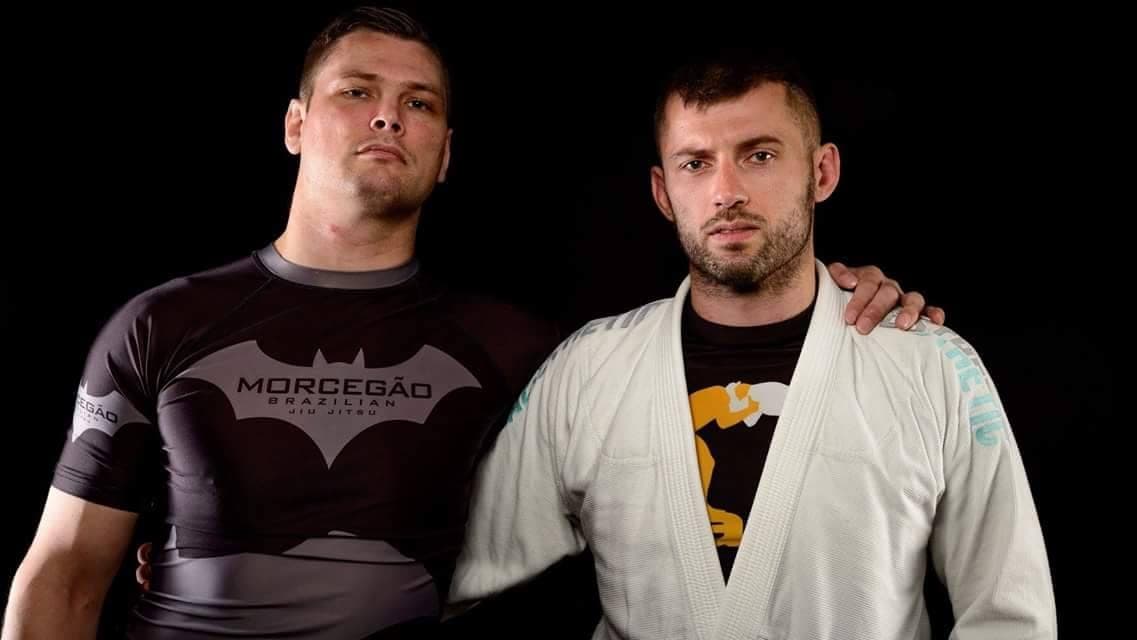
Main photo: Elite Sports; archive portrait of Guilherme Mendes.
The takeaway
Guilherme Mendes's four World titles are a concise competitive record with a substantial second chapter. AOJ began during those competitive years, and his later focus on teaching changes the questions worth asking about the career.
Study the details with a specific problem in mind. Respect the results, keep the context around the techniques, and judge a lesson by the understanding it helps you build rather than by the fame attached to it.
Put a useful lesson into practice
Find BJJ gyms through Let's Roll and look for instruction and training partners who can help you test a technical idea carefully, one clear problem at a time.
FAQ
How many black-belt World titles did Gui Mendes win? His official AOJ biography lists four, in 2009, 2011, 2012, and 2014. Those are his individual competitive titles, separate from later results by AOJ athletes.
Who founded Art of Jiu Jitsu? AOJ identifies Guilherme Mendes, Rafael Mendes, and PM Tenore as its co-founders in 2012. The academy began while Gui was still adding to his World title record.
When did Gui Mendes enter the IBJJF Hall of Fame? The IBJJF records his induction in 2022, alongside Rafael Mendes and other members of that year's class.
How should a regular student study his instructional material? Start with a specific problem from training. Identify the starting controls and relevant reactions, then practice a small part with a suitable partner and guidance from your instructor.

Miles Serrano
Miles Serrano writes about competitors and the decisions that shaped their careers. He is more interested in the adjustment someone made in the third minute than in the medal count afterward.
Related Posts
Competing in gi and no-gi on the same day takes two plans
Prepare for gi and no-gi competition on the same day with separate rule checks, complete outfits, schedule coordination, and a realistic second-bracket plan.
Jiu-jitsu in Montreal: build the visit around a real class
Plan BJJ training in Montreal around confirmed classes, language arrangements, winter travel, visitor policies, and equipment that is ready to use.
BJJ gi pants that fit standing up can still fail on the mat
Check BJJ gi pants at the waist, rise, knees, and cuffs so a good-looking size label becomes a uniform you can actually move in.
Comments (0)
Loading comments...