

Gracie Jiu-Jitsu: understand the name before choosing a school
Quick answer: Gracie Jiu-Jitsu refers to the Gracie family's martial arts tradition, but schools using the name can belong to different organizations and teach different programs. Gracie University, Gracie Humaitá, and Gracie Barra should not be treated as interchangeable. Identify the specific affiliation and beginner curriculum before comparing local classes.
A surname on a gym sign can carry more history than a new student knows what to do with. Search for Gracie Jiu-Jitsu and you encounter family members, schools, video courses, tournament footage, and arguments that started long before you considered buying a gi.
You do not have to settle those arguments to begin training. You do need to know what the school in front of you means by the name. That is a smaller task, and it leads to better questions than asking which branch of an extended family owns the best version of jiu-jitsu.
Think of the search as three separate steps: identify the organization, understand its teaching program, and meet the people who would teach you. The first two provide context. The third turns a famous name into a place you might return to next Tuesday.
A family name is not a single timetable
Gracie Jiu-Jitsu is not a reliable shorthand for one universal membership or lesson plan. Consider the distinct organizations that appear in a search. Gracie Humaitá's history describes its Rio academy's move to Humaitá in 1985 and identifies Rolker and Royler Gracie with the school. That is a specific institutional story.
Gracie Barra publishes its own program structure. Gracie University offers named courses and a network of Certified Training Centers. These organizations may share parts of a wider family history without being the same business or requiring the same class progression.
For a beginner, the practical consequence is simple: read the complete name. Keep the location and organization together in your notes. A review of one academy is not automatically a review of another academy that shares part of its sign.
The same care helps when a friend recommends a school. Ask which location they attended, which class they took, and when. Their experience can be valuable without becoming a claim about every instructor connected to a family surname.
Self-defense is a teaching emphasis worth asking about
Some programs place self-defense scenarios near the beginning of instruction. Others introduce students through a schedule organized around grappling positions and sport practice. The distinction matters, but it becomes unhelpful when it turns into a claim that every school fits one of two sealed boxes.
Ask what the beginner curriculum actually covers. A useful answer names a class, explains the exercises, and describes how students work with partners. An answer built only around the word traditional still leaves you without a picture of the lesson.
Be equally specific about your interest. You may want to understand escapes, become comfortable practicing with another person, or eventually enter a tournament. Those aims are easier to discuss than a broad wish to learn the most effective system.
A martial arts class cannot promise the outcome of a real confrontation. Treat training as practice within defined conditions. When a school discusses self-defense, ask how it addresses awareness, avoiding conflict, and the limits of classroom exercises as well as physical techniques. You are looking for an explanation you can understand, not a guarantee to carry home.
Gracie Combatives names a particular beginner program
Gracie Combatives 2.0 is a Gracie University program presented by Ryron and Rener Gracie. Its published course includes 36 core techniques, additional material, and a defined learning sequence. That tells you more than the general phrase Gracie-style training would.
The distinction between a named curriculum and an entire martial art is useful. If a nearby school offers this program, ask how its in-person classes correspond to the material. Establish where new students begin, how missed lessons are handled, and what practice accompanies the demonstrations.
Do not treat the Gracie Combatives belt as another name for a blue belt. The provider describes a separate progression and assessment process. Ask the receiving instructor to explain the requirements that apply to your training route before paying for a test or setting a deadline for yourself.
You can also evaluate the program without turning the decision into a referendum on every other beginner course. A structured sequence may appeal because you want to know what comes next. Another student may prefer the approach offered by a different local school. The useful comparison is between available instruction you can actually attend.
Sport and self-defense labels need examples
Gracie Barra's fundamentals program describes core techniques and self-defense as part of its beginner instruction. This is one reason to resist a tidy internet split in which one Gracie name supposedly means sport and another means self-defense, with no overlap allowed.
A class description can contain both aims. The balance will become clearer when you ask how a lesson is organized. Does the coach set a scenario, teach a position, introduce a partner response, or work toward a tournament situation? What is the student expected to learn from that particular exercise?
Use those details to decide whether the class interests you. You do not need to rank every teaching method before trying one. You need enough information to understand what you are signing up to practice.
If you are comparing clothing formats too, read the gi and no-gi explanation separately. A gi does not automatically identify a self-defense curriculum, and a rashguard does not tell you the entire purpose of a lesson. Clothing, affiliation, and teaching emphasis are related questions that still deserve separate answers.
Online study and local instruction are different commitments
Gracie University's public FAQ discusses finding a training partner and directs students toward its school and student resources. Even within an online learning system, there is a difference between access to a demonstration and an opportunity to practice it with another person.
Before buying a course, work out where practice would happen. A living room with furniture pushed aside is not automatically a suitable training space. Ask a qualified instructor which exercises you can practice in the space and with the supervision available to you.
Also establish what feedback the purchase includes. Recorded lessons, a question forum, personal assessment, and regular in-person classes are different services. The existence of one does not mean the others arrive with the same payment.
If you already attend a school, ask your coach how outside material could fit the work you are doing. A small, relevant lesson can support a class. A second curriculum followed without any conversation may leave you juggling two sets of expectations and wondering why neither feels complete.
Verify the relationship without turning it into an interrogation
Affiliation is a reasonable thing to check. You can ask courteously which organization the academy belongs to and where that relationship is listed. A specific claim of Gracie University certification should be checked against that organization's resources; it does not serve as the only test of legitimacy for unrelated schools.
Keep your initial message short enough for a useful reply:
Give your experience level and the location you want to attend.
Ask which beginner class the instructor recommends.
Confirm the school's affiliation or certification if that is part of your decision.
Ask about the trial, clothing, booking, and full initial cost.
Explain any practical limits that affect your attendance.
There is no need to request a family tree in the same message. The point is to connect a claim on a website with the program you would join.
Be careful with old information. A coach may have trained under one person and now teach within a different organization. A historic connection can be accurate without describing the school's present membership. Ask about the current arrangement instead of treating every name in a biography as a separate affiliation.
Choose the teacher you will see regularly
Once the organizational questions are clear, the decision becomes pleasantly ordinary. Find out who teaches your available classes. Attend the recommended introduction. Notice whether you understand the task and whether you can ask for help when you lose your place.
For someone entirely new, being able to return matters. A class at an impossible hour does not become convenient because of a distinguished name. Compare the timetable with the week you already have, including work, family commitments, and the trip home.
Think about the people around you as well. You do not need instant friendships, but you should understand how partners are assigned and what the instructor expects during practice. A clear introduction to those details can make the second class feel less like entering an unfamiliar room from scratch.
After the trial, write down one thing you learned and one question you still have. Send the question if it affects your decision. Choosing a school should leave you with an informed next step, not a sense that you must understand a century of jiu-jitsu history before you are allowed to begin.
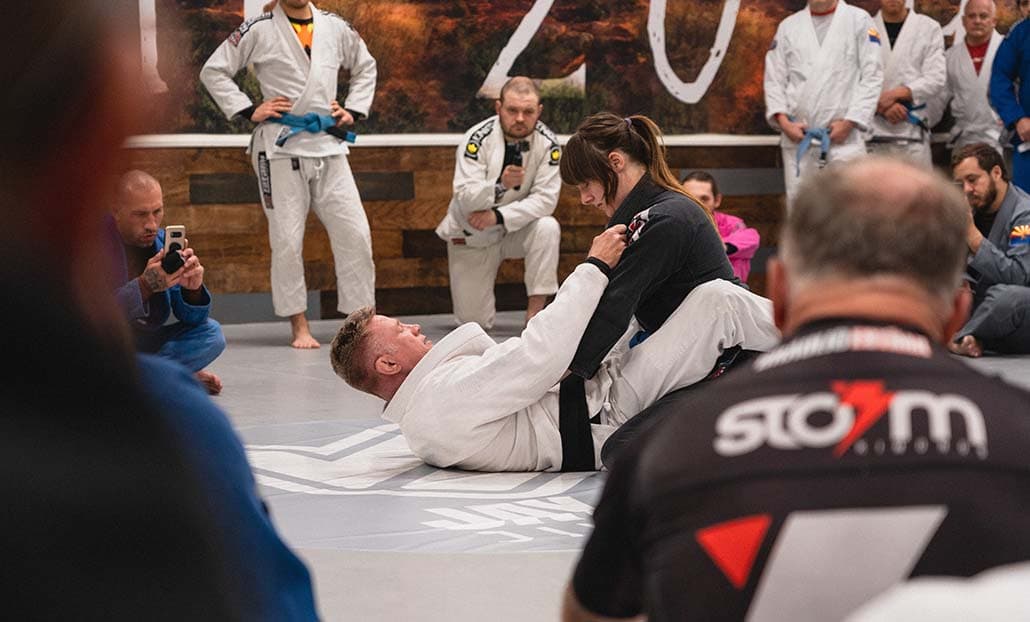
Main photo: Gracie Humaitá Academy.
The takeaway
The Gracie name is a starting point for research. The full organization name, the actual curriculum, and the local teacher make that research useful. Keep those three pieces separate long enough to understand each one.
Then choose a realistic first class. You can respect the history while making a present-day decision about instruction, schedule, and the people you will train with. A good beginning is specific enough to put on your calendar.
Find a school to contact
Use the gym directory to build a local shortlist, then confirm each academy's program and affiliation directly.
FAQ
Is Gracie Jiu-Jitsu different from Brazilian jiu-jitsu? The terms overlap, but Gracie may identify a family tradition, organization, or specific curriculum. Ask the school what the name means in its own program rather than assuming a universal technical distinction.
Are all Gracie schools part of Gracie University? No. Gracie Humaitá, Gracie Barra, and Gracie University have distinct identities. Verify a school's specific affiliation instead of using a shared surname as proof of membership in one network.
Is a Gracie Combatives belt a blue belt? No. Treat them as separate stages and ask the provider for its current assessment and progression requirements. Finishing a video collection should not be assumed to confer either rank automatically.
Do I need to know the Gracie family history before joining? No. It is enough to understand the school's program, who teaches your class, and what beginners are expected to do. The history can become a separate interest as you train.

Rafael Moura
Rafael Moura profiles competitors as people with lives outside the bracket. Some of those stories are comebacks. Most are not, and he does not force them.
Related Posts

Mikey Musumeci gives up the belt to make room for MMA
Musumeci is vacating his UFC BJJ title to focus on MMA training. What he is leaving, what continues, and why the transition matters.

IBJJF membership: finish the paperwork before the deadline
IBJJF membership and tournament entry are separate steps. Plan documents, professor approval, renewals, and junior accounts before registration closes.
Choosing a BJJ seminar worth your time and travel
Choose a BJJ seminar by the subject, teaching format, access, and total cost. Know what to ask the host before buying a ticket.
Comments (0)
Loading comments...