
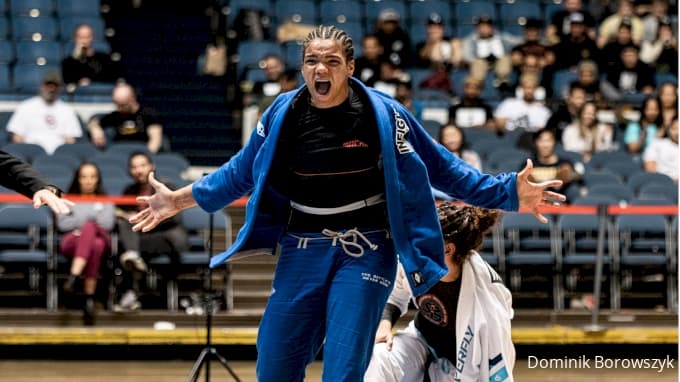
Gabi Pessanha: the most decorated woman in Worlds history
Quick answer: Gabrieli "Gabi" Pessanha is a Brazilian black belt from Cidade de Deus in Rio de Janeiro who competes for InFight Jiu-Jitsu. At the 2026 IBJJF World Championship in Long Beach she won the super-heavyweight and absolute divisions for the sixth consecutive year, taking her to 12 gi world titles — more than any woman in the history of the event, and second all-time behind Marcus Buchecha's 13.
Her semifinal at super-heavyweight lasted about thirty seconds. She caught Simone Abreu in a straight ankle lock and that was the match.
The final took longer and looked worse for the other side. Tayane Porfírio is a multiple-time world champion and the one super-heavyweight who has beaten Pessanha. Pessanha passed her guard and won 9-0. Then she came back the same weekend, went through the absolute bracket, and beat Porfírio again in that final, 2-0, which is a much closer match than the score suggests and was still never really in doubt.
That is twelve world titles at 25 years old. What follows is less about the number and more about the jiu-jitsu that produced it, because the jiu-jitsu is the interesting part and hardly anyone writes about it.
Twelve titles, and what they are made of
Pessanha went into the 2026 Worlds tied with Beatriz Mesquita at ten gi world titles, the most any woman had won. She left with twelve.
The absolute number is the one to sit with. She has won the open weight division at the Worlds six years running, 2021 through 2026, which ties Buchecha's all-time record for absolute golds. She has also won her weight class in each of those same six years. Doubling up at Worlds once is a career highlight for most people. She has not failed to do it since she was 21.
Buchecha's 13 total titles are the only thing in front of her. Roger Gracie is on ten. Bruno Malfacine is on ten. Mesquita is on ten. At the current rate the record falls in 2027.
Cidade de Deus, 2010, a used gi
Pessanha was born on August 8, 2000, in Cidade de Deus, the Rio neighborhood most of the world knows from a film. She played football, did some ballet, did a little judo, none of it seriously.
In 2010 a local black belt named Marcio de Deus started teaching free jiu-jitsu classes in the neighborhood so kids had somewhere to be while their parents worked. As BJJ Heroes tells the story, she thought a sport with that much close contact looked inappropriate and refused to train. Her football friends signed up, so she sat on the side and waited for them to finish. After a few weeks of that she accepted an invitation onto the mat. She was 11. De Deus gave her her first gi, secondhand and worn out.
She won her first Brazilian title in 2013 as an orange belt. In 2018, as a 17-year-old purple belt, she won the Europeans, Pans, Brasileiros and Worlds in the same year, at weight and absolute. A double Grand Slam, at a colored belt, at 17. De Deus promoted her to black belt in June 2019, at 18.
She still trains at InFight in Cidade de Deus. She is also a sergeant in the Brazilian Air Force, which she has said was a way into a professional athlete track that judo and swimming athletes get and jiu-jitsu players usually don't.
The ankle lock is the headline. The passing is the reason.
BJJ Heroes credits Pessanha with 266 wins and nine losses, 183 of the wins by submission. The finishing breakdown is unusual for a heavyweight in the gi:
42 straight ankle locks
41 chokes from the back
18 rear naked chokes
14 armbars
10 triangles
Forty-two straight ankle locks is a strange and specific number. The straight ankle lock is legal at every belt, taught in every beginner class, and almost never finishes anybody good. Pessanha hits it on world champions. She got Maria Ruffatto-Gilpin with it in the absolute semifinal in Long Beach in a little over two minutes, and the IBJJF's own recap flags the ankle lock as the thing she is known for.
Here is the part that gets lost. She is listed as an open guard player, and the footlock game comes off the bottom, but she does not win finals from her back. She wins them on top.
The 9-0 super-heavyweight final was a passing performance against an opponent who has spent a decade defending guard passes at the highest level. Her top game is a pressure game in the oldest sense: she takes the space, kills the near-side frame, and passes while the other person is still trying to get a grip established. What the ankle lock buys her is that no one can safely play a bottom game against her either. Pull guard and the legs are available. Stand and she is going to pass. There is no obviously correct way to fight her, which is a different kind of dominance than simply being bigger.
Nine losses in a career, and one of them was this year
She is not unbeatable, and 2026 is the proof.
Sarah Galvão, a first-year black belt, beat her in the absolute final at the 2026 Pan. They met in the open weight final at all three majors leading into the Worlds. Pessanha told FloGrappling that after the Pan loss she changed her physical preparation, trained more, and worked with her coaches on making her positions faster, and that she came back and won the Brasileiro absolute a few months later.
Porfírio has beaten her too, at BJJ Bet in 2021 by two points and in a Brasileiro weight final. Pessanha's response there was to submit her in an absolute title match at BJJ Stars in April 2025.
Nine losses across a career of nearly 280 matches is remarkable. It is also not zero, and the people who beat her did it by making her fight from a place she hadn't planned for.
Her own division is thin, and that is the real objection
Women's super-heavyweight is not a deep division and pretending otherwise helps no one. At the 2026 Worlds both Pessanha and Porfírio advanced to the semifinals by walkover in a small bracket. That is not a knock on either athlete. It is the reality of the heaviest women's weight class in a sport where most female competitors sit two or three divisions lighter.
Which is exactly why the absolute matters so much in her case. The open weight bracket at Worlds is where the best women in the world regardless of size collide, and it is where she beat Lillian Marchand 4-0 on her way to the final, weeks-old Pan champion and the woman who would take the middleweight world title that same weekend. Six straight absolute golds in a division stacked with lightweights and middleweights who move far better than she does is the record that will hold up in twenty years.
The growth of women's grappling has been real and quick, and the top of the heavyweight brackets has grown with it. The bottom of those brackets has not caught up yet. If you want a sense of how team depth is distributed across the women's side of the sport right now, the team power rankings show it more clearly than medal counts do.
What she says she is chasing
FloGrappling ran a Portuguese-language interview with Pessanha on May 27, 2026, days before she flew to Long Beach. Asked about closing in on the all-time list, she said (translated): "Now I'm always looking at the top of the mountain, which is Buchecha, with 13 titles. If you want to be the best, you need to do what the best do."
She also said the thing that most competitors never admit, which is that she studies opponents but spends most of her attention on her own game, and that a rivalry with a dangerous newcomer is useful to her because it forces her to train harder.
What her game gives the rest of us
Two things transfer directly to a normal hobbyist, and neither requires being 175 pounds.
The first is that the straight ankle lock is not a beginner's move you outgrow. It is a legitimate high-percentage finish if you drill the mechanics: the leg staple, the hip position, the finish angle. Most people abandon it at blue belt because they never learned it properly in the first place.
The second is the shape of her whole game. One threat from the bottom that cannot be ignored, plus a top pressure system that never rushes. That is a small, boring, coherent set of skills executed better than everyone else. It is the same architecture you see in every long career at the top, and it is available to anybody willing to be patient about it.
The takeaway
Twelve world titles, six consecutive absolute golds, an undefeated record at the sport's biggest event, and one loss this season that she turned into a better version of the same game. That is where Gabi Pessanha stands in the summer of 2026, one title behind the all-time record and four years younger than most people are when they hit their peak.
The reason to pay attention is not the medal count. It's that her jiu-jitsu is legible. She does a small number of things at an absurd level: a footlock off the bottom that shouldn't work at this level and does, and top pressure that takes finals apart 9-0 against people who have never been passed like that.
If she gets to 14, it will not be because she's the biggest woman in the bracket. She usually isn't, in the division that counts.
Women's jiu-jitsu is not a side room anymore
The fastest-growing part of most academies is the women's mat. If you're thinking about starting, read our guide to BJJ for women first, then find a gym near you and go take a class.
FAQ
How many world titles does Gabi Pessanha have? Twelve IBJJF gi world titles as of the 2026 Worlds, which is more than any woman in the event's history. She passed Beatriz Mesquita's ten and now trails only Marcus Buchecha, who has 13.
What team does Gabi Pessanha represent? InFight Jiu-Jitsu, based in Cidade de Deus in Rio de Janeiro, where she started training in 2010 in a free community program run by Marcio de Deus. De Deus promoted her to black belt in June 2019, when she was 18.
What is Gabi Pessanha's best submission? The straight ankle lock, which accounts for 42 of her 183 career submission wins per BJJ Heroes, just ahead of chokes from the back at 41. She finished a semifinal at the 2026 Worlds with it in about thirty seconds.
Has Gabi Pessanha ever lost? Yes, nine times in a career of roughly 280 matches. Most recently Sarah Galvão beat her in the absolute final at the 2026 Pan Championship. She has never lost at the World Championship as a black belt.
Related Posts
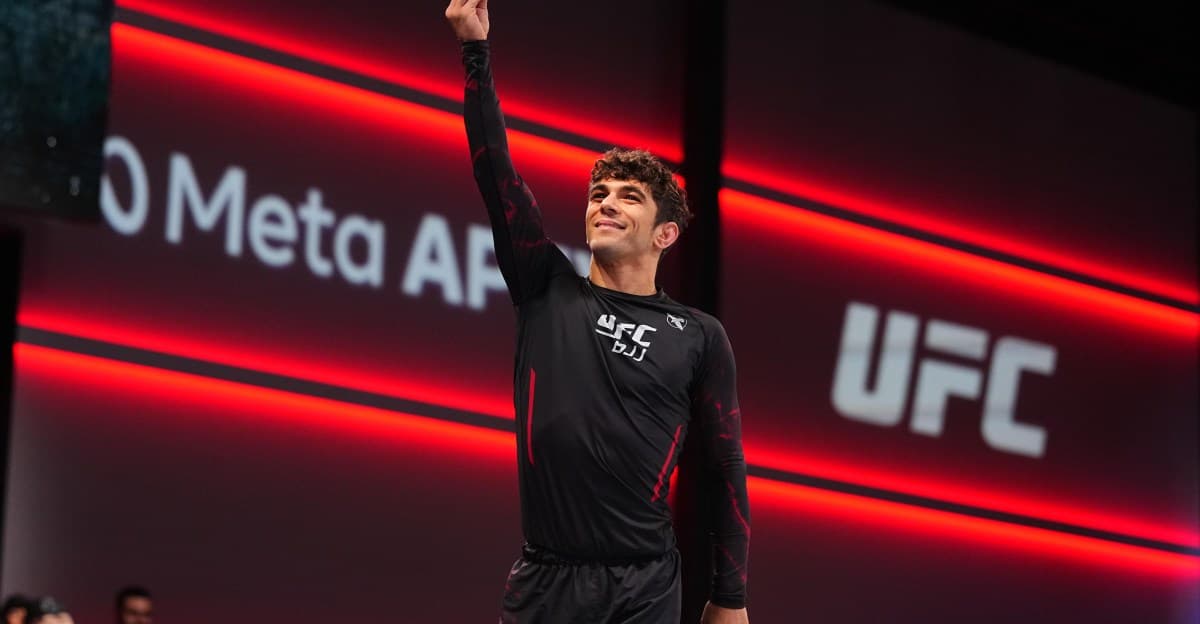
Mikey Musumeci gives up the belt to make room for MMA
Musumeci is vacating his UFC BJJ title to focus on MMA training. What he is leaving, what continues, and why the transition matters.
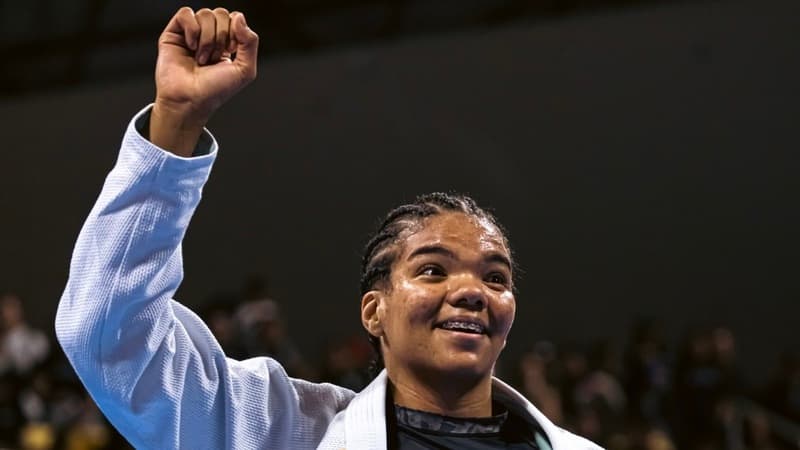
IBJJF membership: finish the paperwork before the deadline
IBJJF membership and tournament entry are separate steps. Plan documents, professor approval, renewals, and junior accounts before registration closes.
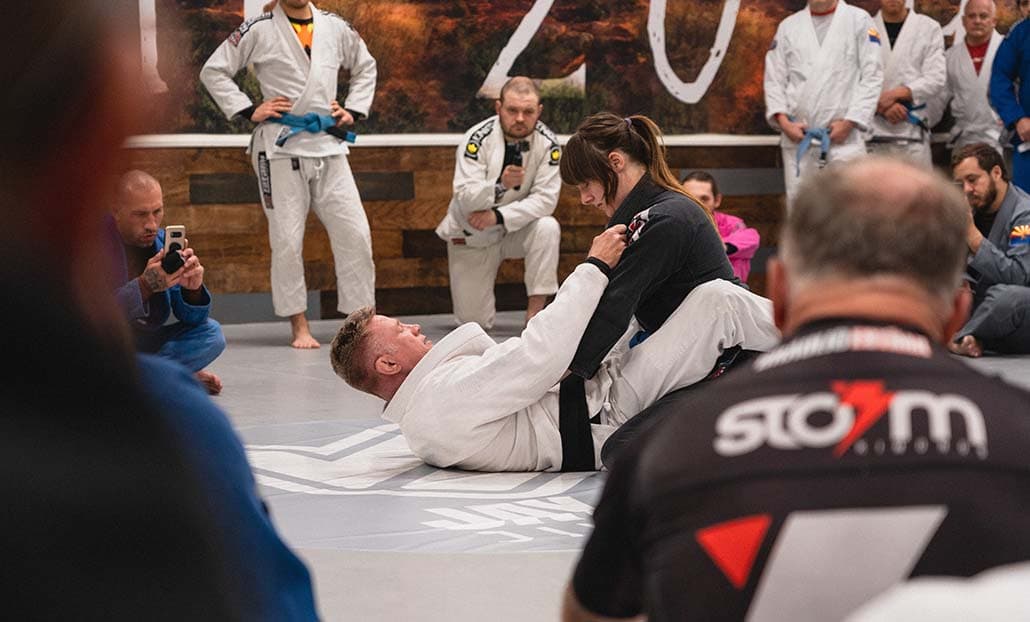
Choosing a BJJ seminar worth your time and travel
Choose a BJJ seminar by the subject, teaching format, access, and total cost. Know what to ask the host before buying a ticket.
Comments (0)
Loading comments...