
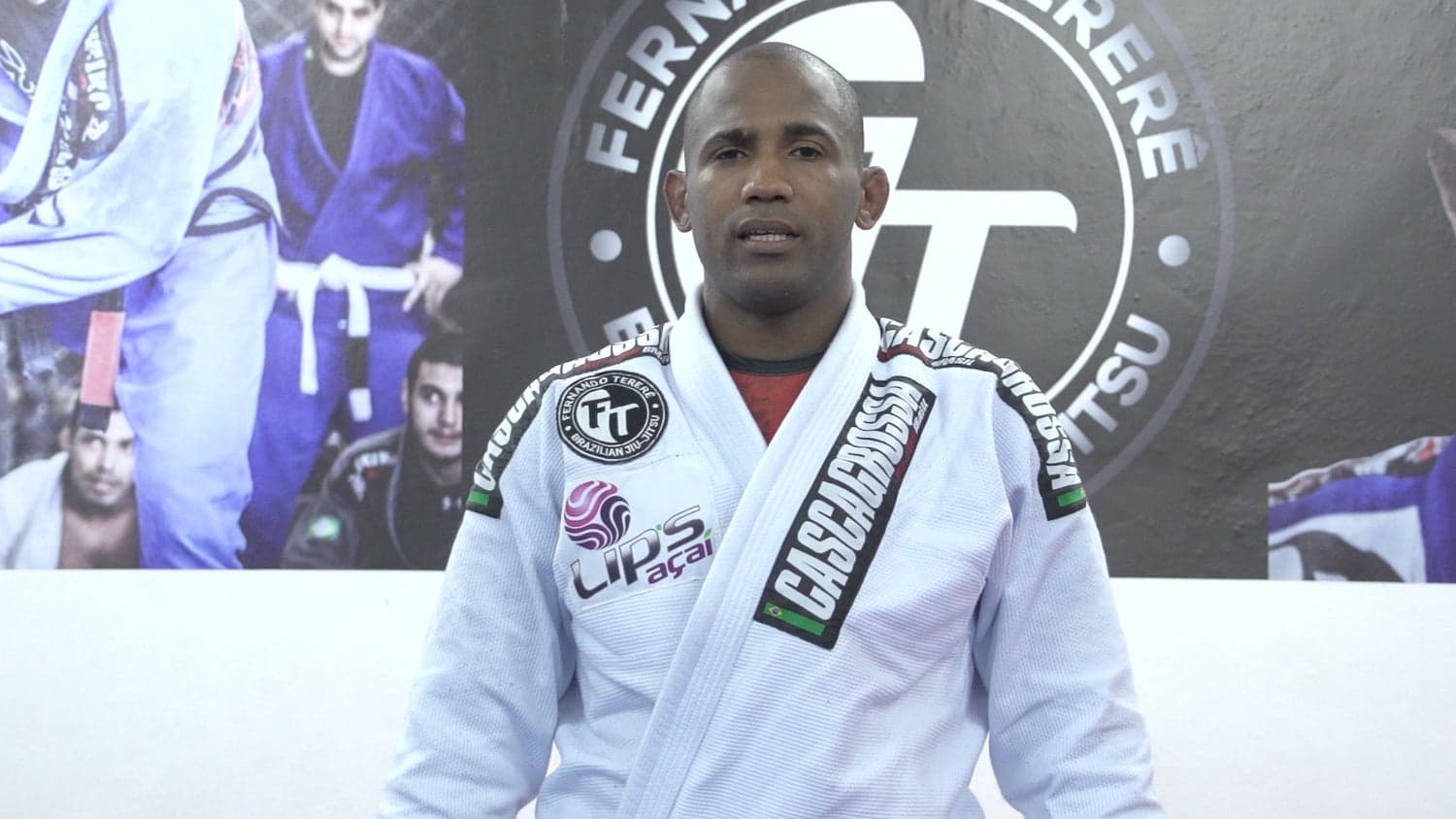
Fernando Tererê: look past the highlight reel
Quick answer: Fernando Tererê Augusto won black-belt World titles in 2000 and 2003 and remains a rewarding athlete to study beyond short highlights. His results, teaching material, and movement are best approached with context: who he faced, what problem he was solving, and what happened before the memorable moment.
On the 2003 Worlds result sheet, the name is Fernando Augusto. Below it, in second place at adult black-belt middleweight, is Marcelo Garcia. A familiar nickname can make an athlete feel like a character from old footage; a result sheet puts him back inside an actual competition, against actual opponents.
Tererê deserves both kinds of attention. The appeal of the footage can bring a new viewer in. The record, the surrounding exchanges, and the teaching can give that viewer something more durable than a collection of spectacular seconds. There is enough jiu-jitsu here to reward a slower look.
Start with a result that can be checked
The IBJJF's official 2003 Worlds results list Fernando Augusto of Master first and Marcelo Garcia of Alliance second in the adult black-belt middleweight division. That establishes the outcome without requiring an exaggerated description of what either man meant to the sport.
It also keeps the date attached to the achievement. A later reputation can change how a historical matchup feels to a modern viewer. The athletes in an older tournament were competing at that point in their development, under the conditions of that event. They were not carrying every accomplishment they would eventually collect.
That does not make the result smaller. It makes it more precise. Tererê won that championship, in that division, with that field. A careful account can let the fact stand before building an interpretation around it.
For someone discovering older jiu-jitsu, this is a useful habit. Pair the clip with an official event record whenever possible. Confirm the year, division, and athletes. A caption written much later may be enthusiastic and still get one of those details wrong.
The second title belongs beside the first
BJJ Heroes' biography records Tererê's black-belt World titles in 2000 and 2003 and identifies Alexandre Paiva in his black-belt lineage. The two titles give the profile a competitive foundation without requiring a complete inventory of every medal.
The gap between championship years is also worth leaving intact. Sports summaries tend to compress careers into uninterrupted momentum. Real competition records contain separate events and changing circumstances. A title in one year does not automatically explain another three years later.
A viewer can use that interval as a reason to look for differences rather than to invent a story about them. Does available footage show different opponents presenting different problems? Which positions recur? Which choices appear only in a particular matchup? Those are questions to investigate through complete material, not conclusions supplied by a title count.
The same discipline helps ordinary training. Seeing an athlete succeed repeatedly should encourage closer study of decisions. It should not create an expectation that progress must look continuous, or that a useful game can be understood by finding one signature movement and treating everything else as decoration.
A heavier division changes the reading
The official 2004 Worlds archive places Fernando Tereré of TT Jiu-Jitsu second in the adult black-belt ultra-heavy division, behind Fabricio Werdum. That is a striking contrast with the middleweight result the year before, and a reason to check division labels carefully when retelling the story.
The record supports a specific statement: he reached the podium in a substantially different division. It does not tell us his exact weight that day or justify an invented account of his motives. Those would require additional evidence.
For a viewer, the change raises interesting technical questions. How does an athlete seek useful angles when the physical matchup differs? Which grips create time to move? When is remaining underneath an opponent more costly than changing the position? The answers have to come from the match, not from a general slogan about technique defeating size.
Size remains part of grappling. An accomplished athlete's result in a heavier category does not make it irrelevant, and it should not become pressure on a beginner to accept unsuitable rounds. Admiring the performance and making sensible choices in your own training are entirely compatible.
Keep the approach attached to the movement
A highlight can make a transition look self-contained. The athlete moves quickly, the opponent loses position, and the edit cuts to another exchange. What may be missing is the grip, angle, or earlier reaction that made the movement available.
When studying Tererê, resist letting the most visible movement carry the whole explanation. Return to the approach. Identify where both athletes' weight is, what each person is controlling, and which route is closed. Then watch the transition at normal speed before slowing it down.
This is a method of study, not a claim that every exchange can be reduced to the same principle. Some sequences depend on timing a beginner cannot reproduce yet. Some depend on a specific opponent's reaction. Understanding those limits is part of learning from the footage.
It also prevents a common training mistake: copying the spectacular portion while omitting the control that made it reasonable. If the entry is missing, more speed may only make the failed attempt harder on a partner. Ask an instructor to help identify a safe, teachable starting point before trying an unfamiliar transition.
Teaching material supplies a different view
Competition footage shows decisions under resistance. Instructional material offers a chance to hear the athlete organize an explanation. Those sources do different jobs. Neither should be treated as a complete replacement for the other.
Tererê's published guard-passing instruction, including the material listed by Budo Videos, provides a route into the teaching side of his work. A product listing establishes that the material exists; it does not prove that a viewer has learned the techniques inside it.
Approach a lesson with a question from your own training. Perhaps you lose contact while moving around the legs, or reach a passing angle without being able to settle. That question can help you decide which explanation is relevant and what needs clarification from your coach.
Do not try to absorb an entire athlete's game in one sitting. Take one sequence, identify its conditions, and practice the appropriate part with consent and control. The useful outcome is a better understanding of a problem, not the ability to recite every chapter title afterward.
Build a small study session around one exchange
A focused review can turn historical interest into a practical learning habit. Choose a complete sequence rather than a montage and give yourself a limited set of questions:
What was the starting position, including grips and body alignment?
What did the opponent do immediately before the successful action?
Which connection remained in place during the transition?
What would you need an instructor to explain before practicing it?
Write down uncertainty instead of filling it with a confident guess. If the camera does not show a grip, note that it is unclear. If the clip begins halfway through an exchange, look for a fuller version before drawing a strong conclusion.
Our guide to keeping a BJJ training journal can help carry the question into class. A short note about a specific difficulty is easier to use than a general instruction to become more creative or athletic. It also gives the coach something concrete to respond to.
Historical footage becomes more valuable when it changes the quality of your questions. You do not have to reproduce the whole sequence for the study to be worthwhile.
Let the athlete remain more than a highlight
A memorable style can become a limitation in the way a person is covered. Every article reaches for the same adjectives, every video uses the same few exchanges, and eventually the reputation seems to explain itself. The actual work disappears behind the description.
Tererê's record offers a way out of that loop. There are named events, different divisions, identifiable opponents, and teaching material. Each gives the reader a place to look more closely. The story can be engaging without requiring unsupported claims about what he thought or how every spectator felt.
The same care applies to personal history. A technical profile does not need to turn an athlete's private difficulties into entertainment. There is substantial sporting material to discuss on its own terms, with respect for the person and the people who shared the mat with him.
For a new fan, the best next step may be one full match and a reliable result sheet. For a practitioner, it may be one lesson studied slowly with a coach. Both approaches give the athlete more credit than an endless repetition of the word legend. They pay attention to the jiu-jitsu itself.
Main photo: Budo Videos; archive instructional photograph of Fernando Terere.
The takeaway
Fernando Tererê's World titles in 2000 and 2003, and his 2004 podium in a much heavier division, provide concrete starting points for a closer look. Keep the dates and opponents attached to the achievements rather than letting a familiar reputation do all the work.
Then study the parts a highlight tends to skip: the approach, the control, and the reaction that made a movement possible. That is where admiration can become a useful question to bring back to training.
Find a place to work on the details
Explore BJJ gyms on Let's Roll and look for instruction that helps you turn a question from match footage into careful, appropriate practice.
FAQ
What is Fernando Tererê's full name? He is widely known in jiu-jitsu as Fernando Augusto Tererê, with official historical results sometimes listing Fernando Augusto or Fernando Tereré. Check the event and division when matching records.
When did Tererê win the black-belt Worlds? His recorded championship years are 2000 and 2003. The IBJJF's 2003 archive places him first in the adult black-belt middleweight division.
Did Tererê compete in a heavier division at Worlds? Yes. The official 2004 archive records him second at adult black-belt ultra-heavy, behind Fabricio Werdum. That result should be described using the event's actual division label.
What is a useful way to study his jiu-jitsu? Start with a complete match sequence or an actual lesson, identify the controls before the memorable movement, and ask an instructor about anything unclear before attempting it with a partner.

Miles Serrano
Miles Serrano writes about competitors and the decisions that shaped their careers. He is more interested in the adjustment someone made in the third minute than in the medal count afterward.
Related Posts
Competing in gi and no-gi on the same day takes two plans
Prepare for gi and no-gi competition on the same day with separate rule checks, complete outfits, schedule coordination, and a realistic second-bracket plan.
Jiu-jitsu in Montreal: build the visit around a real class
Plan BJJ training in Montreal around confirmed classes, language arrangements, winter travel, visitor policies, and equipment that is ready to use.
BJJ gi pants that fit standing up can still fail on the mat
Check BJJ gi pants at the waist, rise, knees, and cuffs so a good-looking size label becomes a uniform you can actually move in.
Comments (0)
Loading comments...