
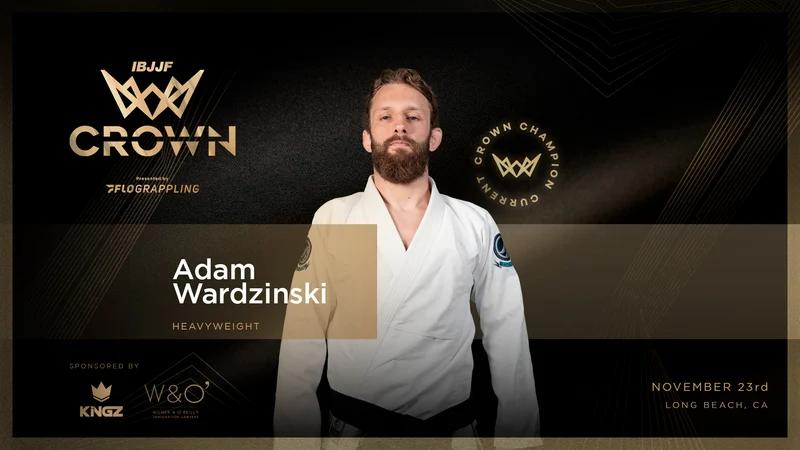
Adam Wardzinski made the butterfly guard a world-title problem
Quick answer: Adam Wardzinski became Poland’s first IBJJF adult black-belt world champion in 2024, finishing all four opponents. His next major results included a tightly contested Crown title and a Grand Slam completed at the 2025 Brasileiros, a run that shows considerably more than an excellent butterfly guard.
Four matches, four submissions. In a division where a single stalled exchange can decide an afternoon, Wardzinski left the 2024 World Championships without needing the scoreboard to settle any of his matches. The heavyweight final ended with Vinicius Liberati caught in a head-and-arm choke.
The achievement carried a national milestone, but the sporting detail is just as interesting. Wardzinski had been competing at black belt since 2016. By the time he reached the top of the adult Worlds podium, he was already eligible for Master 1. His first black-belt Worlds medal was gold, according to the IBJJF’s championship analysis.
That is a good place to begin understanding him: a veteran with a recognizable game who still found ways to turn familiar positions into fresh problems. His story becomes much better when the camera stays on after the butterfly sweep.
The world title came with four different endings
Wardzinski’s 2024 Worlds route ended in a back choke against Rafael Silva, a triangle against Mateus Rodrigues, an Ezekiel against Rider Zuchi, and the head-and-arm choke against Liberati. Those are the finishes recorded in the federation’s submission breakdown. The variety matters more than a simple submission percentage.
A guard can have a strong identity without producing the same ending every time. The butterfly position creates opportunities to change height, disturb a base, or come up into a top position. What happens afterward depends on how the opponent responds. A defender protecting the neck presents a different problem from one posting a hand to remain upright.
Wardzinski’s four finishes illustrate that larger requirement. A world title needs more than the ability to create the first imbalance. It needs a competitor who can recognize the next opening and move before the defender repairs it. His 2024 run ended through several routes rather than one repeated trap.
Butterfly guard makes the opponent choose
Butterfly guard can look strangely modest beside the more elaborate positions in modern gi competition. Both athletes may appear almost upright. The bottom player has neither wrapped the opponent in a closed guard nor extended into an obviously long-range structure. A viewer waiting for a dramatic setup can miss how much is happening in the space between their chests.
The problem is balance. The player on top must deal with inside hooks while preserving a base and denying upper-body control. Lean forward too far and a lift becomes available. Sit back too far and there may be room for the bottom player to rise. Put a hand down and that hand is temporarily unavailable for another defensive task.
Those mechanics help explain why the guard remains relevant against opponents who have certainly prepared for it. Knowing the name of the position does not remove the decisions it demands.
A sweep only starts the harder argument
The two points attached to a sweep can make the movement seem like a completed job. Against an elite opponent, the top position often arrives with another guard already taking shape underneath. The reversal has changed the score and the roles, but it has not automatically produced a pass or a submission.
This is where Wardzinski’s Worlds finishes deserve attention. A player recognized for getting underneath heavyweights ended his championship run with attacks involving the back, a triangle, and upper-body chokes. The connecting work matters: staying close enough to stop a fresh guard from becoming comfortable, controlling a turn, and recognizing when continued positional pressure makes an attack available.
The distinction also explains why a highlight of a beautiful sweep is an incomplete portrait. The lift can be the most memorable second. The more consequential question may be what the athlete can still control ten seconds later. Wardzinski’s 2024 title offers several answers to that question.
The Crown required a much smaller margin
Later that year, Wardzinski reached the IBJJF Crown final after facing Matheus Spirandeli and Horlando Monteiro. Gustavo Batista, another 2024 world champion, stood between him and the title. This time there was no submission finish. Wardzinski won through an advantage associated with a near sweep, as described in the official Crown recap.
That result is a useful companion to Worlds because it asks for a different kind of appreciation. The final was a much tighter contest than his World Championship run. Elite competition contains matches in which both players understand the central danger and neither gives away the opening required for a finish.
The near sweep was consequential precisely because the larger scoring action did not fully materialize. One athlete created a better scoring opportunity; the other prevented it from becoming the full reversal. Readers unfamiliar with that distinction can use our BJJ rules guide to follow how points and secondary decisions fit together.
The Grand Slam ran across a season
At the 2025 Brasileiros, Wardzinski won three matches, two by submission, to complete a Grand Slam that had begun with his 2024 Worlds victory. Across the four major events, the IBJJF’s season account credited him with thirteen wins and eight submissions.
The sequence ran from Worlds into the following year’s majors, spanning two calendar years. It also asks something different from a single excellent weekend. Each tournament produces another bracket, another set of opponents, and another chance for someone to solve the position that worked last time.
A familiar game faces a particular challenge during that kind of run. Its success becomes widely visible. Opponents do not arrive with less information after the first title. The ability to keep producing results therefore says something about execution under preparation, not just the surprise value of a particular guard.
The next final belonged to Nolan Stuart
Wardzinski’s 2025 Crown appearance added a different ending. Returning after a retirement announcement, he beat Igor Tanabe 6–2 and Paulo Merlin 7–0 before losing the final to Nolan Stuart by omoplata. Those results appear in the federation’s 2025 Crown report.
It would be easy to make that final sound like a verdict on everything before it. It was a match, against a particular opponent who found a successful route. The two preceding wins and the earlier titles still exist. So does Stuart’s finish.
An omoplata also provides a useful contrast to the upper-body finishes in Wardzinski’s 2024 Worlds run. The shoulder attack can tie a player’s posture to the opponent’s hip movement and prevent an easy return to a square position. A competitor who usually makes other people carry his imbalance can end up having to solve one himself. The result belongs in the story because it keeps the competition real.
What the full sequence reveals
Wardzinski’s recent career offers several distinct competitive problems rather than one long victory montage:
At the 2024 Worlds, he finished four matches through several submission routes.
At the 2024 Crown, a near-sweep advantage decided a final between world champions.
At the 2025 Brasileiros, he completed a four-major season.
At the 2025 Crown, he reached another final and was submitted by Stuart.
Together, those performances resist the idea that an athlete has one fixed setting. The same competitor can finish a bracket, manage a narrow decision, sustain a season, and lose a final. That range is ordinary at the highest level even when the individual achievements are exceptional.
It also gives the butterfly guard a more accurate setting. The position is part of a competitive system that includes passing, defense, score awareness, and decisions under fatigue. Wardzinski’s identity starts with a guard people recognize. His strongest results depend on what he can do around it.
Main photo: ibjjf.com. Archive image published by ibjjf.com. The photograph is not an image of every event discussed in the profile.
The takeaway
Wardzinski’s first world title is compelling because the details support the achievement: a long black-belt career, a first Worlds medal that was gold, and four submissions on the way there. The later Grand Slam made that performance part of a sustained run rather than an isolated afternoon.
The narrower Crown win and the subsequent loss make the portrait more complete. He has shown that a recognizable guard can remain dangerous against prepared opponents, while the rest of his game supplies the options that recognition alone cannot explain. The butterfly sweep earns the replay. The career earns a longer look.
Find a place to train
Explore the Let’s Roll gym directory to compare local academies and find a room where you can build the positions that interest you.
FAQ
When did Adam Wardzinski win his first black-belt world title? He won the IBJJF adult heavyweight World Championship in 2024, submitting all four opponents and becoming Poland’s first adult black-belt world champion.
Which guard is Adam Wardzinski known for? Butterfly guard is a defining part of his game. His championship results also include back attacks, triangles, and upper-body chokes, so the guard does not describe his entire skill set.
Did Wardzinski complete an IBJJF Grand Slam? Yes. The IBJJF reported that he completed the season’s four-major sequence at the 2025 Brasileiros, following the run that began at the 2024 Worlds.
Who won the 2025 Crown final against Wardzinski? Nolan Stuart submitted him with an omoplata after Wardzinski had defeated Igor Tanabe and Paulo Merlin on the way to the final.

Miles Serrano
Miles Serrano writes about competitors and the decisions that shaped their careers. He is more interested in the adjustment someone made in the third minute than in the medal count afterward.
Related Posts

Fight 2 Win: watch the attack before looking for points
Understand Fight 2 Win’s submission-focused superfights, how to watch the attacks, and why applying differs from receiving a match.

Moving from juvenile to adult BJJ needs a new entry check
A new competition year can change the age division before a birthday. Read the organizer’s age calculation and the rules for the actual adult entry.

Your BJJ tournament is not over at the last handshake
Stay for the correct podium procedure, check the result, and make a medal photograph that respects everyone who shared the bracket.
Comments (0)
Loading comments...