
Butterfly Guard: The Most Underrated Guard in BJJ
Quick answer: Butterfly guard is a seated open guard where your feet hook inside your opponent's thighs, letting you lift and off-balance people much heavier than you. It's one of the most effective guards in BJJ and one of the least glamorous — it works in gi and no-gi, it's kind to aging knees and backs, and it's built entirely around sweeping. Most people should start playing it in late white belt or early blue.
Ask ten people to name the coolest guard in jiu-jitsu and you'll hear berimbolo entries, flying triangles, maybe worm guard. Almost nobody says butterfly.
That's a mistake. Butterfly guard has quietly won more high-level matches than most of the flashy stuff combined, and it's probably the best long-term investment a grappler can make. Here's why.
What butterfly guard actually is
You're sitting up, shins inside your opponent's legs, with the tops of your feet hooked under their thighs. You're close — chest-to-chest close — with grips controlling their arms or collar.
That's it. No cloth wrapped around anything, no knees twisted at strange angles. Just hooks, grips, and posture. The simplicity is deceptive, because those two hooks turn your legs into a forklift.
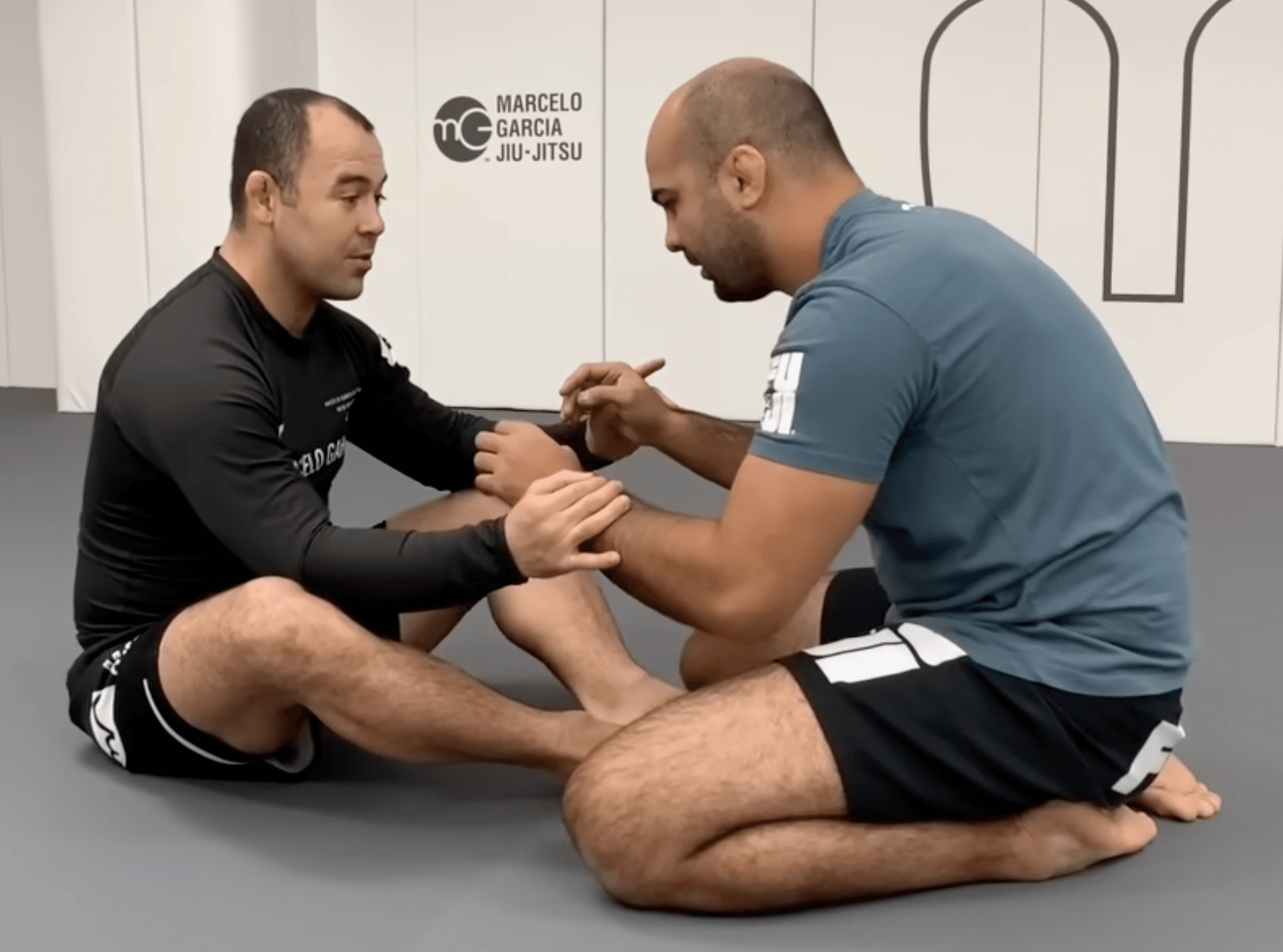
The Marcelo Garcia effect
If you want proof the guard works, look at Marcelo Garcia. Widely considered one of the greatest grapplers of all time, he spent years beating much larger men at ADCC and the world championships — and butterfly guard, along with the x-guard it connects to, was the engine of that game.
The honest lesson from Marcelo isn't "copy his moves." It's that a smaller person, seated, with two hooks in, can consistently put bigger people on their backs. That's the whole promise of jiu-jitsu in one position.
Why it ages so well
It doesn't torque your knees. Guards like de la Riva load the knee in rotation; butterfly keeps your legs working in their natural hinge, which is a big reason older grapplers drift toward it.
It's strength-efficient. You lift with your opponent's momentum and your whole body, not your quads, so it holds up over long rounds and long decades.
It doesn't demand flexibility. If you can sit cross-legged on the floor, you're mobile enough to start.
Plenty of guards have a shelf life. Butterfly is the one people retire into, not out of.
Hooks and elevation, conceptually
The core idea is elevation. Your hooks can't lift a resisting adult off the floor by themselves — nobody's legs are that strong from that angle.
What they can do is redirect weight that's already moving. Butterfly players pull their opponent forward, load them onto the hooks, then lift and turn. You're not hoisting anyone; you're borrowing their weight and choosing where it lands. Judo calls the setup kuzushi — breaking balance before the throw. Same principle, seated.
Sweeps are the goal
Some guards are about holding people in place. Butterfly is not. Its entire purpose is to put you on top, usually via the classic butterfly sweep: trap an arm so they can't post, load them onto one hook, elevate, and roll them over.
That shapes how you should think about the position. If you're playing butterfly and nothing is happening, something's wrong — it's an action guard. Getting on top wins matches at every level, and butterfly is one of the most direct routes there. For where sweeping fits into the bigger picture, see our positions guide.
Sit up — don't lie back
The most common beginner mistake is playing butterfly flat on your back. Once your shoulders hit the mat, your hooks lose most of their power and your opponent's weight pins you in place. The guard mostly dies there.
Sit tall instead. Head up, back off the floor, chest close to theirs, fighting for an underhook or collar grip. A decent rule of thumb: if your shoulder blades are on the mat and you haven't launched a sweep yet, you're late.
Gi vs no-gi butterfly
Butterfly is one of the few guards that translates cleanly to both rulesets — worth knowing if you split your training (we compare the two properly in gi vs no-gi).
In the gi, collar and sleeve grips slow the game down and give you more control over posture. In no-gi, butterfly becomes even more central, because the cloth-dependent guards disappear entirely — you're left with underhooks, wrist control, and hooks, and the position links naturally into wrestling up to your feet.
Spider guard doesn't survive the transition. Butterfly doesn't notice it.
When should beginners add it?
The honest answer: earlier than most people do, but not on day one. Spend your first few months on closed guard and basic escapes. Then, somewhere around late white belt, start sitting up into butterfly whenever your closed guard gets opened — that's the natural doorway.
Keep the scope small. One sweep, one entry, one answer for when they back away. Expect to get flattened regularly for a month or two. That's the tuition, and it's worth paying early, because this is a guard you'll still be using in twenty years.
The takeaway
Butterfly guard is underrated for the dullest possible reason: it doesn't look like much. But it sweeps big people, survives both rulesets, spares your knees, and rewards timing over athleticism — which is a fair description of jiu-jitsu itself.
If you're going to invest deeply in one guard, it's hard to make a better pick.
Learn it from people who play it
The fastest way to build a butterfly game is a room full of different body types and a coach who catches the details. Find a BJJ gym near you on Let's Roll →
FAQ
Is butterfly guard good for beginners? Yes, with a short delay. Learn closed guard basics first, then add butterfly around late white belt. Its core skills — posture, grips, off-balancing — reinforce everything else you're learning.
Does butterfly guard work in no-gi? It's arguably the single most important guard in no-gi. With no cloth to grip, seated guards built on hooks and underhooks become the backbone of most bottom games.
Why do I keep getting flattened in butterfly guard? Almost always because you're lying back instead of sitting up. Keep your back off the mat, stay chest to chest, and attack sweeps early instead of waiting to see what happens.
Is butterfly guard safe for bad knees? It's one of the friendlier guards for aging joints, since it doesn't rotate the knee under load. Nothing in grappling is risk-free, but many older practitioners build their whole game around it for exactly this reason.
Related Posts

Mikey Musumeci gives up the belt to make room for MMA
Musumeci is vacating his UFC BJJ title to focus on MMA training. What he is leaving, what continues, and why the transition matters.
IBJJF membership: finish the paperwork before the deadline
IBJJF membership and tournament entry are separate steps. Plan documents, professor approval, renewals, and junior accounts before registration closes.
Choosing a BJJ seminar worth your time and travel
Choose a BJJ seminar by the subject, teaching format, access, and total cost. Know what to ask the host before buying a ticket.
Comments (0)
Loading comments...