
Running a BJJ gear swap without making it awkward
Quick answer: A gym gear swap needs clear rules about what is accepted, how items change hands, and what happens to anything left over. Require clean, usable equipment and let the owner describe its condition honestly. Keep donating, swapping, and selling separate so nobody has to guess what an item costs or whether it is available.
One student has gi pants they no longer wear. Another has a jacket that never quite fit. Put those two facts together and a gear swap sounds simple, until a table fills with unlabelled clothes and nobody knows who owns the blue A2.
A small amount of organization can keep the event useful. The aim is to help serviceable equipment find an appropriate next owner without turning the academy into a storage room or making anyone feel obliged to accept something unsuitable.
Get the academy’s agreement before collecting anything
Ask the owner or manager whether the event fits the academy’s space, schedule, and policies. A student’s generous idea should not quietly create responsibility for the people who run the gym.
Agree on the location, start and finish time, and who will manage the table. Avoid blocking changing areas or leaving equipment where it interferes with class. If the swap happens around an open mat, keep the two activities clearly organized.
Decide who answers practical questions. Participants should know whether they are dealing directly with an item’s owner or with a person coordinating donations. The gym should not appear to guarantee the condition of every object simply because the table is inside its building.
Keep the first event small enough to manage. One supervised session with a clear end may work better than an indefinite collection box that gradually becomes part of the furniture.
Choose one main way for items to change hands
A donation table, a direct swap, and a secondhand sale are different arrangements. Each can work, but mixing them without labels creates confusion. Someone may reasonably assume an item is free when its owner expects payment.
State the main format in the invitation. If more than one arrangement is allowed, separate the areas and label the items clearly. A participant should not have to begin a negotiation to learn whether a pair of pants is available.
For direct swaps, both owners need to agree that the exchange suits them. Avoid an organizer assigning values or pressuring someone to trade because the event needs to look successful. A polite refusal should remain easy.
If the academy permits sales, keep the terms between the relevant parties and make the process clear. Do not imply a commercial guarantee or refund arrangement that nobody has actually offered. The practical details should be settled before money changes hands.
Accept only equipment that someone can reasonably use
Set a simple condition standard before the day. Clothing should be clean, dry, and in usable condition. Ask owners to disclose repairs, visible damage, and any fit change they know about rather than leaving the next person to discover it during class.
Do not treat the swap as a place to unload items you would not feel comfortable explaining to a new teammate. A worn but serviceable gi and a damaged uniform needing assessment are different things.
Exclude personal-use items that are not appropriate to pass between people, and ask the academy which categories it will accept. There is no need for every kind of training equipment to appear at the first event.
Our used-gi buying guide covers the receiver’s checks. For the organizer, the task is to set conditions that make those checks possible, not to declare every item suitable on the owner’s behalf.
Labels should answer the first questions
A useful label identifies the item, its owner or contact arrangement, the stated size, and any condition detail the next person needs to know. If it is not free, that should be obvious before someone starts trying to match it with another item.
The label size is a starting point, not a promise of fit. An owner can add actual measurements or explain that the garment has changed size through use, while avoiding a confident prediction about who it will suit.
Ask for a few consistent details:
Brand, model if known, and labelled size.
Whether the item is donated, offered for a swap, or for sale.
Known repairs, damage, or fit changes.
How to contact the owner during the event.
Keep personal contact information appropriately limited. A first name and an organizer-mediated introduction may be enough. Do not publish phone numbers on a public photo of the table without permission.
Give people space to decide whether something fits
A donated gi is only useful if the recipient can wear it appropriately. Make it comfortable to inspect or decline an item without having to explain body size, budget, or personal circumstances in front of the group.
Follow the academy’s arrangements for trying on clothing. Keep the process respectful and separate from the training area when appropriate. A person should not feel expected to change beside a public table because the organizer forgot to consider fitting.
For children’s gear, involve the parent or guardian and allow the child’s comfort to matter. Do not assume that a labelled size or a promise to grow into it settles whether the item is suitable for class now.
If an item is intended for competition, the recipient still needs to check the applicable event requirements. The fact that a teammate wore it previously does not guarantee it will pass another inspection or fit a different wearer appropriately.
Make taking and giving equally comfortable
Avoid framing the event as a public distinction between people who have enough and people who do not. Someone may want to pass on an unused item, find a better fit, or reduce the equipment sitting at home. Those are sufficient reasons to participate.
A donation does not need a speech about the recipient. Do not photograph someone receiving a gi and attach a personal story without asking. They may welcome the equipment while preferring that the exchange remain ordinary and private.
Similarly, a person who brings nothing should not be treated as less entitled to browse a donation table if the event is open to them. State any participation rules beforehand rather than inventing them when somebody reaches for an item.
For a direct swap, a person may leave with exactly what they brought. That is not a failure. A useful event gives people options without requiring a transaction from everyone who attends.
Decide the leftover plan before the first bag arrives
At the end of the event, unswapped items still belong to someone. Tell participants whether they must take them home and by what time. Do not assume leaving an item on the table means the owner has donated it permanently.
If the organizer plans to offer leftovers to another organization, obtain agreement from the owners and confirm that the receiving organization wants those items. A donation should not transfer the problem of sorting unsuitable gear to someone else.
Keep unclaimed items separate from the gym’s ordinary lost property. A clearly marked event container and a short, communicated collection window can prevent the two systems from becoming confused. Follow the academy’s policy for anything not collected.
Do not promise that every donated object will find a user. Some equipment may be unsuitable or unwanted. An honest limit is more useful than an ambitious announcement that leaves the gym responsible for disposing of a large pile afterward.
Keep a small record and improve the next event
You do not need a complicated inventory system for a handful of items. You do need enough of a record to know what was donated, what remained with an owner, and what the organizer has permission to do after the event.
Avoid collecting personal information that serves no practical purpose. The event is about equipment, not building a profile of members’ finances or clothing sizes. Keep any necessary record with the people responsible and handle it according to the academy’s normal practices.
Afterward, review the practical problems. Were the labels clear? Was there enough room? Did the leftover plan work? A short conversation can improve the next swap without turning the event into a permanent administrative program.
If the idea worked, choose another date only when there is a reason. An occasional gear swap can be useful without becoming a monthly expectation that members must keep supplying. Let the actual need determine the rhythm.
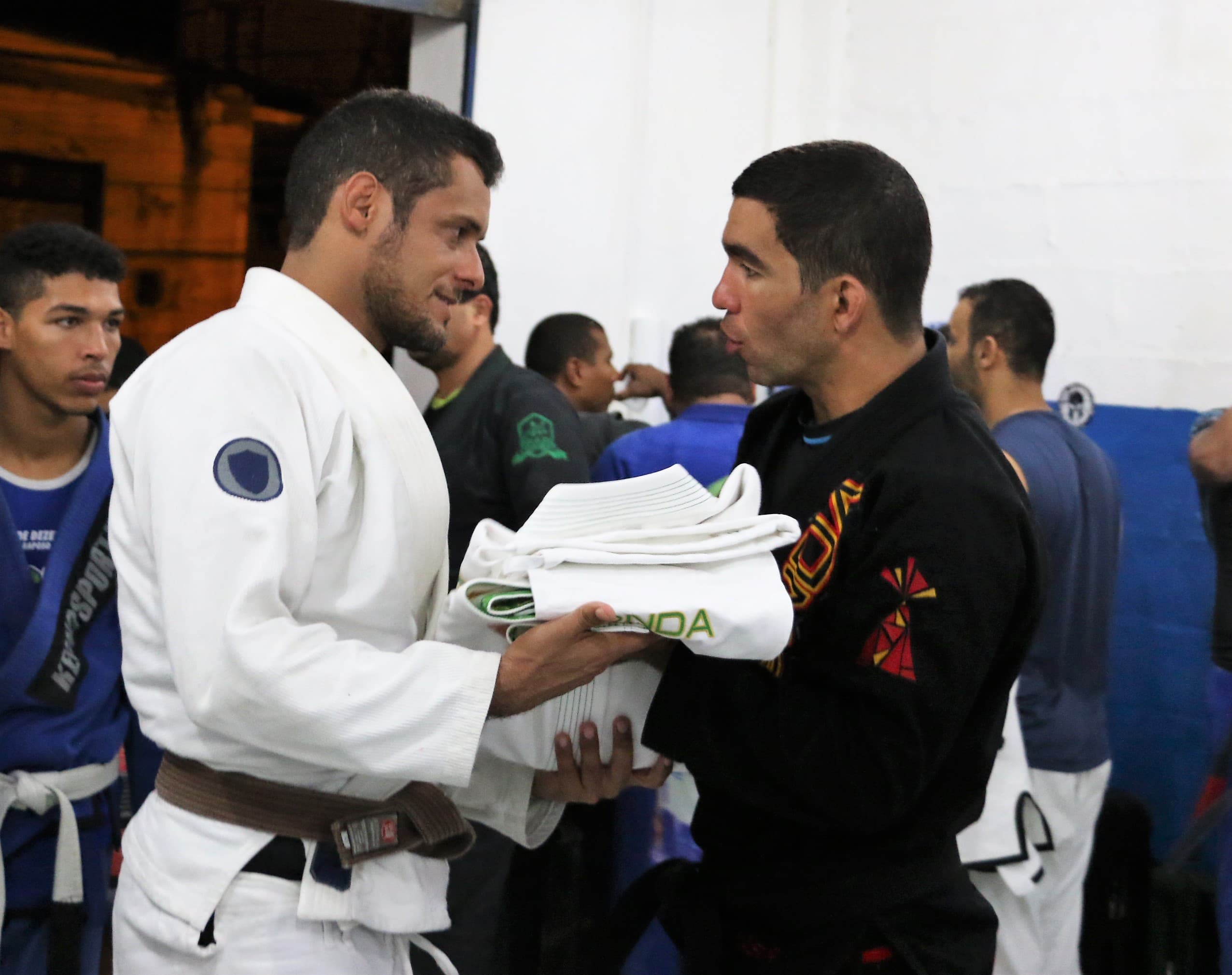
Main photo: DreamRoot Institute; archive photograph from its gi donation coverage, illustrative rather than a reported gear swap.
The takeaway
A useful BJJ gear swap begins with the academy’s agreement and clear terms for how items change hands. Accept clean, usable equipment, label it honestly, and let people inspect or decline it without pressure.
Settle the leftover plan before collecting anything. The event has done its job when suitable gear finds willing owners and the gym returns to normal afterward, without a new pile of unexplained belongings.
Find the room before organizing the event
Use Let’s Roll’s gym directory to connect with an academy, and discuss any community event directly with the people who run it. A gear swap should support the room’s arrangements.
FAQ
Should a BJJ gear swap be free? It can be a donation event, a direct exchange, or a permitted secondhand sale. Choose the format clearly and label items so nobody has to guess the terms.
Can I bring a repaired gi? Disclose the repair and follow the event’s condition rules. The next owner should be able to assess whether the garment is appropriate for training or a particular competition.
Who handles items left after the swap? Decide that beforehand. Owners may need to collect their items, or they may explicitly agree to another destination. Leaving something on a table should not automatically transfer ownership or responsibility.
Do I need to bring something to receive donated gear? That depends on the stated event rules. If a donation table is open to members, avoid adding an unannounced requirement that everyone must contribute an item first.

Kit Langford
Kit Langford covers the louder parts of jiu-jitsu — the marketing claims, the arguments, the gear that promises more than gear can deliver. The jokes are expected to survive a fact-check.
Related Posts

Competing in gi and no-gi on the same day takes two plans
Prepare for gi and no-gi competition on the same day with separate rule checks, complete outfits, schedule coordination, and a realistic second-bracket plan.
Jiu-jitsu in Montreal: build the visit around a real class
Plan BJJ training in Montreal around confirmed classes, language arrangements, winter travel, visitor policies, and equipment that is ready to use.
BJJ gi pants that fit standing up can still fail on the mat
Check BJJ gi pants at the waist, rise, knees, and cuffs so a good-looking size label becomes a uniform you can actually move in.
Comments (0)
Loading comments...