
A bye changes your BJJ bracket, not your preparation
Quick answer: A bye advances a competitor through a bracket stage without a match in that slot. It commonly helps an elimination bracket accommodate an uneven field, but the organizer's format and seeding policy determine its placement. Check your actual first match and reporting instructions; a bye does not guarantee a long wait or a particular opponent.
An empty space beside your name can remove a match from your tournament day. It does not remove the need to be ready. The common mistake is treating a bye as an appointment to compete later, when the bracket only tells you which stage comes next.
Read the path, the match number, and the event's check-in instructions together. That turns an initially confusing diagram into a practical plan without pretending the diagram can predict the entire afternoon.
A bye is part of the bracket's arithmetic
Consider a hypothetical five-person single-elimination division drawn inside an eight-place bracket. Three first-round slots advance without a match. The remaining two competitors contest one first-round match, leaving four athletes for the semifinals. Two semifinals and a final then produce the winner.
There are four contested matches in that example, assuming everyone appears and no additional placement matches are added. Eliminating four people is enough to leave one winner. The empty slots allow the bracket to reach a balanced stage without inventing three more entrants.
That example explains one common use of byes. It is not a claim that every tournament uses an eight-place draw for five entrants. An organizer could choose another format, and small fields sometimes involve structures that do not resemble a standard elimination tree. Our guide to BJJ tournament formats explains why the format needs to be identified before counting possible matches.
Start with the event's rules, then interpret the diagram. Reversing those steps can produce a very confident explanation of the wrong competition.
Seeding and a bye are different pieces of information
A seed describes placement based on the organizer's chosen criteria. A bye describes advancement without a match at a particular stage. The two may be connected, but the appearance of a bye does not prove that the recipient was ranked or favored.
Smoothcomp's bracket documentation gives organizers tools for creating and adjusting brackets, including seeding. The software being used therefore does not, on its own, tell you which placement policy the event selected. The organizer must explain that policy.
If you need to ask, make the question specific. Find out whether the bracket is seeded, which criteria apply, and when corrections close. Asking why another competitor received an easier route assumes something that the drawing may not establish.
There can still be an uneven number of matches between routes. That is a feature worth understanding before entry, especially if your main purpose is getting several competition rounds. A single-elimination event cannot promise the same amount of mat time to everybody simply by arranging names differently.
Find your first contested match
Trace your name forward until you reach a match with another competitor or an incoming winner. That is the first contest you are preparing to enter. Note its identifier rather than relying only on where it sits visually on a phone screen.
A bracket can show the route while leaving the opponent unresolved. If your first opponent will be the winner of another match, watch for that result without deciding that one athlete is certain to advance. Preparing exclusively for the name you recognize can leave you surprised by the person who actually arrives.
Use a short check before leaving the bracket page:
Confirm your name, division, and the event you are viewing.
Identify the first contested match on your route.
Note the mat assignment and reporting instructions, if provided.
Check how the organizer communicates schedule changes.
Smoothcomp's athlete-facing bracket guide explains where competitors can view bracket details and results. Questions about the actual event still belong with its organizer. A platform support article cannot resolve a local check-in instruction that was never entered into the software.
An empty match slot does not create a reliable break
A bye may mean fewer contests before you compete, but it does not tell you how quickly other divisions will move. Matches can end early. Mats can be reassigned. A delay elsewhere can move through the schedule in ways your small bracket does not display.
Smoothcomp's scheduling documentation describes estimated times recalculating when organizers move categories and mats. Treat an estimate as information to monitor, not a guarantee that you can leave until a precise minute.
Follow the event's arrival and check-in requirements even if your first visible slot is empty. Once you are at the venue, ask where announcements happen and what being ready means for your division. Keep the person cornering you informed so their plan is based on the same information.
The practical goal is to avoid two extremes: exhausting yourself because you assumed your match was immediate, or being absent because you assumed a bye bought you an hour. Your coach can help organize the warm-up around the actual event flow. The bracket alone cannot prescribe it.
Plan for less footage, not a lesser result
If you entered hoping for several matches, a bye can reduce the amount of competition footage you bring home. That is worth acknowledging. It does not mean the result you earn under the published format is invalid.
The useful response is to separate your goals. If the priority is testing a specific competition plan, one match may still provide useful evidence. If the priority is accumulating a predictable number of rounds, compare future formats that advertise minimum matches and read the conditions attached to that promise.
Do not solve the disappointment by inventing another commitment on the spot. Entering an extra division, changing weight groups, or taking an open-weight option can alter the demands of the day. Discuss the actual available choice with your coach and the organizer before paying or agreeing.
You can also use the time to watch the relevant rules in practice. Observe how athletes are called, how the referee restarts action, and what the table expects. That is useful preparation, although it should not be presented as an equivalent replacement for competing.
A withdrawal can change the route again
A published bracket is not evidence that every listed competitor will make it to the mat. If someone withdraws or does not appear, the organizer may need to apply its event policy. Your route can change without the original bye having been a mistake.
Ask for the current status rather than trying to infer it from a crossed-out name. Has the division been redrawn? Is your next match still on the same mat? Do you need to report to a different official? The person managing the event should answer those operational questions.
A one-person division raises different issues from receiving an opening bye in a larger field. You might have choices, but the event's terms determine what they are. Do not assume a refund, a move to another bracket, or an automatic extra match is available. The guide to an opponent withdrawing covers those questions in more detail.
If the situation changes close to competition, tell your coach what was actually confirmed. Repeating a spectator's interpretation as an instruction is an easy way to send two people toward different mats.
Keep the post-event account precise
A useful training record distinguishes the placing from the matches. Record where you finished, how many contests you actually had, and which results advanced you. That description can be accurate without either inflating or apologizing for the day.
For example, a hypothetical competitor might finish second after receiving a first-round bye, winning a semifinal, and losing the final. Calling that two contested matches tells a coach exactly how much evidence is available. The placing remains second. There is no need to invent a third match to make the medal sound better.
Review the footage you have at the level it supports. One match can reveal a repeated opening mistake; it cannot establish that the same problem would have occurred against every possible opponent. Keep the next training question specific enough to work on in class.
Then review the event choice. Did the format fit the experience you wanted? Were the updates clear? Did your arrival plan leave enough room? Those answers help you choose a future competition without treating a normal bracket feature as a personal slight.
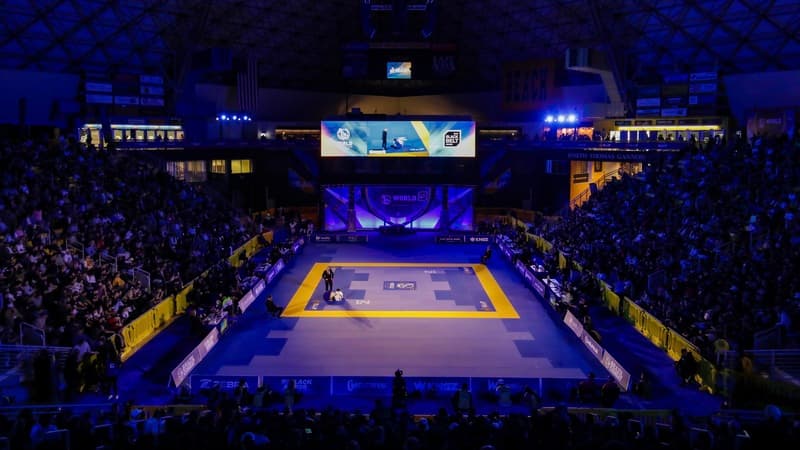
Main photo: IBJJF; 2024 Worlds arena photograph.
The takeaway
A bye changes the route through a competition. It does not reliably tell you your first opponent, your start time, or the value of the day. Learn the format, identify your first contested match, and follow the organizer's reporting instructions as they change.
Afterward, describe the result and the actual matches separately. That gives you an honest record and useful material for the next training session. The diagram can remain a diagram; it does not need to become a judgment about what you earned.
Choose the format before the entry fee
Browse tournaments on Let's Roll, then check the organizer's bracket format, minimum-match conditions, and withdrawal policy before registering.
FAQ
What is a bye in a BJJ tournament? It is advancement through a bracket stage without competing in a match at that slot. It can help an elimination structure accommodate its number of entrants.
Does a bye mean I am the top seed? Not necessarily. Seeding criteria and bye placement depend on the organizer's chosen format. Ask for the policy rather than assuming the bracket is ranked.
Can I arrive later if I have a bye? Follow the event's arrival and reporting requirements. A bye does not create a guaranteed time window, and estimated match times can change.
Does a bye count as a match for my training log? Record it as a bye and count the contests you actually completed separately. That preserves the placing while giving you and your coach an accurate account of the day's mat time.

Tess Hanley
Tess Hanley reads the rulebooks, the entry fees and the fine print. When a federation or a gym changes something, her first question is who ends up paying for it.
Related Posts

Mikey Musumeci gives up the belt to make room for MMA
Musumeci is vacating his UFC BJJ title to focus on MMA training. What he is leaving, what continues, and why the transition matters.
IBJJF membership: finish the paperwork before the deadline
IBJJF membership and tournament entry are separate steps. Plan documents, professor approval, renewals, and junior accounts before registration closes.
Choosing a BJJ seminar worth your time and travel
Choose a BJJ seminar by the subject, teaching format, access, and total cost. Know what to ask the host before buying a ticket.
Comments (0)
Loading comments...