
Missed BJJ classes: catch up without cramming
Quick answer: After missing BJJ classes, ask the instructor which part of the current material you need for the next session. Learn that prerequisite, practice it with a cooperative partner, and rejoin the class sequence. You do not need to recreate every missed hour before you are allowed to train again.
Missing three classes can leave you with one important gap or several minor ones. The number of absences does not tell you which. You might have missed the entry that the current lesson depends on, while remembering enough of the surrounding position to follow everything else.
The first task is to identify that gap. Watching a pile of unrelated videos can make you busier without making the next class easier. A short conversation with the person teaching the curriculum gives the catch-up work a defined purpose.
Ask what the next lesson assumes
Tell the instructor which sessions you missed and ask what you should know before joining the current material. A useful answer may be a starting position, a grip sequence, or a basic response to the partner's movement. Ask for the smallest piece that lets you participate meaningfully.
If the coach says there is nothing you need to prepare, accept that answer. Some sessions can stand alone. You do not need to create remedial work because the absence feels larger than its practical effect on the class.
If there is a prerequisite, ask when and how to review it without interrupting instruction. The coach might point you toward an academy video, suggest a few minutes before class, or pair you with someone who knows the setup. Follow the arrangement that fits the room.
Write the answer down in plain language. A note such as starting with the partner's knee between your legs is more useful than a technique name you cannot yet connect to a position. Names can vary; the actual arrangement of the two bodies is what you need to reproduce.
Rebuild the starting position before the sequence
When reviewing with a partner, first establish where both people begin. Identify the grips, body orientation, and immediate task. If those details are wrong, repeating the finish may only make the mistake more familiar.
Ask the partner to pause at the beginning while you check the setup with the instructor's explanation. Then move through the first change slowly. You should be able to say what caused that change and what the partner is expected to do in response.
This does not require turning practice into a lecture. One clear sentence may be enough. For example, you might explain that a particular grip is being removed before a movement can begin. The actual grip and movement should come from the lesson, not from an assumption based on a similar-looking position.
Only extend the sequence when the start is clear. If the entry remains confusing, return to that question rather than collecting extra finishes. A long sequence built on an uncertain beginning is difficult to repeat and harder to troubleshoot against resistance.
Borrow notes carefully
A teammate's notes can help you locate the lesson, but they were written for that teammate's memory. An abbreviation that makes perfect sense to them may omit the detail you need. Ask them to show what a note refers to instead of trying to decode it alone.
Distinguish the instructor's explanation from the teammate's interpretation. Both can be useful, but they serve different purposes. A partner may have recorded a variation that suited their body or a question they were personally working on. That does not automatically make it the version the whole class is practicing.
If video exists, check whether it is an academy resource intended for students and use it according to the school's rules. Do not assume that a clip from a private group can be forwarded elsewhere. Ask before recording a demonstration for your own reference.
Keep the material you collect limited to the identified gap. The aim is to arrive ready for the next lesson. A folder full of every resource connected to the position may be interesting later, but it can make a short catch-up task unnecessarily difficult to finish.
Use one question to guide the first round
Choose a question you can test in practice. It should concern a specific part of the material rather than whether the entire technique works. You might ask whether you can reach the starting grip when the partner is allowed to prevent it, or whether you recognize the response that triggers the next movement.
Agree on the exercise with your partner. Define where you start and what each person is trying to do. Ask the instructor to check the task if you are uncertain about the position or the permitted movements.
For a simple review, decide:
Which position begins the exchange.
What the person practicing is trying to establish.
What resistance the partner will provide.
When to stop and reset.
The reset matters. Without one, a narrow review can become a full round in which the intended position appears once and then disappears. You may still have a useful roll, but you will have answered a different question.
The guide to drilling BJJ offers a broader way to organize practice. For catching up, keep the exercise small enough that both partners know what counts as a successful repetition.
Keep outside instruction in its proper place
An outside video may show the same named technique with a different grip, entry, or objective. That does not necessarily make either version wrong. It does mean that combining them without noticing the differences can make your academy's lesson harder to follow.
Start with the version being taught in class. Once you understand it, compare other approaches deliberately. Ask what problem the variation solves and which starting assumptions it changes. Avoid replacing a missing explanation with the first search result that uses a familiar title.
The IBJJF rules help desk directs athletes to its rules resources for techniques permitted at their rank. That is a reminder to check the relevant rules when outside material includes unfamiliar submissions. A video being easy to find does not establish that its content belongs in your current class or competition division.
If you want to study an alternative, bring it to the coach as a question. Describe the difference you noticed rather than announcing that the lesson should have used the other version. A specific comparison gives the instructor something concrete to answer.
Rejoin the class before making a new curriculum
Attend the next suitable session even if your review feels incomplete. Tell the instructor what you checked and what still confuses you. That lets the coach place the remaining question within the actual lesson instead of leaving you to solve it through more solitary preparation.
During paired instruction, explain your gap briefly so the partner understands why you may need an extra repetition. Be considerate of their practice too. If your question would require a long explanation, ask the instructor how to handle it rather than taking over the entire round.
Notice whether the missing detail still causes trouble in the current material. Sometimes the next lesson supplies the explanation you needed. Sometimes it exposes a more precise question. Either outcome is useful because it replaces a vague feeling of being behind with something you can address.
Do not measure the catch-up by how many videos you watched or pages you wrote. Measure it by whether you can enter the practice, understand the assigned task, and ask a more useful question when you get stuck. Those are observable changes in the class itself.
Make future absences easier to recover from
At the end of an ordinary class, record the starting position and one detail you want to retain. This creates a simple reference if you miss the following session. You can compare the last thing you understood with the new material rather than trying to reconstruct a month from technique names.
If your attendance is regularly irregular, tell the coach what schedule is realistic. Ask which sessions provide the clearest continuity for you. The answer may involve a particular fundamentals class or a recurring practice slot, depending on the academy's structure.
Keep that arrangement practical. You do not need to apologize repeatedly for having a job, family, or other commitments. You do need to communicate enough for the instructor to understand your situation and help you use the sessions you can attend.
A short training note should remain easy to maintain. If recording every detail becomes another task you keep missing, reduce it. The purpose of the record is to help you return to the material, not to create a second source of unfinished homework beside the first one.
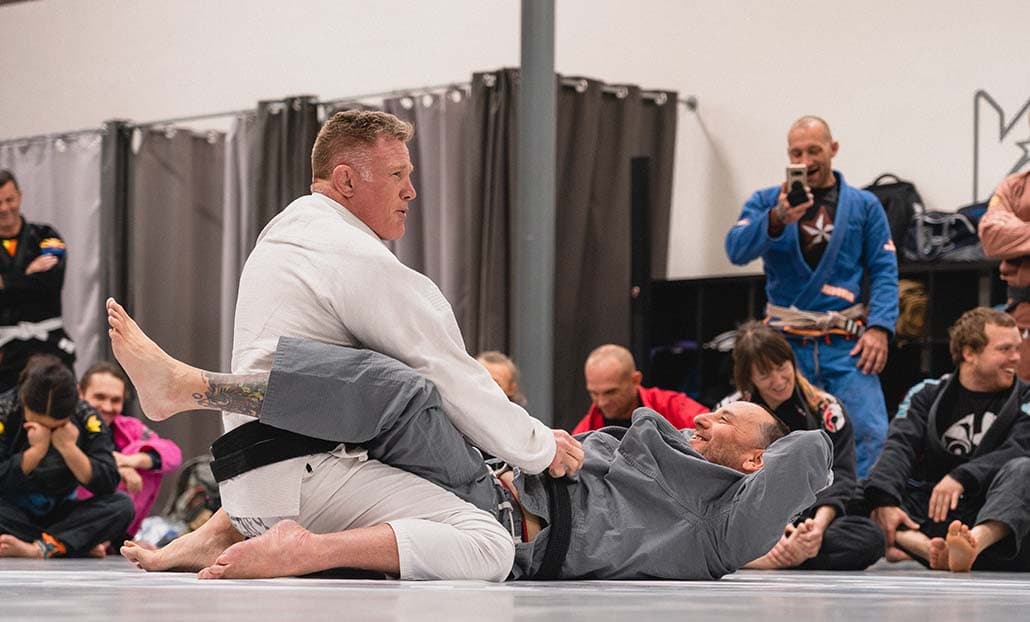
Main photo: BJJ Globetrotters; archive instructional photograph.
The takeaway
Start with the next class's actual requirements. Identify the missing setup or decision, review it with an appropriate resource, and test it through a clearly defined exercise. That is a smaller and more useful task than trying to reproduce every session you missed.
Then return to the regular class and let the remaining questions become specific. Catching up is complete enough when you can participate productively. There will still be details to learn; that is true for the people who attended every class too.
Find a workable training schedule
Use the gym directory to compare local options, then ask the academy how its classes connect across the week.
FAQ
Should I watch videos to replace missed BJJ classes? Start with the instructor's recommendation and the actual material you missed. An unrelated video can introduce different assumptions without filling the gap in your class sequence.
Can a teammate teach me what I missed? A teammate can help review material they understand, with the instructor's guidance where needed. Ask the coach to resolve uncertain details rather than treating remembered notes as a complete lesson.
Do I need a private lesson after missing a week? Not automatically. Identify the specific gap first; a brief explanation or a few focused repetitions may be enough to rejoin the current class.
What should I write in my training notes? Record the starting position, the main task, and a detail you want to ask about. Keep the note short enough that you will actually use it before the next session.

Nina Okada
Nina Okada explains positions the way a good training partner does: one problem at a time, with the limits of the explanation said out loud. She is careful about the difference between what footage shows and what it only suggests.
Related Posts

Mikey Musumeci gives up the belt to make room for MMA
Musumeci is vacating his UFC BJJ title to focus on MMA training. What he is leaving, what continues, and why the transition matters.
IBJJF membership: finish the paperwork before the deadline
IBJJF membership and tournament entry are separate steps. Plan documents, professor approval, renewals, and junior accounts before registration closes.
Choosing a BJJ seminar worth your time and travel
Choose a BJJ seminar by the subject, teaching format, access, and total cost. Know what to ask the host before buying a ticket.
Comments (0)
Loading comments...