
Training BJJ in another language starts before the first grip
Quick answer: Tell the instructor which language you understand before joining a BJJ class abroad. Agree on clear stop signals, watch the starting position and goal of each exercise, and ask for clarification before practicing something you have not understood.
Recognizing an armbar does not mean you understood the instructions that came before it. The coach may have asked for a limited drill, named a restriction, or explained how partners should stop. The movement is only part of the lesson.
Training in another language can still be an enjoyable part of travel. It works better when you treat communication as something to arrange with the host rather than assuming that every important detail will be obvious once two people are wearing gis.
Tell the academy before you arrive
When asking to visit, say which languages you understand and how much BJJ experience you have. Ask whether the proposed session is suitable and whether the instructor can help you follow the class. A clear answer is more useful than hoping another visitor will translate at the right moment.
Keep the request reasonable. The host may teach primarily in a language you do not speak, and the class is not obliged to change its format for one person. Another session, a private introduction, or a different academy may fit better. That is a practical mismatch, not a judgment about hospitality.
Use a translation tool for the initial message if needed, but keep the wording simple. Include the date, session, experience level, and equipment question. Complex jokes and idioms are less important than making sure the host knows exactly what you are asking.
Save the reply and the correct address. If the academy has several locations or similarly named classes, confirm which one you are attending. The language challenge is easier to manage when you have already removed uncertainty about the place and time.
Agree on stopping before discussing technique
At the start of partner work, make sure both people understand how to stop the exchange. Tapping should be respected immediately, and a clear verbal stop signal should be agreed on as well. Do not assume a word you recognize will be understood in the same way by every partner.
Ask the instructor how the class signals a pause, change of partner, or end of the round. Those instructions affect everyone in the room. Following them is more important than learning a long vocabulary of technique names on your first evening.
If you are unsure during contact, stop and ask. A misunderstanding about the assigned task is a good reason to pause. There is no benefit in continuing because you worry that asking a question will expose how little of the explanation you understood.
The same care applies when you host a visitor at your own academy. Speak clearly, avoid assuming that a nod means complete understanding, and make it easy for them to stop. Helpful communication is part of the training arrangement, not an extra favor reserved for fluent students.
Find the starting position and the immediate goal
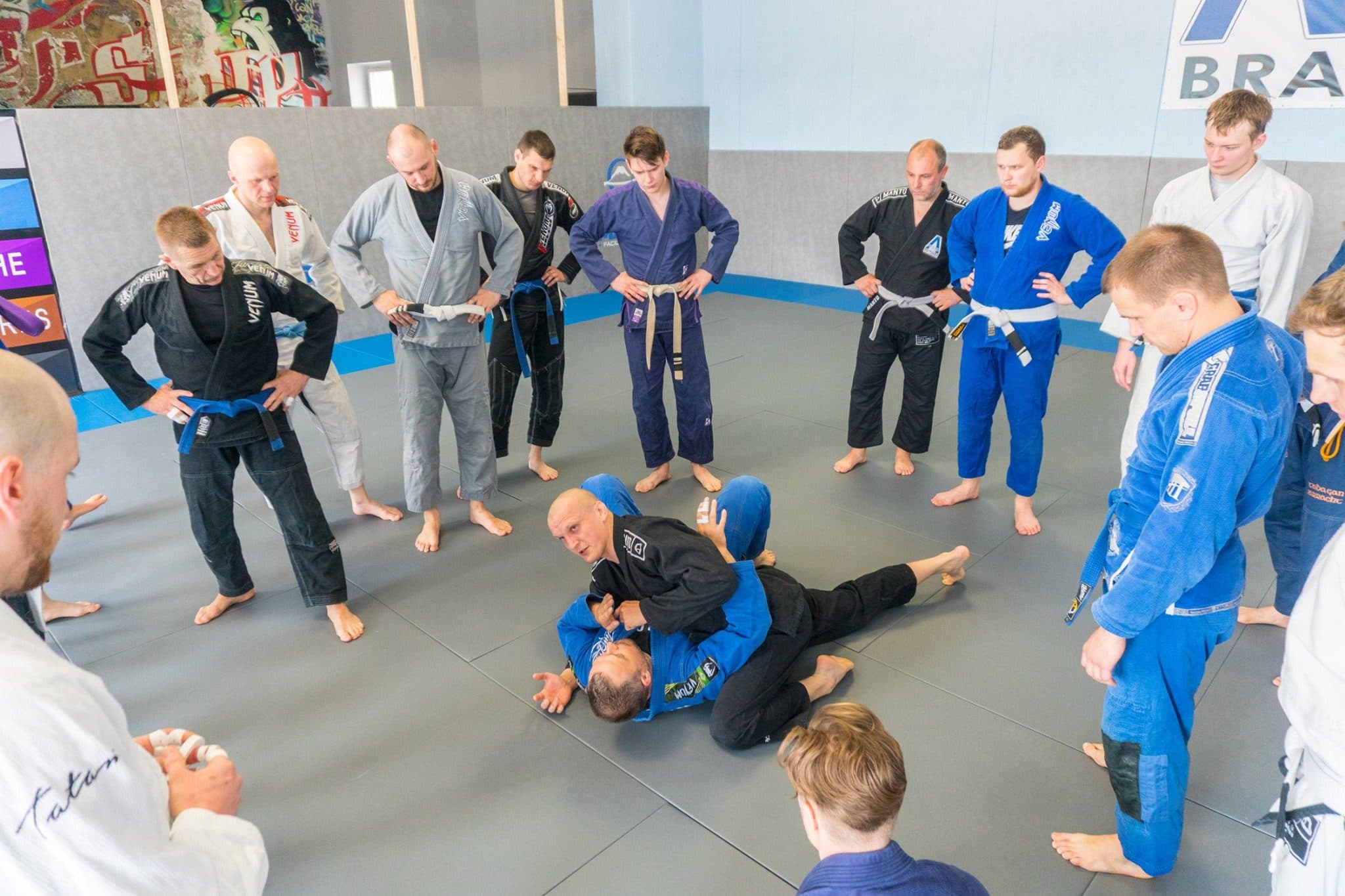
During a demonstration, identify who begins on top, where the grips are, and what the exercise is trying to achieve. Those details give you a structure for the movement even when some of the spoken explanation is unfamiliar.
Watch the whole demonstration before attempting to copy a small detail. The first action may be a setup, a common mistake, or an example of what not to do. If you begin practicing from a partial view, you may reproduce the wrong part with considerable confidence.
After the explanation, ask a short question about the task. Pointing to the relevant position and confirming the goal can be more effective than requesting a translation of every sentence. The instructor can decide whether a brief explanation is enough or whether you need additional help.
Do not pretend that visual learning removes the need for instruction. Contact level, prohibited actions, and reset conditions may not be visible in a demonstration. Treat the body position as one source of information and confirm the rules that govern the practice.
Use a small vocabulary that does real work
A few useful words can make the visit smoother. Learn greetings, thanks, left and right, stop, and a simple way to say that you do not understand. Ask the host which words the class uses for changing partners or restarting.
Technique names may not translate neatly. A position can have a local name, an English name, and a Portuguese name, and two academies may favor different terms. Recognizing the shape and purpose of the position is more useful than insisting that the name you know must be the correct one.
For a short visit, prioritize phrases that let you:
Ask the partner to stop or slow the activity.
Explain your experience and any relevant limitation.
Confirm which person begins in which position.
Ask the instructor to demonstrate the starting point again.
You are not preparing for a vocabulary test. Choose language that helps you participate responsibly. The Portuguese-in-BJJ guide can provide background, but learning a few familiar mat words does not mean you understand an entire class conducted in Portuguese.
Make partner practice a shared task
Tell your partner that you may need to check the instructions. Keep the explanation brief and let them know what you did understand. That gives them something useful to confirm rather than leaving them to guess whether you are confused about the movement, the language, or both.
If the partner can help, let them show the first repetition at the agreed pace. Then switch roles and check whether your version matches the assigned task. If the two of you remain uncertain, ask the instructor rather than building a new exercise out of several guesses.
Avoid making the partner responsible for translating the whole evening. They came to train as well. The host’s plan should account for your participation, and any additional help from a student should remain voluntary and manageable.
When you do understand, continue normally. A language difference does not require apologizing before every repetition. Clear communication can be brief. The goal is to share the exercise with enough confidence that both people can concentrate on practicing it.
Use translation tools outside active contact
A phone can help with a question before class or during an appropriate break. It is less useful in the middle of a moving round. Stop, move out of the way, and ask permission before introducing a device into the practice area.
Keep translated questions short and literal. Ask about one issue at a time: the starting grip, the permitted intensity, or whether you should reset after a particular outcome. Long explanations can create more ambiguity than they resolve.
Do not record the instructor or students to translate the lesson later without permission. The academy’s filming policy still applies, and the people in the frame have their own expectations. A visitor’s need for clarification does not automatically authorize recording a class.
Remember that a translation can be wrong. If an answer appears to conflict with what the instructor demonstrated or with a clear stop request, pause and ask again. The device is an aid to the conversation, not a reason to ignore the people in front of you.
Leave the visit with a few accurate notes
After class, write down the names or concepts you want to remember while the context is fresh. Describe the starting position and goal in your own language. That can be more useful than preserving a technique name you are not sure you heard correctly.
If you want to practice the material at home, bring the question to your regular coach. Explain what you believe the visiting instructor showed and where you remain uncertain. Do not present a partially understood lesson as a definitive correction to the way your academy teaches.
Thank the host and any partner who helped. If you plan to return, ask whether the same session remains the best choice. Familiarity can make the next visit easier, but it does not remove the need to confirm the timetable and visitor arrangements.
The visit does not need to produce a large collection of techniques to be worthwhile. Following the class, sharing useful practice, and learning how another room organizes training are substantial outcomes. A few things understood accurately are better than a long list of movements copied without their conditions.
Main photo: BJJ Globetrotters; illustrative archive teaching photograph.
The takeaway
Arrange the communication before the first round. Tell the host what you understand, agree on stopping signals, and identify the starting position and purpose of each task. Pause whenever the instructions are not clear enough to practice responsibly.
You do not need fluency to be a considerate visitor. You need a workable agreement with the academy and the willingness to ask a small question before a misunderstanding grows into a difficult exchange.
Confirm a class abroad
Search the gym directory, then ask your chosen academy about language, session suitability, and visitor arrangements before making the trip.
FAQ
Can I train BJJ abroad without speaking the local language? Often a visit can be arranged, but ask the academy first. Suitability depends on the class, instructor, and communication available. Do not assume that recognizing techniques will cover every instruction.
Which words should I learn first? Prioritize a stop signal, a way to say you do not understand, and the class’s words for changing partners or resetting. Ask the host what will be most useful in that particular room.
Can another student translate for me? They may offer to help, but do not make them responsible for the entire lesson without agreement. Discuss your needs with the instructor and keep any partner assistance manageable.
Should I use my phone to translate during a round? Stop the activity first and move out of the way. Use translation tools at an appropriate break, with the host’s permission where needed. Never let a device replace a clear response to a partner asking to stop.

Owen Bellamy
Owen Bellamy writes for the person training twice a week around a job. Nothing he suggests requires quitting the job.
Related Posts
Otávio Sousa: three world titles in the hardest kind of company
Otávio Sousa’s 2012, 2013, and 2016 world titles tell a richer story when the other names on the middleweight podium stay in view.

Mikey Musumeci gives up the belt to make room for MMA
Musumeci is vacating his UFC BJJ title to focus on MMA training. What he is leaving, what continues, and why the transition matters.
IBJJF membership: finish the paperwork before the deadline
IBJJF membership and tournament entry are separate steps. Plan documents, professor approval, renewals, and junior accounts before registration closes.
Comments (0)
Loading comments...