
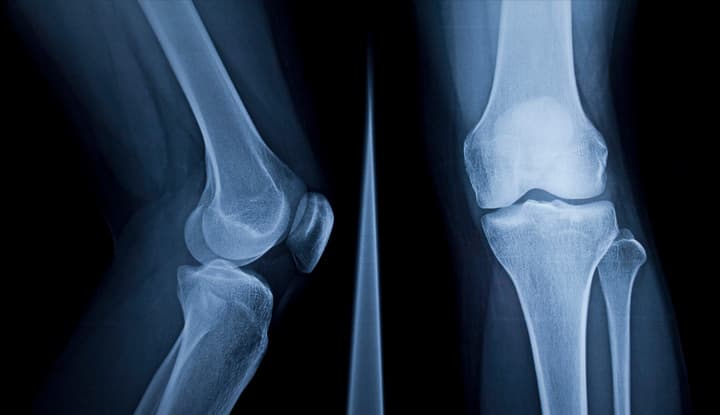
Knees, back, and neck: the three injuries that end BJJ careers
Quick answer: The knee is the most frequently injured joint in jiu-jitsu across the major injury surveys of the sport, the lower back becomes a bigger problem the longer you train, and the neck accumulates load quietly until one bad stack pass makes it loud. The prevention work with the strongest evidence behind it is progressive strength training, not stretching — a 2014 meta-analysis in BJSM found strength training cut sports injuries to under a third, while stretching showed no protective effect. None of this replaces getting an actual diagnosis from a physio or doctor.
People don't quit jiu-jitsu because they got submitted too much. They quit because a knee never came back right, or because they spent eighteen months managing a back that flares every time they play guard, and paying $180 a month to feel worse than they did at 30 stopped making sense.
We've written the general version already, in training BJJ with an injury. This is the specific one: three body parts, and what the research supports doing about them.
Where people actually get hurt
The surveys agree more than you'd expect. A study of 1,287 practitioners in Physical Therapy in Sport found 59.2% reported at least one injury over six months, knee most common. A 2025 cross-sectional study of 881 practitioners put the rate at 5.5 injuries per 1,000 training hours, with knees (25%) and shoulders (13%) most affected. A survey of 1,140 athletes across 62 countries reported the knee at 27.1% of injuries, with regular competition, older age, and higher belt rank all appearing as risk factors.
Two findings deserve more attention than they get.
First, this happens in training. In the 2025 study, 89% of injuries occurred in training and 79% of those during sparring. You're not going to get hurt at the tournament. You're going to get hurt on a Wednesday.
Second, the pattern shifts with time in the sport. The 1,287-person survey found more experienced athletes were likelier to report low back injuries, while less experienced athletes reported more head, elbow, and upper extremity problems. White belts get hurt not knowing what's happening to them. Brown belts get hurt by mileage.
Why the knee eats it
Jiu-jitsu asks the knee to do the one thing knees are worst at: rotate under load with the foot planted and someone else controlling the leg.
Standing up in someone's guard is the classic. Feet pinned by their hooks, hips pulled one way, and the knee is the joint that gives. Sprawling is the same mechanism at speed. Stack passing loads a flexed, rotated knee under bodyweight. And the entire leg entanglement game exists to attack the knee on purpose, which is why reaping stayed banned in gi divisions long after no-gi rules opened up at the upper belts.
The MCL takes most of it. An epidemiological study of 198 BJJ athletes in Acta Ortopédica Brasileira found the medial collateral ligament was the most affected structure at 38% of reported knee injuries, the mechanism was a sprain in 86% of cases, and 65% were managed conservatively rather than surgically.
That last number is the encouraging one and also the trap. Most knee injuries in jiu-jitsu aren't surgical, which is exactly why so many people never get theirs looked at.
Tweak or stop: reading a knee
Specific advice belongs to a clinician who can put hands on your knee. But there's a difference between the ache every gym produces and the injury that means you stop today.
Signs that warrant a real appointment, per AAOS guidance on meniscus tears: catching or locking, a knee you can't fully straighten, the joint giving way, and swelling and stiffness building over two to three days. Dramatic swelling within an hour, or being unable to put weight on the leg, is a same-day problem rather than an ice-it-and-see one.
The practical separator: a tweak improves across a week and a real injury doesn't. Four weeks out and it still doesn't feel like the other knee? You've stopped gathering information by waiting.
Worth naming too: the heel hook gives no useful warning. Knee ligaments don't produce the escalating pain an armbar does, which is why every serious leg lock room teaches tapping to position rather than to pain. A gym that treats heel hooks like any other submission has a culture problem with a knee-shaped consequence.
The lower back, and the anterior pelvic tilt story
Guard players spend years in hip flexion. Sooner or later someone tells you this has given you anterior pelvic tilt, that the tilt is why your back hurts, and that the fix is stretching your hip flexors.
That chain is weaker than the confidence with which it gets delivered. A 2020 systematic review in EFORT Open Reviews concluded there is no causal evidence that excessive anterior pelvic tilt leads to pain, loss of function, or reduced quality of life, and cited work finding the tilt present in the large majority of symptom-free adults. Posture is a weak predictor of back pain generally.
What's left is less satisfying but more useful. Most low back pain in grapplers is non-specific, meaning no single structure can be blamed, and the guidance reflected in the Lancet low back pain series is to stay active, avoid unnecessary imaging, and rebuild loading rather than resting until it feels perfect.
Red flags are the exception and they aren't subtle: numbness or weakness down a leg, pain that wakes you at night and won't settle in any position, or any change in bladder or bowel control. That last one is an emergency room, not a physio appointment.
The gym pattern is a volume story, not a posture story. Backs go the week someone adds a fourth session, or comes back from vacation straight into two hours of hard rounds, or starts deadlifting again after eight months off. Load tolerance builds slowly and disappears fast.
The neck: stacking, bridging, and accumulated load
Serious cervical injuries in jiu-jitsu are rare. A 2022 case report and literature review covering a cervical flexion-distraction fracture in a BJJ athlete noted that cervical injuries account for only a small share of reported injuries in the sport, and that serious ones show up rarely. Reassuring, and also why the neck gets ignored until it stops being fine.
The everyday load comes from three places. Getting stacked, where your own bodyweight compresses a flexed neck while a heavier person drives forward. Bridging off the crown of your head instead of your shoulders, a habit most self-taught escape artists develop. And defending chokes by cranking your chin into your chest against pressure, over and over, for years.
The fix is unglamorous: when you're stacked and your chin is buried, turn out or tap. Riding it out with a folded neck to avoid conceding three points is a bad trade, and everyone who has made it enough times can name the week it caught up with them. The same instinct under competition adrenaline is probably the highest-risk moment in a normal grappler's year.
The prevention work with evidence behind it
This is where the research is unusually clear, and where most gyms do the opposite.
Lauersen and colleagues' 2014 meta-analysis in the British Journal of Sports Medicine, covering 26,610 people and 3,464 injuries, found strength training reduced sports injuries to less than a third. Stretching was the one intervention showing no protective effect. Stretch because you want to invert or play a specific guard, not as insurance. Our mobility guide treats it as capacity work, which is the right framing.
Three specifics worth building a program around:
Hip hinge patterns. Romanian deadlifts, trap bar pulls, hip thrusts. Loading the posterior chain builds the tolerance guard retention and scrambles keep demanding.
Nordic hamstring curls. van Dyk and colleagues' 2019 review in BJSM concluded that programs including the Nordic curl roughly halved hamstring injury rates across 8,459 athletes. That headline has since been challenged on methodological grounds, so treat the exact number with suspicion. The exercise itself is cheap, and eccentric hamstring strength is relevant to a sport where your legs get extended under load constantly.
Neck isometrics. Thinner evidence, and contested. A review in Sports Medicine describes associations between isometric neck strength and lower injury risk in collision sports; a later systematic review found the evidence insufficient to say neck strengthening prevents concussion. Two or three sets of gentle holds in each direction is cheap and low-risk. Don't sell it as armor.
Start lighter than your ego wants and add over months. Strength training for BJJ covers programming, but the short version is that two sessions a week for a year does more for your longevity than any warm-up routine.
"Training around it" usually means training exactly as hard
The phrase usually means "training exactly as hard, while injured," which is how a six-week problem becomes a two-year one.
Done properly it's specific and slightly embarrassing, which is why people skip it. Tell your partner before the round, not mid-scramble. Pick your rounds instead of taking whoever's next in line. Do positional work from positions that don't load the injured tissue, which usually means giving up the position you'd rather fight for. Skip takedowns. Accept for a while that you're the person who taps early and doesn't explode out of bad spots.
The failure mode is predictable: train around a knee for three weeks, feel good, enter a tournament, get stacked in match two. If you can't do hard rounds, you can't compete. Same question.
The takeaway
The knee is the joint jiu-jitsu takes, and most of what it takes is MCL sprains that heal without surgery if you let them. The back arrives later, and it responds to load management and staying active far better than to whatever posture theory is circulating this year. The neck is a quiet account you make withdrawals from every time you ride out a stack pass.
If you take one thing from the research: lift progressively, twice a week, for years. Better evidence than anything else on the list, and the thing hobbyists skip because it isn't jiu-jitsu.
And get things looked at. A physio who understands grappling is worth more to your next decade than a new gi, an instructional, or a competition entry, and most people reading this have bought all three since the last time their knee felt normal.
Write down what your body keeps telling you
Most people massively underestimate how much they trained the month their back went. Sessions, intensity, and the gaps between them are easy to see in hindsight if you wrote them down. Keep a training log with Let's Roll Passport →
FAQ
Is my knee injury from BJJ serious or just a tweak? Signs that push toward a real appointment include locking or catching, an inability to fully straighten the knee, the joint giving way, immediate large swelling, or the inability to bear weight. Swelling and stiffness building over two to three days also warrants assessment. A tweak improves noticeably within a week; anything still wrong at four weeks needs a diagnosis rather than more patience.
Why does my lower back hurt from playing guard? Usually because of training load rather than posture. Systematic review evidence does not support anterior pelvic tilt as a cause of back pain, and most low back pain is non-specific. Current guidance favors staying active, avoiding early imaging, and rebuilding loading tolerance. Numbness, leg weakness, or bladder and bowel changes are red flags that need urgent medical attention.
Does stretching prevent BJJ injuries? The best available meta-analysis found strength training reduced sports injuries to under a third, while stretching showed no protective effect on injury rates. Stretch to access positions you want to play. Lift to reduce your chance of getting hurt.
How do I protect my neck in jiu-jitsu? Stop riding out stack passes with your chin buried, bridge off your shoulders rather than the top of your head, and tap early to neck cranks. Isometric neck strengthening is cheap and reasonable, though the evidence that it prevents injury is mixed rather than settled. Any numbness, tingling, or radiating arm symptoms should be assessed by a doctor immediately.
Related Posts
Mikey Musumeci gives up the belt to make room for MMA
Musumeci is vacating his UFC BJJ title to focus on MMA training. What he is leaving, what continues, and why the transition matters.
IBJJF membership: finish the paperwork before the deadline
IBJJF membership and tournament entry are separate steps. Plan documents, professor approval, renewals, and junior accounts before registration closes.
Choosing a BJJ seminar worth your time and travel
Choose a BJJ seminar by the subject, teaching format, access, and total cost. Know what to ask the host before buying a ticket.
Comments (0)
Loading comments...