
BJJ with hearing loss: make the class easier to follow
Quick answer: Make BJJ communication accessible by asking the student what works for them, keeping demonstrations visible, and agreeing on clear start, stop, and tap communication before partner work. Put important class information in a form the student can reliably use. Hearing loss does not tell you which language, device, or communication method a person prefers.
The instructor explains the grip while looking down at the demonstration partner. Then the room breaks into pairs. A student who missed the explanation is now expected to reconstruct it while everyone else begins moving.
That is a class-design problem worth noticing. A welcoming BJJ gym can still have moments where information is available only through a voice, a buzzer, or a conversation across the room. Improving those moments begins with the person who needs access, rather than a coach guessing what should be enough.
Ask the student before choosing the solution
Have a direct, private conversation about communication preferences. Ask what helps during instruction, partner work, and class announcements. Let the student describe the arrangement they want instead of assuming that all deaf or hard-of-hearing people communicate in the same way.
The National Association of the Deaf's media guidance describes varied communication methods and stresses the importance of people's own perspectives. That is a useful starting point for a gym: a label does not provide an individual access plan.
Someone may prefer written information, clear face-to-face speech, a signed language, an interpreter, or a combination. Do not assume that speechreading is available or sufficient, or that a device means every instruction will be heard. Ask what works in this specific setting.
Keep the conversation practical and respectful. The student does not owe the class a medical history. You need an agreed way to communicate, a way to check whether it works, and permission before sharing any personal information with other staff or partners.
Make the explanation visible
A coach can separate explanation from movement when doing both at once hides the information. Face the group for the key instruction, demonstrate the action, then return to a position where the student can access the next explanation.
The Hearing Loss Association of America's communication guidance recommends facing the listener, speaking clearly at a moderate pace, and avoiding yelling. Apply those ideas where they fit the student's preferences, rather than assuming that a louder voice solves every missed instruction.
Ask where the student can see best. The answer may change with the technique, the room, or an interpreter's position. Leave enough space for a clear view of the relevant grip and the person communicating the explanation.
If the student needs to watch an interpreter and then the physical demonstration, allow time for both. Do not treat the necessary pause as an interruption to the real lesson. Access to the explanation is part of the lesson, just as access to the demonstration is.
Put key details somewhere stable
Important information should not depend entirely on catching an announcement once. Consider a written class outline, a visible timer, or a brief message containing the exercise boundaries. Choose the format with the student and keep it practical for the room.
You do not need to transcribe every casual remark to make a useful start. Prioritize the details that change what people are expected to do: the starting position, permitted actions in a drill, the reset condition, and the number or duration of turns.
A simple board can answer a question without making the student repeatedly approach the coach. It can also help anyone who arrived at the edge of the explanation or forgot a detail. Keep the wording clear enough that the board does not create another puzzle.
If using captions or speech-to-text tools, check the output rather than assuming technical terms are captured correctly. The student and instructor should have a way to resolve uncertainty. A plausible but incorrect technique name is not a reliable substitute for an accessible explanation.
Agree on stop communication before contact
Partner work requires a shared way to stop immediately. The coach, student, and partner should establish and check the communication before a drill or round begins. Do not rely on an audible signal alone when someone may not receive it.
Discuss how physical tapping, verbal stops, and the coach's intervention will be recognized in the positions being practiced. Every partner remains responsible for attending to stop signals and releasing immediately. A new arrangement should be demonstrated and understood before intensity is added.
Do not improvise unfamiliar gestures during a submission and assume the other person will interpret them correctly. If communication is uncertain, pause the activity and resolve it with the coach. The same applies when an exercise makes a previously agreed signal difficult to notice.
This is not a reason to reduce the student to a special warning for the room. It is a practical agreement between the people sharing an activity, with clear responsibilities on both sides and no need to disclose unrelated personal details.
Make partner changes accessible too
A well-planned explanation can fall apart when the student moves to a new partner who does not know the agreed communication. Build a brief check into the change rather than expecting the student to repair the arrangement from scratch every time.
With the student's permission, the coach can help partners establish:
How to get each other's attention before explaining a change.
Which communication method they will use between repetitions.
How the start, stop, and reset signals will be recognized.
How to call the instructor when either person is uncertain.
Keep the check ordinary and reciprocal. Both partners need to understand the task. Neither should begin moving while the other is still reading, signing, or looking toward the instructor.
The guide to different BJJ training partners offers more context for working with the people in your room. Reset the agreement before testing the movement. Here, that agreement includes a communication method that remains usable when the exercise starts.
Give devices and interpreters a practical plan
If a student uses hearing technology, let them guide the conversation about what they use during class. Questions about contact, sweat, impact, or equipment suitability should go to the appropriate device professional or manufacturer where needed. A coach should not promise that a particular device is safe for grappling without a basis for that advice.
Agree on storage if something must be removed, and revisit how communication will work afterward. Removing a device can change the available communication; it should not leave the student with an arrangement that depends on hearing instructions they can no longer access.
If an interpreter is involved, discuss sightlines, movement, and a safe location around the training area. Speak to the student directly. The interpreter supports communication; they do not replace the student as the person making choices about participation.
Avoid treating a teammate's informal help as automatically equivalent to the access the student needs. Ask whether the arrangement is effective, and seek appropriate support when it is not. Good intentions are a starting point, not a completed access check.
Check the ordinary information outside class
Access also includes schedule changes, registration instructions, cancellations, and the conversation after a session. If all updates happen through voice notes or shouted reminders, a student may miss something even when the technical lesson itself is accessible.
Offer important updates in a reliable written form and keep the channel consistent. Our guide to BJJ gym group chats discusses making practical information easy to find. A clear message containing the actual change is more useful than a busy thread that assumes everyone heard the earlier announcement.
For social events, ask about communication needs without requiring attendance. A noisy gathering may work differently from the training room. Let the student decide what they want to join and what would make participation easier.
Do not interpret a missed response as rudeness or lack of interest without checking whether the information was accessible. A small clarification can prevent an ordinary communication gap from becoming a mistaken story about someone's personality.
Review the arrangement with the person using it
An access plan should be checked in practice. After the first session, ask what worked and which moments remained difficult. Keep the question open enough that the student can identify a problem you did not notice.
Make one concrete adjustment at a time when that is practical. Perhaps the board was useful but positioned behind the demonstration. Perhaps partner changes needed a clearer pause. Perhaps the timer was visible from one side of the room but not from the actual starting position.
Share the agreed process with relevant instructors, with the student's consent, so access does not depend on one particular coach being present. Keep personal information limited to what is needed for the arrangement.
The measure is whether the student can receive information, ask questions, and participate in the agreed activity. A gym does not need applause for making an explanation available. It needs a process that continues to work after the first welcoming conversation.
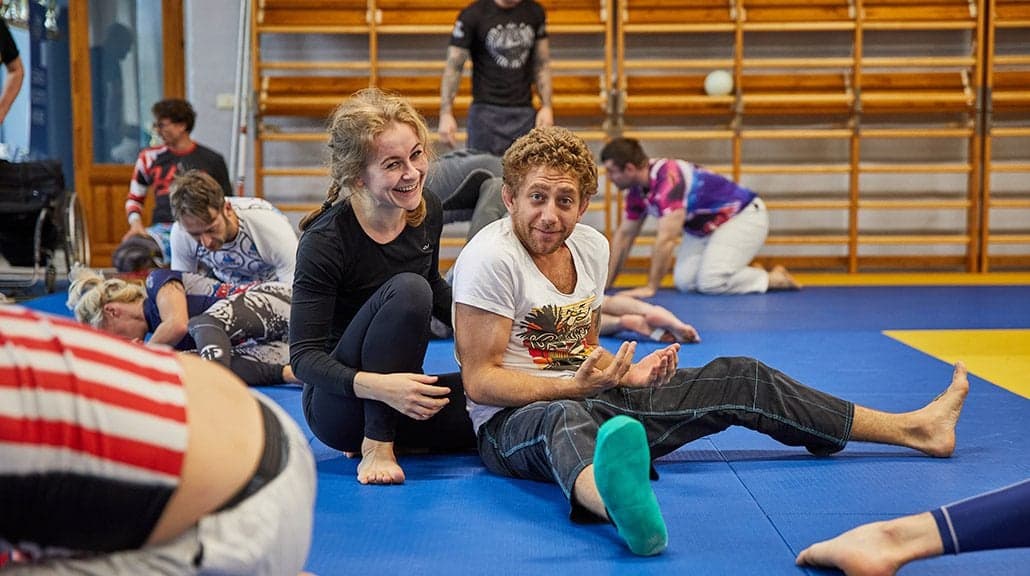
Main photo: BJJ Globetrotters; illustrative classroom photograph. No hearing condition is attributed to anyone pictured..
The takeaway
Accessible BJJ instruction starts with asking the student what communication works, then carrying that answer through demonstrations, partner changes, stop signals, and everyday announcements. Visibility and clear written information can help, but the individual should guide the arrangement.
Review the plan in the actual room. A practical change that makes the next class easier to follow is more valuable than a broad promise that everyone is welcome without checking how the information reaches them.
Ask about access before your first visit
Use the gym directory to find academies, then contact the staff about your preferred communication and the arrangements you need for a class visit.
FAQ
Should a coach speak louder to a student with hearing loss? Ask what helps rather than assuming volume is the answer. Clear face-to-face communication, written information, signing, or other arrangements may be more useful for that individual.
Do all deaf students use sign language? No. Communication methods and preferences vary. Ask the student directly and avoid assuming that a label, speech ability, or device tells you what access they need.
How should partners handle taps and stop signals? Agree on and check reliable communication with the coach before contact. Do not depend solely on an audible cue when it may not be received, and pause whenever either person is uncertain.
Can a student keep a hearing device on while grappling? That depends on the device and individual circumstances. Seek appropriate device-specific guidance and establish an accessible communication plan for whichever arrangement the student uses.

Rafael Moura
Rafael Moura profiles competitors as people with lives outside the bracket. Some of those stories are comebacks. Most are not, and he does not force them.
Related Posts
Jiu-jitsu in Montreal: build the visit around a real class
Plan BJJ training in Montreal around confirmed classes, language arrangements, winter travel, visitor policies, and equipment that is ready to use.

Competing in gi and no-gi on the same day takes two plans
Prepare for gi and no-gi competition on the same day with separate rule checks, complete outfits, schedule coordination, and a realistic second-bracket plan.

BJJ gi pants that fit standing up can still fail on the mat
Check BJJ gi pants at the waist, rise, knees, and cuffs so a good-looking size label becomes a uniform you can actually move in.
Comments (0)
Loading comments...