
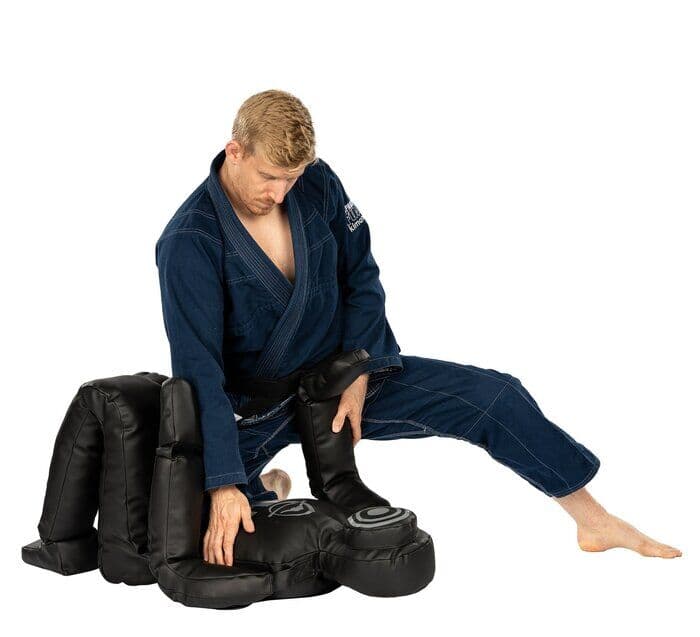
A grappling dummy cannot answer back. Buy accordingly.
Quick answer: A grappling dummy can provide a repeatable shape for practicing movements you already understand. It cannot give the changing resistance, timing, or feedback of a person. Buy only after identifying the drill, suitable model, space, and setup you will actually use; otherwise, more partner practice may be the better use of your budget.
A grappling dummy has one outstanding quality: it is available when your training partner is not. It also has one substantial limitation: it will agree with almost anything you do. A sequence that works beautifully on an object may still contain a problem a person would expose immediately.
That does not make the equipment useless. It makes the buying decision narrower than the advertising often suggests. Choose the object for a task it can perform, then leave the rest of your jiu-jitsu education with people who can move, react, and tell you what happened.
Name the drill before choosing the model
Start with a movement your coach has already taught and ask whether a dummy would be useful for rehearsing it. You should be able to explain what you intend to practice without pointing to a product video and saying everything in that.
A familiar transition around a stationary torso asks something different from a standing throwing drill. A model that holds one useful shape may be frustrating for the other. The word grappling on the listing does not settle that difference.
Manufacturer categories make the distinction visible. FUJI's Australian product page, checked October 10, separates a seated grappling model from a standing throwing model. That is a product distinction, not an endorsement of either or a claim that you need both.
Write the intended use beside the budget. If you cannot identify the first few sessions you would do with the equipment, pause the purchase. A specific drill is a better shopping filter than a general hope that owning another piece of gear will create training time.
Shape matters more than a human-looking outline
Look at where the limbs begin, how they bend, and which positions the dummy can hold without constant rearranging. A product can look impressively human in a photograph while being awkward for the particular movement you want to rehearse.
Ask for a demonstration of the actual task, preferably one that shows setup and reset rather than only a polished sequence. If you spend most of each repetition rebuilding the object's posture, that is part of the training experience you are buying.
The Suples dummy range illustrates how products can be designed around different grappling and throwing uses. Compare the stated intended use and configuration of the exact model. Do not transfer claims from one item in a manufacturer's range to every product carrying its name.
Also consider whether the drill depends on a detail the object cannot represent well. If the task is recognizing when a partner changes pressure or begins a particular defense, a fixed shape may remove the very information you need to practice reading.
More weight is not automatically more realism
An object of a given weight does not behave like a person of the same weight. A person supports part of their own body, changes posture, and moves in response to you. A dummy may need to be lifted or reset in ways a cooperative partner would not.
For that reason, avoid choosing a model solely by matching your own body weight or an imagined opponent. Follow the manufacturer's limits and ask your coach which load, if any, makes sense for the specific supervised practice you have in mind.
Check whether the listed weight describes the delivered product, a suggested filled weight, or an empty shell. An inexpensive unfilled item can require additional materials, time, and storage. Use only filling and setup methods permitted by the manufacturer; improvising heavy internal pieces can create a very different object from the one advertised.
The daily handling matters too. If you cannot comfortably move the equipment between its storage place and the practice area, it may not be the convenient option you expected. Count setup as part of the session rather than imagining the dummy will always be waiting neatly in position.
The room is part of the purchase
A dummy does not make a small room suitable for every drill. Consider the surface, clearance, neighboring furniture, and the direction you will move. A standing practice area has different demands from a place to rehearse a controlled movement on the floor.
Do not use a product's existence as permission to attempt unfamiliar throws at home. Appropriate coaching and a suitable training surface still matter. If you cannot establish that the intended activity belongs in the space, choose another activity rather than hoping the equipment solves the environment.
Our home mat-space guide covers the larger setup. The buying calculation should include any required surface or storage arrangement, not just the price of the dummy. The complete setup may cost more or occupy more room than the product photo suggests.
Shared housing adds another practical question: what happens when the session ends? A bulky object that must live in the hallway can become a household negotiation. Decide where it goes before it arrives in a box that is almost as inconvenient.
Use it to rehearse, then check the movement with a person
A sensible dummy session has a narrow purpose. Rehearse a familiar movement slowly enough to notice your own sequence, then take any uncertainty back to class. The equipment gives you repetition; the coach and partner help determine whether you are rehearsing the right thing.
One possible practice loop is:
Ask your coach which familiar movement suits solo equipment practice.
Set up the position according to the agreed task and product instructions.
Stop when you cannot explain why a step is working or failing.
Return to supervised partner practice to check the movement and its limitations.
This is a suggested learning arrangement, not a promise of improvement from a certain number of repetitions. Repeating an unclear movement more quickly does not make the missing explanation appear.
The drilling guide offers ways to make practice more specific. A dummy is one possible tool within that process. It cannot decide when you are ready for more resistance, and it cannot tell you that the apparent opening exists only because its arm never moves.
Count the complete cost and the return conditions
Compare delivered prices for the exact configurations you are considering. Include shipping, filling if applicable, and any required accessories. A price comparison that treats an empty shell as equivalent to a ready-to-use item leaves out work and expense.
Read the return conditions before opening, filling, or using the product. Find out whether the seller accepts returns after assembly and who pays to ship a bulky item back. Ask directly if the policy does not explain the situation you are considering.
A used dummy deserves the same practical inspection as other shared training equipment. Check its covering, seams, closures, and cleaning instructions. Ask about damage and modifications. Do not assume an object is suitable merely because it was previously kept inside a gym.
Avoid buying on the strength of a discount countdown. If the intended drill, configuration, and space remain unresolved, a lower price does not resolve them. The cheapest unused dummy still costs more than deciding you did not need one yet.
Compare it with the other use for the same money
The alternative is not always another dummy. Depending on your circumstances, the same budget might support a coached session, additional class access, or a more suitable practice space. Compare the obstacle each purchase would actually remove.
If your problem is that you do not understand the movement, instruction may address it more directly. If you understand a narrow sequence and want a convenient way to rehearse its arrangement between classes, equipment may have a clearer role. If you lack room, neither a larger dummy nor a longer instructional library changes the floor plan.
Borrowing or trying an appropriate model at your academy can reduce the guesswork, if the coach permits it. Pay attention to the reset, handling, and limitations rather than only the first entertaining minute. Those are the details that determine whether you use it after the novelty fades.
Then make the decision without asking the equipment to represent your seriousness about training. Owning less gear is not a lesser commitment. Buying a useful tool is not a shortcut by definition. The question is whether it performs a job you genuinely have.
Main photo: FUJI Sports Australia; product photograph.
The takeaway
A grappling dummy is most defensible as a tool for a specific, familiar task. Match the model to that task, account for setup and space, and confirm the movement later with a coach and partner. Keep its inability to react visible in your expectations.
If the shopping process cannot produce a clear first use, leave the purchase for later. The dummy will not be offended. It is exceptionally good at that part of the partnership.
Find the feedback equipment cannot provide
Explore BJJ gyms on Let's Roll and ask about instruction or supervised practice for the specific position you want to improve.
FAQ
Is a grappling dummy worth buying for BJJ? It can be useful when you have a specific familiar movement to rehearse and suitable space. It is harder to justify as a general replacement for instruction or partner practice.
Should the dummy weigh as much as a training partner? Not automatically. An object and a person behave differently, and the appropriate configuration depends on the task. Follow manufacturer guidance and ask your coach about your intended use.
Can beginners learn submissions from a dummy alone? A dummy cannot provide the feedback and changing reactions needed to assess understanding. Use coached instruction and appropriate partner practice; keep equipment rehearsal within tasks you have been taught.
Should I buy a seated model or a throwing model? Choose according to the actual practice you intend to do and the manufacturer's stated use. Shape, reset demands, space, and handling matter more than the general label on the listing.

Kit Langford
Kit Langford covers the louder parts of jiu-jitsu — the marketing claims, the arguments, the gear that promises more than gear can deliver. The jokes are expected to survive a fact-check.
Related Posts

Mikey Musumeci gives up the belt to make room for MMA
Musumeci is vacating his UFC BJJ title to focus on MMA training. What he is leaving, what continues, and why the transition matters.
IBJJF membership: finish the paperwork before the deadline
IBJJF membership and tournament entry are separate steps. Plan documents, professor approval, renewals, and junior accounts before registration closes.
Choosing a BJJ seminar worth your time and travel
Choose a BJJ seminar by the subject, teaching format, access, and total cost. Know what to ask the host before buying a ticket.
Comments (0)
Loading comments...