
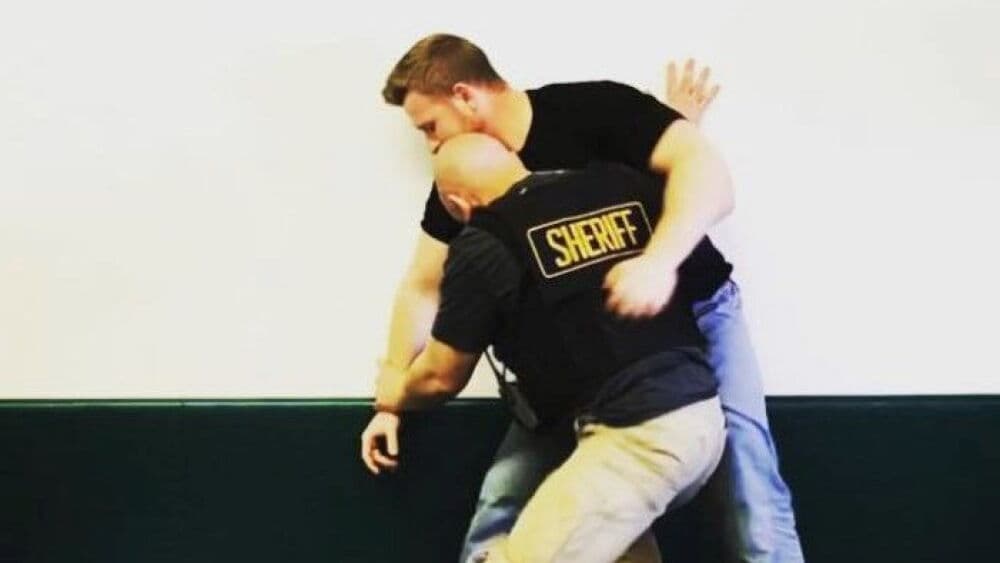
BJJ for cops and soldiers: what the evidence actually shows
Quick answer: The most-cited evidence is Marietta, Georgia PD, which released data in 2021 showing officers who trained jiu-jitsu were injured 48% less often during forceful arrests, arrestees 53% less often, and taser deployments down 23%. Those numbers are real but come from a small, self-selected sample published by the department itself. The stronger argument is structural: force encounters end up at close range, and grappling is the only skill set built for that. The weaker argument is that a sport black belt equals a defensive-tactics program. It doesn't.
Two things are true about jiu-jitsu and policing, and almost no one says both out loud. Grappling addresses a real, well-documented gap in how officers are trained to handle a resisting person. And the evidence base for it is thinner than the Instagram posts suggest, while some of what a good sport gym teaches you will get you hurt with a gun on your hip.
Both of those can be true. Here is where each one holds up.
The case study everyone cites
In 2019, after a video of an arrest in which officers struck a man repeatedly went viral and drew heavy criticism, Marietta PD in Georgia started a jiu-jitsu program. New hires were required to attend at least one class. Any officer could attend up to three classes a week on the department's dime, taught by an outside instructor, Humberto Borges, who runs a gym in Cobb County.
In February 2021 the department released its own outcome data, and 11Alive covered it. Officers with jiu-jitsu training were injured during a forceful arrest 48% less often than officers without. Arrestees were injured 53% less often. Taser use dropped.
Jits Magazine's itemization of the same release fills in the arithmetic. Of 145 sworn officers, 95 opted in and 50 did not. Those 95 attended more than 2,600 classes with one reported training injury. Non-participants used a taser in 77% of use-of-force incidents; participants used one in 54%. Officer injuries in the eighteen months before the program: 29. In the eighteen months after: 15, none of them participants. The department also put a dollar figure on it, netting about $40,752 after training costs.
The Marietta numbers are softer than they look
Those are good numbers. They are also fragile ones, and treating them as settled science does the argument no favors.
Start with self-selection. Officers chose whether to train. The comparison is not jiu-jitsu officers versus a matched control group; it is people who volunteered for extra physical training against people who declined. Volunteers are plausibly fitter, younger and more invested in avoiding a bad outcome. Some of the effect is the training. Some is who signed up.
Then look at the sample. The suspect-injury figure comes from 33 use-of-force incidents in 2020: 20 involving non-participants, 13 involving participants. Hospitalization in 13 of 20 versus 4 of 13. That is a real difference and it is also four incidents. Move one case and the percentage swings hard.
The officer-injury figure is a before-and-after comparison across two eighteen-month windows straddling 2020, a year when arrest patterns everywhere went sideways. And the package was released by the department that ran the program, promoted through a Gracie Breakdown video. Not fraud. Not independent evaluation either. Even the taser number wobbles depending on where you read it: the itemized release says 23%, 11Alive reported 27%.
The peer-reviewed literature is thinner still. The most relevant recent study, Butler and Wang in Martial Arts Studies in December 2024, surveyed over 300 officers and found positive correlations between jiu-jitsu experience and officers' confidence in their defensive tactics. Worth having. It measures what officers believe about themselves, not what happened on the street.
Why grappling maps to the problem anyway
The structural case does not depend on Marietta at all.
The number people half-remember comes from an LAPD review. Sergeant Greg Dossey, an exercise physiologist with the department, went through all 5,617 use-of-force narratives filed by LAPD officers in 1988, out of 316,525 arrests. Of the roughly 2,031 incidents that became actual altercations, 95% fell into five recognizable patterns, and of those, 62% ended with officer and suspect grappling on the ground.
Treat that carefully. One agency, one year, nearly four decades ago, presented at a training seminar rather than published in a journal. It is also the origin of the mangled "90% of all fights go to the ground" line that appears on roughly every martial arts gym website in America.
But 62% from a real case review makes the point. An arrest is not a fight someone is trying to win. It is a fight where one person has to make another person do something specific while staying accountable for the outcome. That collapses to close range fast, and at close range there is exactly one martial art with a century of development in controlling a resisting human being without hitting them.
The Army worked this out in the nineties
The military got here first, and how it got here is instructive.
In 1995 the commander of 2nd Ranger Battalion ordered a rebuild of the unit's hand-to-hand training, on the basis that the existing manual was not producing anything useful. Sergeant First Class Matt Larsen led the effort, and the Rangers brought in the Gracies: Rorion and Royce made multiple trips to the battalion, and Larsen went out to Torrance to train.
Larsen founded the Army Combatives School at Fort Benning in 2000 and rewrote the field manual, published in 2002 as FM 3-25.150. His central insight was about program design, not technique selection. Previous systems failed, he argued, because they picked a small set of "simple, effective" moves, taught them once, and offered nothing after. No reason to keep training, so the training stopped.
So MACP was built the other way: a small foundation of techniques chosen because they represent whole categories, assembled into drills soldiers repeat as warm-ups until they own them. Drill One is mount, escape, guard, pass, mount, reverse, repeat. Then a competition ladder whose rules widen as the level rises. Basic starts from the knees with no leg locks. Standard starts from the feet. Intermediate adds open-hand strikes to the head and closed fists to the body. Advanced is effectively MMA.
That escalation is deliberate, because Larsen understood that competitors train what wins and a narrow ruleset produces a narrow soldier.
What sport jiu-jitsu will teach you that gets you hurt
This is where candid instructors and experienced cops agree.
A sport BJJ gym rewards habits that are actively bad in an environment where weapons exist and the fight might not be one-on-one:
Pulling guard. Voluntarily going to your back on concrete, next to a suspect's friends, while wearing twenty-five pounds of gear and carrying a firearm on your hip.
Turning your back. Giving up the back costs four points in a tournament. It costs considerably more when the person behind you has both hands free near your holster.
Ignoring the third party. Every round in a gym is one person. Almost no real encounter is guaranteed to stay that way.
Playing for the finish. Sport scoring pushes toward submission. The job needs control, cuffs and disengagement, not a heel hook.
None of this argues against jiu-jitsu. It argues against assuming the sport version transfers unmodified. Wikipedia's own MACP entry notes the standing critique of submission-focused training in a combat zone: it stalls forward movement and raises your exposure to a second attacker.
We went deeper on this tension for civilians in is BJJ good for self-defense and in BJJ self-defense.
What a good program looks like
Writing for Police1 in March 2024, Jerrod Hardy, a twenty-year officer who also owns a large MMA gym, laid out what changes when you coach jiu-jitsu for law enforcement rather than tournaments. Three things sit at the center: weapon retention, transitioning cleanly to cuffing, and being able to disengage.
Everything else follows. Positions get judged by whether you can handcuff from them, not whether they score. Mount is less attractive when it puts your holster in reach and pins you in place. Standing up in base is a win condition, not a failure. Rounds get constraints: a training gun in the holster either of you can grab, a partner who might get up and run, a second person who joins at thirty seconds.
The other half is frequency. One eight-hour defensive tactics block a year does not build a reflex. Marietta worked partly because officers could train three times a week all year, which is a completely different stimulus from an annual recertification.
What jiu-jitsu is not
It is not a use-of-force policy. A department that adds mat time and changes nothing about supervision, reporting or accountability has bought a training program and called it reform.
A black belt is also not a defensive-tactics instructor credential. Those are different jobs: the legal standard, the reporting requirements, medical considerations around restraint, the department's own policy. A brilliant competitor with no grounding in any of that should not be writing a curriculum, and the good ones will tell you so.
The takeaway
The strong version of the pro-jiu-jitsu argument does not need Marietta. It is that force encounters go to close range, that officers and soldiers are asked to control people without hurting them, and that no other discipline has spent a hundred years on that exact problem. That case stands on its own. The weak version, the one treating a self-published departmental release as proof and a sport black belt as a qualification, invites the eye-roll it gets.
For everyone reading this who is neither, the useful takeaway is that the institutions with the most to lose from bad hand-to-hand training all landed on grappling, and all of them modified it. That is a decent template for a civilian. Train the sport, because live resistance is what makes it work at all, and know precisely which of your habits only exist because of the rules.
Find a gym that trains the way you need
Sport gym, self-defense-first academy, or a room full of people who do this for a living: compare them in the Let's Roll gym directory.
FAQ
Did jiu-jitsu training really reduce police use of force in Marietta? The department's own 2021 release reported that trained officers were injured 48% less often during forceful arrests and that arrestees were injured 53% less often. The direction is encouraging. The caveats: officers chose whether to participate, the incident counts are small, and the department published its own data.
Do most real fights go to the ground? The most-quoted figure traces to a review of LAPD use-of-force reports from 1988, which found roughly 62% of altercations ended with officer and suspect grappling on the ground. One agency, one year, and not the same as the "90% of fights go to the ground" claim it later mutated into. The defensible version: close-range grappling is common enough that being helpless there is a serious gap.
Is sport BJJ good enough for police or military use? As a base, yes; as a complete answer, no. Sport training builds timing and pressure tolerance that only come from live resistance, but it rewards guard pulling, back exposure and submission hunting, all bad ideas around weapons and third parties. Law enforcement programs modify it around weapon retention, cuffing and disengagement.
Why did the US Army adopt Brazilian jiu-jitsu? After 2nd Ranger Battalion rebuilt its hand-to-hand training in 1995, SFC Matt Larsen brought in the Gracie family and built what became the Modern Army Combatives Program, codified in FM 3-25.150 in 2002. Grappling formed the base because it could be drilled daily, sparred at full resistance, and extended through a competition ladder ending in essentially MMA rules.
Related Posts
Mikey Musumeci gives up the belt to make room for MMA
Musumeci is vacating his UFC BJJ title to focus on MMA training. What he is leaving, what continues, and why the transition matters.
IBJJF membership: finish the paperwork before the deadline
IBJJF membership and tournament entry are separate steps. Plan documents, professor approval, renewals, and junior accounts before registration closes.
Choosing a BJJ seminar worth your time and travel
Choose a BJJ seminar by the subject, teaching format, access, and total cost. Know what to ask the host before buying a ticket.
Comments (0)
Loading comments...