
The elbow-knee connection gives BJJ escapes a smaller target
Quick answer: The elbow-knee connection helps protect the space beside your torso by bringing an elbow and knee into a useful defensive relationship. It can support guard retention and some recovery situations, but it is one part of a position that also depends on frames, hip movement, and the opponent's controls.
A passer does not need your entire body to be open. A useful gap beside the ribs or hips may be enough to continue the approach. The bottom athlete can be working hard with both hands and still leave that space available by reaching too far away from the torso.
The elbow-knee connection gives a concrete defensive question: what is protecting the side the passer wants to occupy? The answer is more useful than a general instruction to become tighter. It directs attention toward a relationship you can examine with a partner and improve with an instructor.
Identify the space before copying the shape
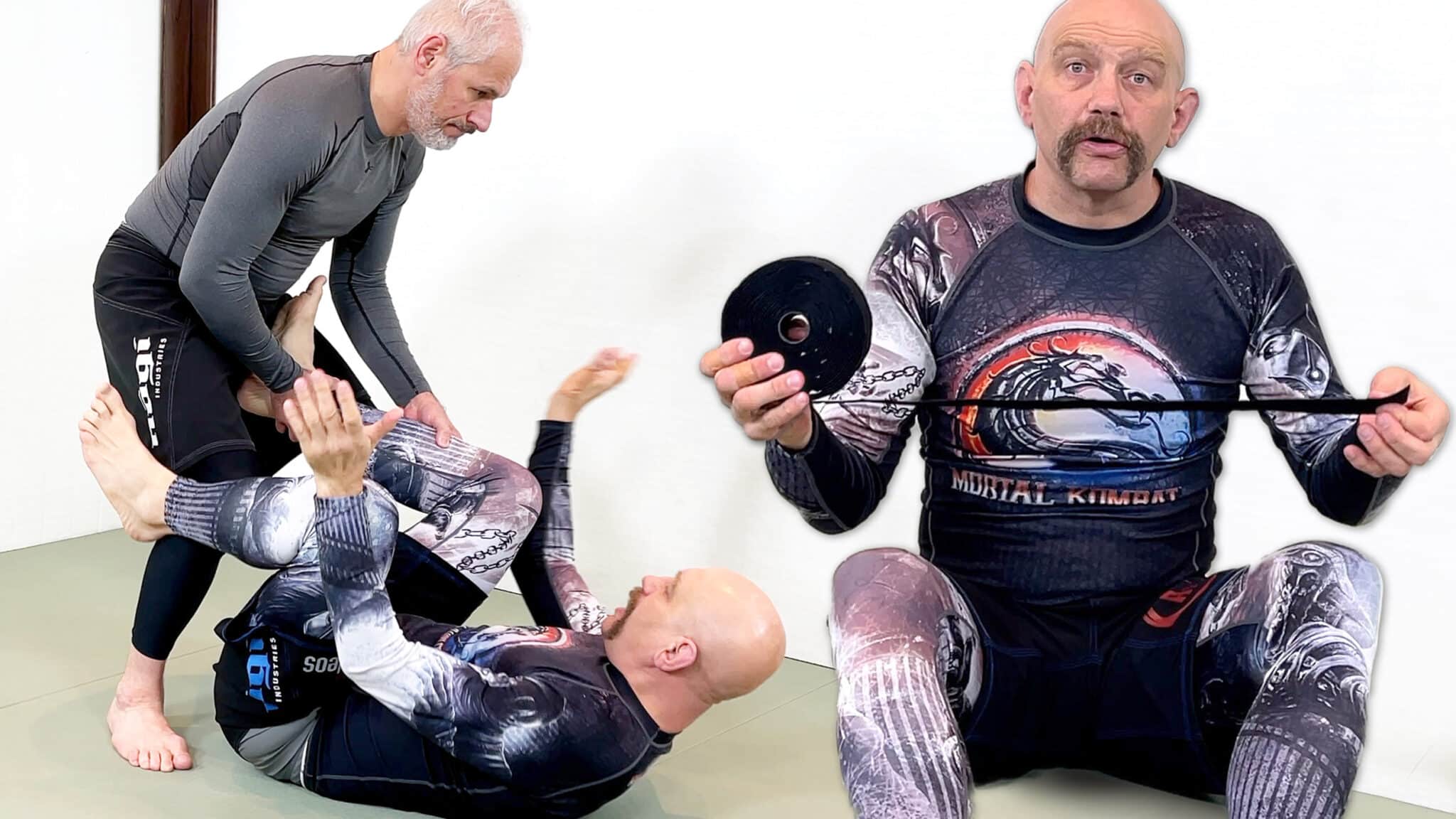
Begin with the area the opponent is trying to enter. In a common passing situation, the top athlete is moving beyond the legs toward the side of the torso. An elbow and knee placed in a useful relationship can help make that route harder to occupy.
Stephan Kesting's explanation of elbow-knee connection describes a forearm-and-shin barrier that protects the space between the hip and armpit. He also makes clear that the concept is not a complete answer to every passing problem.
That limitation matters. Copying a compact shape without considering the passer's controls can leave the athlete unable to move or respond. The connection needs to be evaluated within the whole position, including head, shoulders, hips, and the other limbs.
Ask your coach to show the specific opening being protected in the drill. Once you can identify it, the position becomes easier to understand. You are preserving a useful barrier, not trying to satisfy a rule that your elbow and knee must touch at every moment of every round.
Reaching can exchange one problem for another
A hand reaching toward the passer may feel active and defensive. Depending on the situation, it may establish a useful grip. It may also separate the elbow from the body and expose space that was previously difficult to enter.
The point is to notice the tradeoff rather than declare all reaching wrong. Ask what the new grip accomplishes and what space becomes available while you take it. A connection that looks attractive in isolation may be poorly timed if the opponent can advance during the reach.
In slow practice, compare the two arrangements. Let the coach position the passer at an agreed stage and show what changes when the elbow moves away. Keep the demonstration controlled so the bottom athlete can feel the difference without having to resist a sudden full-pressure pass.
This gives the student a more specific correction than keeping everything tight. The useful question is whether the arm is serving the immediate defensive task. Sometimes another frame or grip is appropriate. Sometimes the arm needs to return before the knee can perform its part of the job.
The hips still need a way to move
A compact defensive position can become a trap if the athlete treats it as a place to remain indefinitely. The connection should help create or preserve an opportunity to recover a useful guard or begin an appropriate escape. It does not remove the need to move.
Ask which direction the hips need to travel in the situation being taught. Then identify what currently prevents that movement. The answer may involve an upper-body control, a leg position, or the passer's angle. The elbow-knee relationship is part of that discussion rather than a substitute for it.
Practice the starting structure before adding the movement. If the frame collapses immediately, the athlete may not have enough time to understand the recovery. If the partner offers no pressure at all, the athlete may not learn what the structure is meant to resist.
The coach can adjust those conditions so both parts are visible. Preserve the useful space, make the appropriate movement, and check the new position. The goal is a better relationship to the opponent, not a longer stay in a compact shape that has no next action.
Distinguish an approaching pass from an established pin
The available options change as the passer advances. Before the upper body is controlled, a defensive connection may be easier to establish. After a stable pin, the athlete may need to address other controls before bringing the knee into useful position.
Do not apply an early-stage instruction as if it guarantees an escape from every late-stage situation. Describe where the drill starts. Has the passer cleared the legs? Is the head controlled? Can the bottom athlete turn? These details affect which response is appropriate.
A useful session can study two nearby starting positions and compare them. In the first, the bottom athlete still has room to connect the elbow and knee. In the second, a particular control has closed that route. Ask the coach what preliminary action is now required.
That comparison teaches recognition as well as movement. You learn when the connection is available, what helps preserve it, and when the problem has become something else. It also prevents a student from interpreting every failed attempt as proof that the concept does not work.
Build a drill with a clear checkpoint
Have an instructor choose a suitable passing approach and a limited task for each partner. The top athlete tries to reach an agreed positional checkpoint. The bottom athlete works to preserve the relevant space and recover a useful defensive relationship.
Keep the pace low enough that both people can identify what changed. Reset when the passer reaches the checkpoint, the bottom athlete completes the agreed recovery, or either person needs to stop. A short, repeatable exchange is easier to study than an extended scramble.
After a few repetitions, review:
Which space was the bottom athlete trying to protect?
Did the elbow and knee support that task without unnecessary strain?
What other frame or control made movement possible?
At which point did the passer remove the opportunity to recover?
These questions give both partners a useful job. The top athlete supplies an honest version of the agreed pressure. The bottom athlete practices recognizing and responding to it. Neither needs to prove a general theory by winning every repetition.
Avoid turning connection into forced compression
The word connection can encourage a student to pull the body into a shape that is uncomfortable or unnecessary. The exact relationship between elbow and knee depends on the position and the person. Ask your instructor to adapt the task to the movement you can perform comfortably.
Do not force a knee through a trapped space or use a partner's weight to push beyond a comfortable range. If a limb is caught, stop and clarify the position. A useful defensive concept should be learned through control, not through a test of how much discomfort can be tolerated.
Also avoid assuming that more muscular tension is always the answer. The structure, angle, and timing may need correction. Gripping harder or curling more aggressively can make it difficult to move without solving the actual positional problem.
Our guide to being a good training partner addresses the communication that makes this practice useful. Agree on resistance, respond immediately to a stop or tap, and let the instructor resolve uncertainty before adding pace or pressure.
Review the moment the space opened
After a round, the most useful question may be when the connection was lost rather than how the final pin felt. Look for the decision or contact that opened the side of the torso. Was the arm reaching? Was the knee displaced? Did the passer establish a control that prevented the hips from following?
If the sequence is unclear, ask the partner to describe what they felt from the top. They may have noticed a gap the bottom athlete did not recognize. Use that observation as a starting point for the coach, not as a final diagnosis that must be accepted without examination.
Choose one adjustment for the next session. It might be recognizing an earlier grip, preserving a frame, or changing the timing of the hip movement. A precise experiment is easier to evaluate than deciding to keep the elbows closer in every position forever.
The concept becomes valuable when it improves those decisions. You can identify the space, understand the connection that protects it, and recognize when the situation requires another response. That is a workable defensive skill, even though it does not promise that the guard will never be passed.
Main photo: Grapplearts / Stephan Kesting; instructional composite photograph.
The takeaway
The elbow-knee connection gives a useful way to protect space beside the torso during appropriate defensive situations. Study the opening being blocked, the other controls involved, and the movement the connection is meant to support.
Practice from a clearly defined stage of the pass and keep the task comfortable and controlled. The aim is a better defensive decision and a route to the next position, not a rigid shape held regardless of what the opponent is doing.
Get feedback on the actual position
Explore BJJ gyms on Let's Roll and ask an instructor to help you identify where elbow-knee connection fits into your guard retention and recovery practice.
FAQ
What is elbow-knee connection in BJJ? It is a useful defensive relationship between an elbow and knee that can help protect space beside the torso. Its purpose and exact shape depend on the position and the opponent's controls.
Do my elbow and knee always have to touch? No universal touching rule applies to every exchange. Ask your coach what space the connection should protect and how it should work in the specific position being practiced.
Will it escape every side-control pin? No. An established pin may require addressing other controls before a knee can return to a useful position. Distinguish early passing defense from a later escape problem.
What if the position feels uncomfortable? Stop and ask the instructor to adjust the setup or choose another response. Do not force a trapped joint or use extra pressure to imitate a shape that does not fit the situation.

Nina Okada
Nina Okada explains positions the way a good training partner does: one problem at a time, with the limits of the explanation said out loud. She is careful about the difference between what footage shows and what it only suggests.
Related Posts
Mikey Musumeci gives up the belt to make room for MMA
Musumeci is vacating his UFC BJJ title to focus on MMA training. What he is leaving, what continues, and why the transition matters.
IBJJF membership: finish the paperwork before the deadline
IBJJF membership and tournament entry are separate steps. Plan documents, professor approval, renewals, and junior accounts before registration closes.
Choosing a BJJ seminar worth your time and travel
Choose a BJJ seminar by the subject, teaching format, access, and total cost. Know what to ask the host before buying a ticket.
Comments (0)
Loading comments...