
Training on crowded BJJ mats takes a different kind of awareness
Quick answer: On crowded BJJ mats, reduce the space your round needs and stop before another pair enters it. Follow the instructor’s traffic rules, agree on suitable starting positions, and move together when a reset is needed.
The empty square beside your partner may stop being empty halfway through a guard pass. Another pair rolls toward it, somebody stands up behind you, and the room suddenly has more moving parts than your round can comfortably handle.
A busy class can be a good problem for a gym to have. It still needs a plan. Students should not have to guess who moves, which rounds can start standing, or whether sitting one out will leave them without a partner for the rest of the evening.
Agree on the space before the round starts
Take a look around before the slap and bump. Notice the wall, the mat edge, the instructor’s demonstration area, and the pairs already moving nearby. A gap large enough for two people sitting down might be too small for a takedown exchange. Starting a round does not reserve every patch of floor either person could reach.
Ask your partner what sort of round fits. You might start with one person passing and the other playing guard, or work from a position the instructor has assigned. That is a practical choice about the room. It does not mean standing training is unimportant or that the gym should abandon it whenever attendance rises.
The instructor’s arrangement comes first. Some classes separate standing rounds, organize groups, or give particular pairs designated space. If the arrangement is unclear, ask before everyone starts moving. One question at the beginning is less disruptive than several pairs negotiating in the middle of a scramble.
Partners also need to know whether either person is new to the room. A visitor cannot follow a custom they have never heard explained. Briefly pointing out the reset procedure is a useful part of welcoming a new teammate.
A smaller round can still have a real purpose
A small training area favors a clear problem. A round starting in half guard might focus on recovering the underhook or freeing the trapped leg. A seated guard round might end when the passer establishes control beyond the legs. Ask the coach for an appropriate task instead of inventing a position that one partner does not understand.
Define the finish as well as the start. If both partners keep chasing every transition after the original problem has been solved, the round can quickly require the entire room again. A reset lets you revisit the skill you meant to practice while staying inside the space you actually have.
Do not confuse limited space with permission to squeeze a risky exchange into a corner. Some movements need room even when they start on the ground. If the task repeatedly sends someone toward a wall or another pair, change the task or wait for more space.
It is also reasonable to ask for a different partner or position. A particular size difference or training goal may make the available patch unsuitable. The answer does not have to be finding a way to force the original plan to work.
Stop while stopping is still simple
The best moment to avoid a collision is before the collision becomes part of the technique. If you see another pair approaching, say something clear and stop moving. Use the room’s agreed signal if it has one. Your partner should not have to work out whether an unfamiliar shout means stop, switch, or defend a submission.
Release any submission immediately when stopping. Do not preserve a dangerous grip while discussing where to move. There is no training benefit in keeping a joint under pressure because the timer has not finished. Once both people are settled, move together and agree on how to restart.
Neither partner should treat the interruption as a disputed tournament result. You can return to approximately the same position or begin again from the original setup. If recreating the exact position is awkward, let it go. The next useful repetition is worth more than an argument about whose knee was where.
Remember that the other pair may not have seen you. A neutral request makes coordination easier. They are dealing with their own bodies, grips, and blind spots. There is rarely enough evidence in one near miss to decide that somebody was deliberately taking your space.
Let the instructor manage competing claims
You may have heard that lower belts always move for higher belts, or that the pair nearest a particular edge has to reset. Those customs are not a universal traffic code. Follow the policy of the academy you are attending rather than importing a rule from another room.
When two pairs cannot agree, stop and get the instructor’s attention. The person running the session can move groups, change the exercise, or decide that standing work needs its own turn. Rank does not make a collision useful, and debating rank while everyone else is rolling is unlikely to improve the evening.
A sensible room-level plan can include:
A clear signal that stops both partners immediately.
Separate space or turns for standing practice.
A stated method for moving pairs and restarting rounds.
An option to wait rather than squeeze another pair onto the mat.
These are suggestions for discussion with the coach, not instructions for a student to take over the class. The instructor may have reasons for a different arrangement. What matters is that the people training understand the arrangement and can follow it without improvising during contact.
Watch where a technique ends
Beginners are often occupied by where to put a hand or foot next. More experienced partners can help by noticing where the exchange is likely to finish. A sweep may send someone sideways, a passing exchange may rotate both people, and a scramble may carry them farther than either expected.
That awareness should affect the choice before the movement begins. If there is no room for the finish, use a different option, pause, or ask to move. Slowing down is useful only if the movement still fits. A slow collision with a wall is still a collision.
Avoid promising a partner that you can control every landing. They may react differently from the way you expect, and a neighboring pair can change the available space. Give the room enough margin for ordinary uncertainty rather than relying on perfect timing from everyone involved.
During instruction, ask the coach to identify the space a drill requires. A movement that looks compact from the sidelines may need a wider landing area when practiced. That is especially worth checking when the class is learning something unfamiliar and nobody yet knows its usual direction of travel.
Waiting is part of the session, too
If the room uses rotating groups, know when your turn starts and where to wait. Keep bags, bottles, and seated spectators away from the area people are using. An inactive pair can create an obstacle just as easily as an active one when they sit close to a moving round.
Use the pause to watch one relevant detail. If you are working on guard recovery, notice when the bottom player loses contact with the passer. You do not need to narrate every mistake or become an extra coach. Watching quietly can make the next turn more useful without adding instructions the pair did not request.
A rotation should also remain understandable to newcomers. If you are keeping a place for a partner, say so plainly rather than leaving someone to infer an invisible queue. Small explanations prevent the awkward feeling that everybody else knows a system you have somehow missed.
And if you need a longer break, tell your partner before they spend the rest of the rotation waiting for you. Taking a break is ordinary. Leaving someone uncertain about whether they still have a round is an avoidable inconvenience.
Raise recurring problems after the round
One busy evening and a persistent space problem call for different conversations. If the same collisions keep happening, tell the instructor what you observed and where. Describe the practical issue: standing pairs and grounded pairs repeatedly meeting in the same corner, for example. That is easier to address than a general complaint that the class is chaotic.
Ask what students should do next time. The coach might change the layout, adjust the exercise, or repeat instructions that some people missed. Give the agreed change a chance to work. A crowded room can become more orderly without anybody needing to be blamed for turning up to train.
If you are choosing a regular session, attendance patterns may also matter to you. A smaller class at another time could suit your current needs, if it is available. That is a scheduling decision, not a judgment about the people who prefer the busiest evening.
Keep responsibility shared but specific. Students can stop, communicate, and respect the layout. The person running the class decides how many active pairs the session can reasonably accommodate. No individual student should feel obliged to solve the entire room while defending a guard pass.
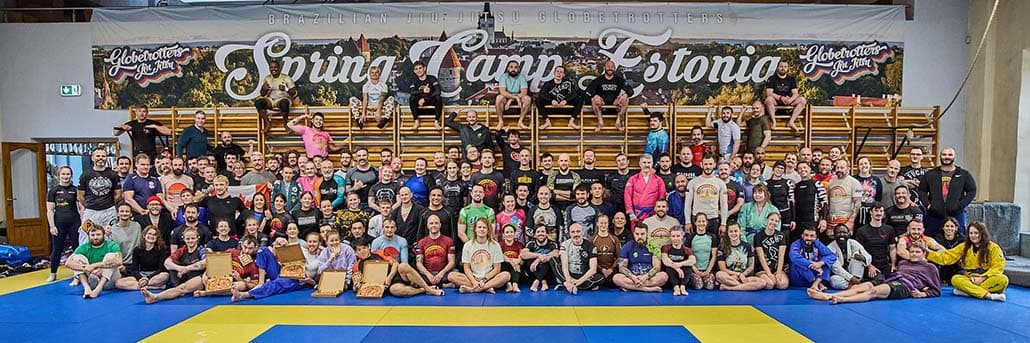
Main photo: BJJ Globetrotters; archive camp group photograph.
The takeaway
Before a crowded round, agree on a starting position, a stopping signal, and enough room for the movement you expect to practice. When the space changes, pause early and follow the instructor’s reset procedure. A useful round can be smaller than a full open-ended match.
You are there to practice with the people around you, and those people extend beyond your immediate partner. Leave enough attention for the neighboring pair. The technique will still be there after everyone moves a few feet.
Find a session that fits
Browse open mats, then ask the host about capacity, starting positions, and how visiting pairs should handle resets before joining the session.
FAQ
Should lower belts always move for higher belts? Follow the host academy’s policy. Customs differ, so ask rather than assuming a rank-based rule applies everywhere. Stop the exchange first if there is any immediate risk of a collision.
Can crowded-mat rounds start standing? That depends on the instructor’s layout and the available space. Ask before starting. A separate standing area or rotation may work better than mixing takedown exchanges with closely packed grounded pairs.
Do we have to recreate the exact position after moving? Agree with your partner and follow class instructions. An approximate reset or fresh start is often sufficient. Never keep a submission under pressure while moving or negotiating the restart.
Is it reasonable to sit out when there is no room? Yes. Tell your partner or instructor and wait in the designated area. Joining an overcrowded round is not a requirement for making good use of the class.

Owen Bellamy
Owen Bellamy writes for the person training twice a week around a job. Nothing he suggests requires quitting the job.
Related Posts
Otávio Sousa: three world titles in the hardest kind of company
Otávio Sousa’s 2012, 2013, and 2016 world titles tell a richer story when the other names on the middleweight podium stay in view.

Mikey Musumeci gives up the belt to make room for MMA
Musumeci is vacating his UFC BJJ title to focus on MMA training. What he is leaving, what continues, and why the transition matters.
IBJJF membership: finish the paperwork before the deadline
IBJJF membership and tournament entry are separate steps. Plan documents, professor approval, renewals, and junior accounts before registration closes.
Comments (0)
Loading comments...