
Be the teammate a beginner is glad to see again
Quick answer: Help a new teammate understand the room before trying to teach them everything you know. Introduce yourself, follow the coach's instructions, and make the drill predictable enough for them to participate. Remembering their name at the next class may be more useful than delivering a long welcome speech at the first one.
The shoe rack can be the first difficult position in jiu-jitsu. A new person has arrived, found a room full of people who apparently know what to do, and discovered that even standing in the right place involves information they do not yet have.
A regular member can help with that. It does not require becoming the gym's unofficial orientation department. A short introduction and one practical answer can get somebody from the doorway to the instructor without making their arrival the evening's main event.
Begin with the room, not your training history
Say your name and ask theirs. Then find out whether they have checked in with the coach or front desk. If they have not, help them reach the person responsible for the class. A friendly member should make that connection easier, not accidentally take over it.
Offer the immediate information they need: where bags go, where to change, or where the coach would like them to wait. Use the academy's actual rules. Do not invent a universal jiu-jitsu custom because that is how another gym did it five years ago.
There is no need to ask for their full athletic history while they are trying to locate the changing room. The instructor may need relevant background before training; the nearest purple belt does not need a complete interview before saying hello.
If you cannot remember a name, ask again. Most people can survive being asked twice. Being addressed as “new guy” indefinitely is a less impressive solution. A name gives the next conversation somewhere to begin, and it costs very little to use it.
Make the first drill a shared task
Once the coach pairs you up, start with the drill that was actually assigned. A beginner should not have to decide between the instructor's explanation and your improved version, complete with three counters and a story about someone who does it differently.
If they are unsure, help identify the specific uncertainty. Which leg moves? Which person goes first? Where does the drill stop? Those questions are small enough to answer without turning the pair into a second class running beside the first.
Then give them a turn. A helpful explanation that consumes the entire drilling period is still a period in which the other person did not practice. If the movement is not clear to either of you, call the coach over rather than filling the gap with confidence.
Be a predictable partner. When the task is cooperative, provide the agreed position and response. Introducing a surprise defense because the beginner has finally remembered the steps changes the task before they know it has changed. Save resistance for the stage the instructor has set, and make sure both people understand what that stage is.
Let the instructor own the difficult questions
A regular member can show where the water fountain is. Technical troubleshooting, injury-related adjustments, and decisions about suitable sparring partners belong with the instructor or the appropriate professional.
This boundary helps the beginner as much as the coach. Someone on their first evening cannot easily distinguish advice grounded in experience from advice delivered in a very convincing voice. The fact that you have been attending longer makes you familiar with the room; it does not make every answer yours to supply.
There is a straightforward way to stay helpful: tell the coach what is happening. Explain that the pair is unsure about the starting position, or that the student has a question about an exercise. Let the person with responsibility for the session decide what comes next.
Avoid making the new person perform their confusion for the whole room. A quiet question at the edge of the drill is often enough. They came to learn a physical skill, and asking for clarification should feel like an ordinary part of that process.
A friendly round needs an agreed job
If the instructor includes the newcomer in sparring, explain the immediate arrangement before the timer starts. Ask whether they understood the coach's instructions. Agree where to begin and what the round is supposed to involve.
Follow the gym's introduction to tapping and release immediately when a partner taps or asks to stop. Do not turn the round into a test of how much a beginner will tolerate. A lower belt is not an invitation to supply an unrequested demonstration of every submission you know.
Equally, there is no need to narrate every second. Constant commentary can leave a new student trying to move, listen, and decide whether you have paused the round all at once. If a pause is needed, make it clear, then reset with their agreement.
The aim is a round whose terms both people understand. That might be positional work, a constrained task, or something else the coach has chosen. You can be welcoming while still providing a useful training response. Friendly does not have to mean vague, and a beginner should not have to guess which parts of the round are real.
Beginners need access to questions
BJJ Globetrotters explicitly welcomes beginners and describes “White Belt Appreciation Hour” at many of its camps, giving white belts time with black belt coaches to ask beginner questions. Its Copenhagen camp information provides one published example of that approach.
A regular academy does not need to copy a camp's event name or timetable. The useful idea is that questions can have an obvious place to go. New members should not have to interrupt a private conversation or wait for the instructor to notice a worried expression.
Ask your coach how they prefer beginners to get help. It might be during drilling, after class, or through a scheduled fundamentals session. Then point people toward that route accurately.
This also protects the student's practice time. A question about tying a belt should not require sitting through an unsolicited history of belt promotions. Give the answer needed now, and leave the larger subject for a conversation they actually choose to have. There will be other evenings.
A clear welcome can be part of the gym's design
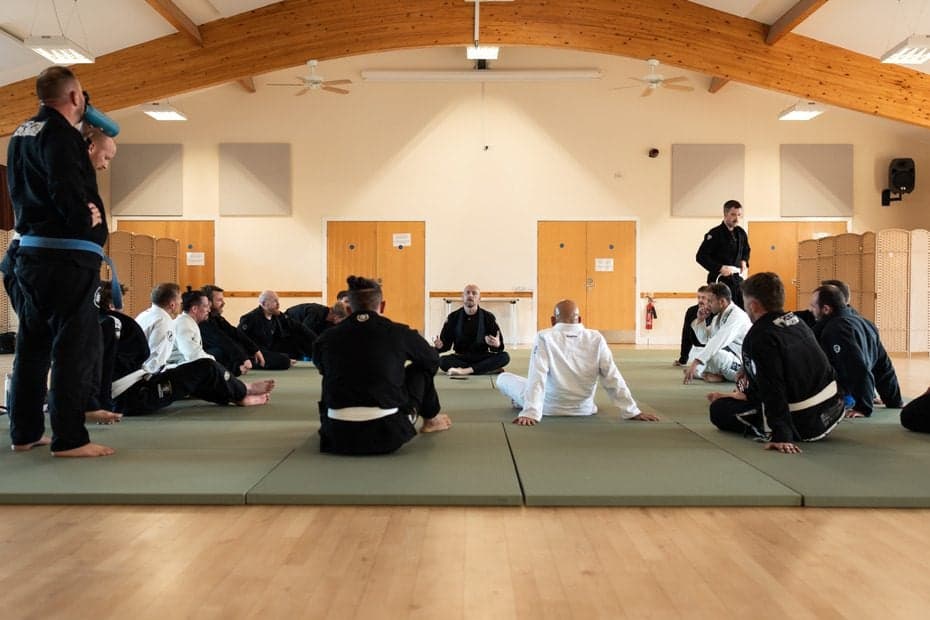
In a BJJ Globetrotters interview about KODAMA BJJ, coach Wayne Tomsett describes asking prospective members why they want to train. He also explains that members read a club charter and code of conduct before joining. The gym's class photograph is the main image for this article.
Those are ways to make expectations explicit. A person interested in competition and a person looking for a new activity may arrive through the same door with different assumptions about the class. Asking gives the academy information; a written code gives members something more dependable than rumor.
For an existing teammate, the practical lesson is to avoid assigning the newcomer a goal. They do not have to want your training schedule, your preferred ruleset, or your competition calendar. Listen to what they say before recommending a different life.
You can mention which classes you enjoy and why. Present that as your experience of the timetable, rather than a requirement for belonging. The person who can attend twice a week should not receive the impression that they have already failed an attendance target nobody officially set.
The second welcome is easier to miss
The first class usually has a visible introduction. The next few visits can be less obvious. The person is no longer entirely new, but they may still know almost nobody.
A small routine helps:
Use their name when they return.
Invite them to partner when the coach asks the class to pair up.
Explain a changed drill or room arrangement instead of assuming they remember it.
Let them know which class you expect to attend next, without making them commit.
Keep the invitation light. A missed week does not require an explanation to every regular in the room. Work, transport, and ordinary life can make a new habit irregular. Welcome them back without turning attendance into a public accounting exercise.
And leave room for quiet people. Not everyone wants a long conversation before training. A nod, a name, and a clear invitation can be enough. The goal is to make participation easier, not to require a particular social personality as the entry fee.
If you are the newer person yourself, the gym directory can help you compare class options. Ask the academy directly how it introduces beginners; that answer is more useful than trying to judge the entire experience from a highlight video.
Main photo: KODAMA BJJ, via BJJ Globetrotters; July 2026 academy feature.
The takeaway
A useful teammate reduces the amount of guessing a newcomer has to do. They connect the person with the coach, cooperate with the assigned task, and help make the next visit familiar. None of this requires a speech about the meaning of jiu-jitsu.
The practical standard is simple: after training with you, the new person should know a little more about how to participate. They should also have had time to practice, ask their own questions, and decide whether they want to come back.
Find a class that fits
Explore nearby gyms and contact the instructor about beginner classes and trial arrangements.
FAQ
Should I teach a beginner extra techniques during drilling? Stick to the assigned task unless the instructor asks you to do otherwise. If a question goes beyond what you can clearly explain, bring the coach over.
Do I need to roll with every new person? No. Follow the coach's pairing decisions and your own training limits. You can still help with an introduction or practical information.
What if I forget their name? Ask again, then use it. A brief second introduction is less awkward than avoiding the person's name for months.
How can a quieter member help? Offer a clear partnership invitation, answer a practical question, or point someone toward the instructor. Being welcoming does not require entertaining the room.

Owen Bellamy
Owen Bellamy writes for the person training twice a week around a job. Nothing he suggests requires quitting the job.
Related Posts

Mikey Musumeci gives up the belt to make room for MMA
Musumeci is vacating his UFC BJJ title to focus on MMA training. What he is leaving, what continues, and why the transition matters.
IBJJF membership: finish the paperwork before the deadline
IBJJF membership and tournament entry are separate steps. Plan documents, professor approval, renewals, and junior accounts before registration closes.
Choosing a BJJ seminar worth your time and travel
Choose a BJJ seminar by the subject, teaching format, access, and total cost. Know what to ask the host before buying a ticket.
Comments (0)
Loading comments...