
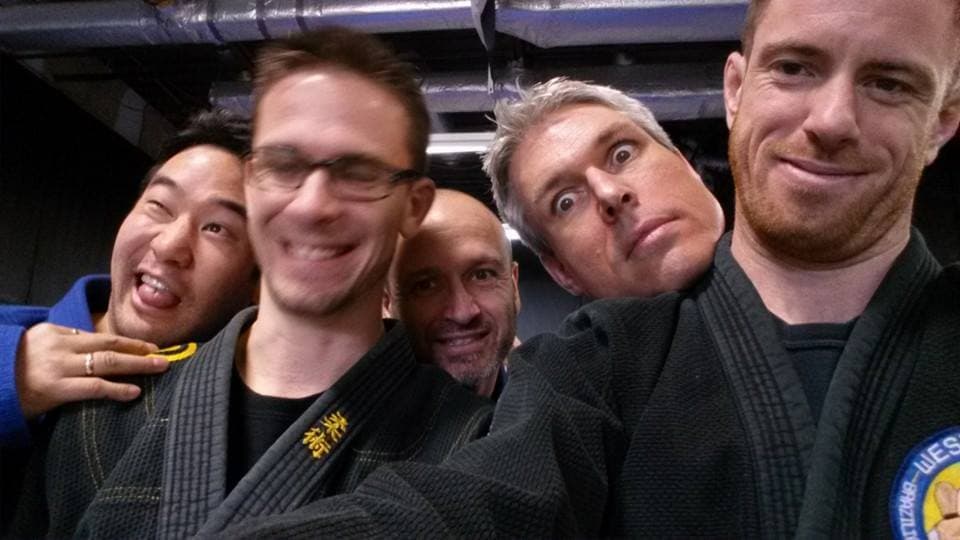
Bringing a bad day to BJJ without giving it to your partner
Quick answer: If you bring a bad day to BJJ, choose a session you can participate in responsibly and tell your partner anything relevant to the pace. You can drill, take fewer rounds, pause, or leave without turning the class into a test of character. The person training with you is not responsible for absorbing the frustration you arrived with.
You reach the gym carrying an argument that is no longer happening. Your bag goes by the wall. The conversation stays in your head, ready to resume whenever there is a quiet moment.
Training may still be a good part of the evening. It does not require you to pretend the day was fine, and it does not give the day permission to decide how you treat a partner. The useful task is choosing what you can do well enough for both people to have a reasonable class.
Give yourself a moment before choosing the session
Do not let arriving at the building make every later decision automatic. Before stepping onto the mat, notice whether you can follow instructions, respond to a partner, and control the pace you agree to use.
This is a practical check, not a demand to become cheerful. You can be annoyed, disappointed, or distracted and still participate thoughtfully. The question is whether the feeling is making it difficult to do the actual tasks the class requires.
If you are unsure, speak briefly with the coach about a lighter or more limited session. You might join instruction and drilling while leaving live rounds for another day. The academy's format may offer a suitable option, or it may make more sense to rest and return later.
Avoid framing the choice as winning or losing against the day. You are deciding what kind of participation is available tonight. That decision can change after warm-up, after drilling, or after one round if the experience tells you something different.
Tell the partner what affects them
Your partner does not need the full story unless you want to share it and they want to listen. They do need clear information about the round. "I'd like to keep this controlled tonight" is more useful than hoping they will infer the right pace from your expression.
Make the request concrete enough to act on. You might want a positional round, less intensity, or a pause to clarify the starting arrangement. Ask rather than announcing conditions after the other person has already agreed to something else.
If they want a different kind of round, choose another option without resentment. Someone preparing for an event may reasonably prefer a harder session with another partner. Your request can be valid without obligating every person in the room to meet it.
Keep your own side of the agreement. Asking for a light round and then accelerating whenever you lose position creates confusion. If you notice yourself doing that, stop, acknowledge the change, and reset or finish the round early.
Choose a task smaller than winning practice
A bad day can make an ordinary training exchange feel like another result you need to control. Give yourself a narrower task that does not depend on beating the partner: maintain an agreed pace, recognize a position, or practice a familiar sequence carefully.
Choose something compatible with the class. You are not asking the entire room to change its lesson around your mood. A small focus can sit inside the assigned drill without taking anything away from the person beside you.
For example, you might pay attention to releasing immediately at every tap, resetting without rushing, or asking one clear technical question. These are concrete actions you can carry out even if your performance feels uneven.
Avoid giving yourself a long list of self-improvement demands. The evening does not need to repair the argument, improve your guard, prove your discipline, and produce a profound insight. One useful training task is enough to justify attending.
Notice when the pace stops matching the agreement
Look for changes in behavior rather than trying to measure how angry you are. Are you moving faster than you intended? Ignoring the drill boundaries? Treating an ordinary reset as something to resist? Those are signs to pause and reconsider the round.
The partner may also tell you directly. Listen without turning their feedback into another dispute. If they say the pace is too high, the useful response is to slow down or stop, not to explain why the day entitles you to continue.
A short reset can include:
Stop the exchange and release the position.
Check that the partner is okay and clarify what changed.
Agree on a simpler task if both people want to continue.
End the round if you cannot reliably keep that agreement.
There is no need for a public speech. A clear acknowledgment and a changed action do more than a long apology followed by the same behavior in the next exchange.
Use the coach without making them solve everything
A coach can help you choose an appropriate training task or partner arrangement. They may notice that you are rushing a movement or that a particular round is not a good fit tonight. Give them enough information to help with the class.
Keep the request within their role. You can say you are distracted and want to focus on drilling. You do not have to ask them to settle the personal problem that made the day difficult. They may be willing to listen later, but that is separate from managing a room full of students.
If you need to step out, communicate briefly when practical. Leaving the mat to collect yourself is easier for staff to understand when they know you are taking a break rather than dealing with an unreported injury or another immediate problem.
A good training decision does not require a coach to approve your entire emotional state. Their help is most useful when it concerns the next concrete action: which exercise, what pace, and whether continuing makes sense.
Keep conversation voluntary
Teammates can be good company after a difficult day. Ask before unloading a long account of what happened. Someone may have the time and attention to listen, or they may be trying to get home, prepare for a round, or manage their own evening.
A brief invitation leaves room for either answer: "Do you have a minute after class?" If they do, share what you want without making them responsible for producing a solution. If they do not, accept that without treating it as a measure of the friendship.
The gym's group chat is also not automatically the right place for a detailed personal dispute. Our guide to BJJ gym group chats considers how shared spaces can stay useful without becoming compulsory audiences for every conversation.
You can enjoy the ordinary parts of being around teammates without explaining everything. A greeting, a familiar drill, or a short conversation about something unrelated may be all you want. There is no requirement to turn the evening into a disclosure.
Let a shorter class count
If drilling goes well but you do not feel ready for live rounds, stopping there can be a complete decision. You attended, practiced, and left before asking more of yourself or a partner than the evening supported.
Avoid comparing that session with someone else's full schedule. They arrived with different circumstances. Your choice does not need to look impressive from the side of the mat to be sensible for the people involved.
The same applies if you decide not to train at all. Let staff know if a booking or class arrangement requires it, take your belongings, and leave respectfully. There will be another opportunity to practice. You do not have to create a difficult round just to avoid the feeling of having wasted a trip.
Be honest afterward about what happened. A shortened session can be useful without needing a story that it was secretly the hardest or most disciplined choice. It was the amount of training you could participate in responsibly that day.
Leave the result of the day open
Training may change how the evening feels, or the original problem may still be waiting afterward. Do not make the class responsible for guaranteeing relief. It is an activity shared with other people, not a promise that every difficult feeling will disappear before the final bow or handshake.
Afterward, notice the practical outcome. Did you keep the pace you agreed to? Did you treat the partner well? Did the chosen task fit your attention? Those questions can guide the next visit without turning one evening into a judgment about your character.
If difficult days repeatedly make safe, considerate participation hard, consider what support or changes would help outside the round itself. The gym can be part of your life without being required to carry every part of it.
For tonight, an ordinary ending may be enough: pack the bag, thank the partner, and go home. You can have had a bad day and still have left the people at the gym with a decent training experience.
Main photo: BJJ Globetrotters; illustrative archive photograph, not a reported visit or a named subject in this article.
The takeaway
Bringing frustration to BJJ is different from handing it to a partner. Choose a manageable task, communicate the pace, and pause when your behavior stops matching the agreement.
You do not need a perfect mood or a full session to participate well. The useful standard is whether you can share the activity responsibly, with enough freedom to change the plan when the evening calls for it.
Find a training routine that fits your life
Explore BJJ gyms on Let's Roll and ask about class formats, drilling sessions, and options that suit the kind of training you want to maintain.
FAQ
Should I train BJJ after a bad day? Decide based on whether you can follow instructions, communicate, and control the agreed pace. A limited session may fit, while another evening may be better for rest or a different activity.
Do I need to tell my partner what happened? No. Share the information that affects the round, such as wanting a controlled pace or a positional exercise. A personal conversation can remain separate and voluntary.
What if I become frustrated during rolling? Stop and release, check in with your partner, and decide whether a simpler agreed task is appropriate. End the round if you cannot keep the pace and boundaries reliably.
Does leaving before sparring mean the class was wasted? No. Instruction and drilling can be a worthwhile session on their own. Choose the amount of participation you can manage responsibly rather than forcing rounds to complete an imagined requirement.

Rafael Moura
Rafael Moura profiles competitors as people with lives outside the bracket. Some of those stories are comebacks. Most are not, and he does not force them.
Related Posts
Jiu-jitsu in Montreal: build the visit around a real class
Plan BJJ training in Montreal around confirmed classes, language arrangements, winter travel, visitor policies, and equipment that is ready to use.

Competing in gi and no-gi on the same day takes two plans
Prepare for gi and no-gi competition on the same day with separate rule checks, complete outfits, schedule coordination, and a realistic second-bracket plan.

BJJ gi pants that fit standing up can still fail on the mat
Check BJJ gi pants at the waist, rise, knees, and cuffs so a good-looking size label becomes a uniform you can actually move in.
Comments (0)
Loading comments...